
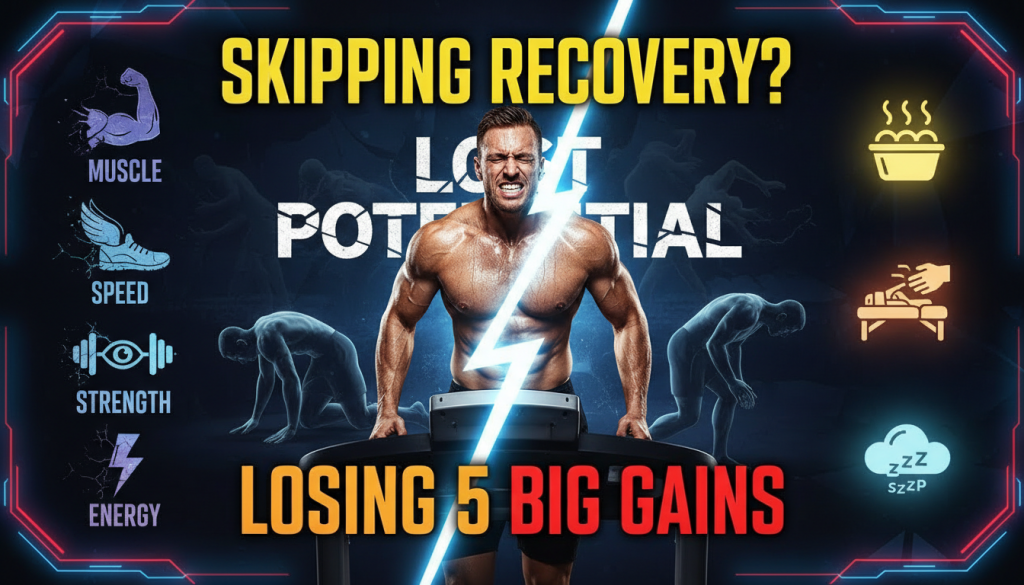
How Skipping Recovery Slows 5 Powerful Proven Gains (Backed by Science, Data & Real-World Running)
If you train hard but feel stuck, sore, or strangely slower, the problem often isn’t your mileage or your shoes—it’s what you’re not doing between workouts. For many runners and fitness enthusiasts, Skipping Recovery Slows Powerful progress in ways that are easy to miss: your speed gains stall, strength fades, tech metrics plateau, and your enthusiasm quietly drains away. This guide breaks down exactly how that happens—and what to do instead.
Outline / Table of Contents
- Why Recovery Is a Performance Multiplier, Not a Luxury
- How Skipping Recovery Slows Powerful Gains: The 5 Big Areas
- Gain #1 – Speed: How Skipping Recovery Slows Powerful Speed Gains
- Gain #2 – Endurance: How Skipping Recovery Slows Powerful Aerobic Gains
- Gain #3 – Strength & Resilience: How Skipping Recovery Slows Powerful Structural Gains
- Gain #4 – Tech, Data & Gear: How Skipping Recovery Slows Powerful Tech-Driven Improvements
- Gain #5 – Mindset, Motivation & Identity: How Skipping Recovery Slows Powerful Mental Gains
- A Practical Recovery Framework for Runners (No, You Won’t Get “Soft”)
- Making Recovery Automatic: Plans, Apps & Watch Settings
- Final Checklist: Are You Actually Recovering Enough?
Why Recovery Is a Performance Multiplier, Not a Luxury
Training doesn’t make you faster. Recovery from training does.
Every workout is a controlled stress. You damage muscle fibers, deplete glycogen, and disturb your nervous system. You only come back stronger if your body has time and resources to repair those systems—and then slightly overbuild them. That “overbuild” is the gain you’re chasing.
When you constantly train on half-recovered legs, several subtle problems show up: slower paces at the same effort, rising resting heart rate, sleep disruption, lack of pop, and a creeping “flat” feeling on runs that should feel easy.
Because the decline is gradual, many runners try to fix this with more intensity. That’s like turning up the volume on a speaker that’s not plugged in.
How Skipping Recovery Slows Powerful Gains: The 5 Big Areas
Across research and real-world coaching, Skipping Recovery Slows Powerful progress in five specific ways:
- Speed and neuromuscular sharpness
- Endurance and aerobic development
- Strength, durability and injury resistance
- Data-driven progress from watches, apps and shoes
- Mental toughness, motivation and long-term identity
Let’s go through each one, with a focus on what it looks like in the real world—and how you can fix it without sacrificing ambition.
Gain #1 – Speed: How Skipping Recovery Slows Powerful Speed Gains
How Speed Actually Improves (It’s Not Just “Run Fast, Get Fast”)
Speed is part engine (VO₂ max, lactate threshold) and part wiring (neuromuscular coordination, tendon stiffness, stride mechanics). High-quality speed workouts target both. But that wiring is fragile when it’s tired.
When you stack intense days without proper recovery, a few things happen:
- You lose the ability to hit target paces.
- Your form breaks down earlier in sessions.
- Your nervous system stays in a worn-out, “dull” state.
That means you accumulate “junk intensity” at sub-par quality. You’re no longer training the sharp, precise speed you want; you’re rehearsing sloppy, fatigued form.
Skipping Recovery Slows Powerful Speed Gains in 4 Specific Ways
For speed, Skipping Recovery Slows Powerful gains in very predictable patterns:
- Blunted neuromuscular adaptation – You can’t recruit fast-twitch fibers as easily when they’re not repaired; your turnover feels stuck.
- Shortened stride length – Tired hip flexors and glutes reduce extension and drive, cutting your speed ceiling.
- Less quality per session – You may complete the workout on paper, but time-on-target and smooth mechanics are poor.
- Increased risk of niggles in key speed muscles – Hamstrings, calves and Achilles are especially vulnerable when under-recovered.
Real-World Signs Your Speed Is Being Blunted by Poor Recovery
- Your “fast” runs feel more like grinding than snappy.
- Your times plateau for weeks despite hard training.
- Warm-ups take longer before legs feel loose or responsive.
- You struggle to accelerate late in workouts or races.
Speed-Specific Recovery Strategies
- Separate hard days by at least 48 hours (often 72 hours for masters runners).
- Use true easy days: conversational pace, low heart rate, minimal muscle soreness.
- Include light neuromuscular work when fresh – short strides or hill sprints after easy runs, when you’re not exhausted.
- Limit back-to-back hard surfaces – follow track or road intervals with softer easy runs where possible.
Gain #2 – Endurance: How Skipping Recovery Slows Powerful Aerobic Gains
Endurance Is Built During Recovery Windows
Aerobic endurance depends on mitochondrial density, capillary networks, and efficient fuel usage. Long runs and tempo work stress those systems; recovery is when your body invests in building them up.
When you nail the balance of stress and recovery, your heart rate for a given pace drops, you can run longer with less effort, and you finish long runs feeling pleasantly worked—not destroyed.
How Skipping Recovery Slows Powerful Endurance Gains
In the endurance domain, Skipping Recovery Slows Powerful changes in these ways:
- Chronic under-fueling of adaptation – Glycogen and muscle damage never fully replenish; your body prioritizes survival, not growth.
- Persistent low-level inflammation – This interferes with mitochondrial and capillary remodeling.
- Cardiovascular strain at easy paces – You see “cardiac drift” earlier: heart rate rises even at stable pace.
- Poor long-run quality – Instead of finishing strong, you fade hard, reinforcing late-race fatigue rather than resilience.
What Under-Recovered Endurance Feels Like
- Easy runs feel “heavier” than they should, especially early in the week.
- Your long runs end with form breaking down even at moderate paces.
- You feel sleepy or mentally foggy after what used to be routine distances.
- Your weekly mileage jumps, but race performance doesn’t budge.
If you want to push distance safely, understand the risk patterns first. Articles like How to Spot Early Shocking Signs: 7 Proven Mileage Risks are worth reading before adding another 10% to your weekly total.
Endurance-Friendly Recovery Habits
- Fuel early post-run – Aim for carbs plus protein within 60 minutes.
- Protect sleep as a “long-run companion” – The night after big efforts is non-negotiable.
- Alternate stress types – Don’t combine your biggest long run with your highest weekly intensity.
- Plan true cutback weeks every 3–4 weeks to consolidate gains.
Gain #3 – Strength & Resilience: How Skipping Recovery Slows Powerful Structural Gains
Running Is Strength Training… Whether You Treat It Like That or Not
Every foot strike is a single-leg landing under several times your body weight. Bones, tendons, ligaments and supporting muscles adapt to that load—but only if you give them the recovery windows they require.
Strength gains and tissue remodeling are relatively slow processes. That’s why small, smart increments in training volume beat “hero weeks” every time.
How Skipping Recovery Slows Powerful Structural Gains
At the tissue level, Skipping Recovery Slows Powerful strengthening through:
- Insufficient time for collagen repair – Tendons and ligaments stay weak spots, prone to overload injuries.
- Under-repair of microfractures – Bones need rest to adapt; otherwise, you edge toward stress reactions.
- Compensatory patterns – When one area is fatigued, another overcompensates, increasing imbalances.
- Muscle inhibition – Sore, tight muscles don’t fire optimally, reducing their stabilizing function.
Warning Signs Your Durability Is Being Undermined
- “Hot spots” that appear on the same joint, bone or tendon after harder weeks.
- Needing longer warm-ups to feel structurally stable, not just warmed up.
- Feeling strong on day 1–2 of the week but fragile by days 4–5.
- A revolving door of minor injuries instead of one big, clear issue.
Recovery That Actually Builds Durability
- Schedule strength training intelligently – 2–3 times weekly, but not max-load squats right before your biggest long run or interval day.
- Include low-impact cross training – Cycling, elliptical or pool can boost circulation without extra pounding.
- Use active recovery, not bed-rest – Short walks, mobility work and light drills stimulate healing.
- Rotate shoes strategically – Different stack heights and foams shift stress patterns across tissues.
New midsole foams and rocker designs can reduce impact and muscular strain, but only if you still respect recovery. If you’re considering a fresh daily trainer to take some load off your legs, articles like Is the New Brooks Glycerin Flex Your Next Daily Trainer? can help you match shoe choice to your training stress and recovery needs.
Gain #4 – Tech, Data & Gear: How Skipping Recovery Slows Powerful Tech-Driven Improvements
Your Watch and Apps Are Only as Smart as Your Recovery
Modern runners rely heavily on watches, running apps, and training platforms. These tools calculate training load, recovery time, VO₂ trends, and race predictions. But they assume a semi-rational human who actually recovers when indicated. (Recovery for runners)
If you ignore rest suggestions, recovery metrics or HR data, the algorithms can’t model you accurately. You might think your device “doesn’t work,” when in reality it’s modeling a different athlete than the one you are on tired legs.
How Skipping Recovery Slows Powerful Tech-Based Gains
In the tech space, Skipping Recovery Slows Powerful benefits in several ways:
- Garbage in, garbage out – Consistent training on fatigue skews heart rate, pace and power correlations.
- Misleading training status – You see “unproductive” or “overreaching” messages but ignore them, undermining the system.
- Inaccurate heart rate zones – Max and threshold values drift if tested while over-fatigued.
- Misjudged shoe performance – New shoes feel flat because you’re flat, not because the foam is bad.
Better Data Starts With Respecting Recovery
To get genuinely useful guidance from your tech:
- Test zones and fitness when reasonably fresh – Don’t perform a threshold test the day after a brutal workout.
- Use easy days to recalibrate – Watch your heart rate at easy paces; trends over time matter more than one “hero run.”
- Pay attention to recovery alerts – A watch suggesting 48–72 hours of rest after a massive interval session is not overreacting; it’s modeling accumulated strain.
If you’re using an Apple Watch, setting up your heart rate zones properly is critical to knowing when you’re truly easy versus quietly overreaching. Guides like How to Set Up 5 Powerful Apple Watch Heart Rate Zones can make your recovery days more honest and your hard days more targeted.
Gear Choices and Recovery
High-stack, plated, or super-foam shoes are often marketed as cure-alls, but they’re not a substitute for rest. However, they can support recovery-centric strategies:
- More cushioning for easy runs to reduce impact on tired legs.
- Different stiffness profiles to vary load distribution across the foot and lower leg.
- Lightweight uppers to reduce overall fatigue in very high-mileage blocks.
The smartest rotation is built around your training and recovery calendar, not just aesthetics or sales hype.
Gain #5 – Mindset, Motivation & Identity: How Skipping Recovery Slows Powerful Mental Gains
Mental Toughness Is Built, Not Burned Out
Many runners secretly see recovery as weakness. They believe “real” runners go hard, daily. Ironically, this mindset often leads to the opposite of what they want: loss of confidence, declining performance, and even quitting.
Strong running identity isn’t just about miles; it’s about consistency across seasons and years. Recovery is what makes that long arc possible.
How Skipping Recovery Slows Powerful Mental Gains
Psychologically, Skipping Recovery Slows Powerful development in areas like:
- Confidence – Constant fatigue teaches your brain that you’re fragile and easily broken.
- Joy and curiosity – When every run feels like a grind, the playful side of training disappears.
- Self-awareness – Rejecting rest makes you worse at reading your own signals.
- Identity as an athlete – You start seeing yourself as “washed up” or “stuck” instead of adaptable and evolving.
Mindset Shifts That Unlock Long-Term Progress
- Redefine toughness – It includes saying no to an unnecessary workout when your body clearly needs rest.
- See rest as a skill – Learn to calibrate it based on the signals your body and data provide.
- Plan seasons, not weeks – Zooming out reduces the anxiety of taking one rest day now and then.
Building a stable running identity where recovery has a legitimate place is a long-term project. Articles such as Running Identity Building for 7 Powerful, Proven Habits dig deeper into the psychology behind training choices and how to keep your relationship with running healthy.
A Practical Recovery Framework for Runners (No, You Won’t Get “Soft”)
Principle 1: Equal Respect for Stress and Rest
Think of your week as a budget. Hard workouts “spend” recovery credit; easy days and rest days “replenish” that credit. If your spending always exceeds your replenishing, debt accumulates as fatigue, soreness and plateau.
A good rule for most runners:
- 2–3 “stress” days per week – intervals, tempos, long runs, or heavy strength.
- The rest easy or moderate – truly easy pace, short strides at most.
Principle 2: Easy Means Easy (Physiologically, Not Ego-Based)
On easy days, your primary goal is to boost circulation, maintain movement patterns and encourage healing. A common rule: you should be able to speak in full sentences without gasping.
Use tools to keep yourself honest:
- Heart rate ceilings for easy runs.
- RPE scales – rate of perceived exertion no higher than 4/10.
- Data audits – if “easy” pace is creeping faster while feeling harder, you’re not recovering.
Principle 3: Weekly & Monthly Recovery Structures
Recovery isn’t just about the next day; it’s about patterns:
- Micro level (week): Alternate hard and easy, or group stressors intelligently (e.g., hard run + light strength, then truly easy day).
- Macro level (month): Every 3–4 weeks, reduce volume and intensity by 20–40% to let structural and aerobic gains catch up.
Principle 4: Recovery Modalities That Actually Matter
You don’t need an expensive massage gun or cryo chamber. The big impact tools are simple: (Rest prevents injury)
- Sleep – 7–9 hours; big training blocks may need more.
- Nutrition – enough calories, carbs to replenish glycogen, and protein to repair muscle (about 20–30g per meal, depending on body size).
- Hydration and electrolytes – especially after hot or long sessions.
- Movement – walking, easy cycling, mobility work.
Other tools (foam rolling, massage, compression, ice baths) can help you feel better, which can indirectly support recovery, but they do not replace sleep and fuel.
Principle 5: Individualize Based on Age, Training Age and Life Load
Two runners doing the same mileage can have wildly different recovery needs based on:
- Age
- How many years they’ve been training consistently
- Job stress and life responsibilities
- Sleep quality and nutrition
Don’t copy a pro’s schedule if you also work 40+ hours, commute, and have a family. The pro’s “real job” is recovery. Yours probably isn’t.
Making Recovery Automatic: Plans, Apps & Watch Settings
Adaptive Plans That Bake in Recovery
One of the easiest ways to respect recovery is to remove some decision fatigue. Adaptive training plans can adjust your week based on your performance, feedback and sometimes even device data. That means if your intervals run slower or HR is high, the system might pull back automatically.
Resources like Adaptive Running Plans and 7 Proven Ways to Incredible Progress can help you choose or design plans that treat recovery as a core variable, not an afterthought. This is especially valuable if you’re prone to “just adding one more” workout.
Using Heart Rate Zones to Protect Recovery
Set your zones accurately and trust them. Let your watch help you keep recovery runs truly easy, even on days when your ego wants to push.
Smart use of zones allows you to:
- Cap intensity on recovery days.
- Ensure hard days are actually hard enough to justify recovery.
- Spot early overtraining trends when easy HR drifts upward week to week.
Structuring Seasons With Recovery in Mind
Think in terms of seasons, not just races. For example:
- Base phase: focus on easy mileage, a bit of tempo, heavy emphasis on recovery to build durable capacity.
- Build phase: more structured intensity; recovery days become even more critical.
- Peak and taper: high-quality sessions with purposeful reductions in volume to sharpen performance.
- Post-race recovery phase: 1–3 weeks of reduced training to reset structurally and mentally.
A well-designed training plan will reflect these cycles, showing clearly where recovery weeks and down cycles belong so you’re not guessing from the couch after a bad run.
Final Checklist: Are You Actually Recovering Enough?
Quick Self-Assessment
Answer these questions honestly:
- Do you have at least 2 days per week that feel genuinely easy?
- Do you wake up at least most mornings without feeling crushed from the previous day’s session?
- Is your “easy” pace similar—or getting a bit faster—at the same heart rate month to month?
- Have you avoided major injuries or prolonged niggles over the last 6–12 months?
- Do you look forward to most runs, or do they feel like obligations?
If several of your answers are “no,” then for you, Skipping Recovery Slows Powerful progress right now, in real time—not just in theory.
Simple Changes With Big Upside
- Add one extra rest or very light cross-training day every 10–14 days.
- Insert a cutback week (volume down 25–40%) every 3–4 weeks.
- Make one run per week truly conversational and unstructured, no pace goals.
- Commit to 7 nights of better sleep as an experiment in performance.
Why Recovery Is a Competitive Advantage
Most runners will keep trying to outwork their fatigue instead of outsmart it. They’ll push through plateaus, stack workouts, and ride the roller coaster of minor injuries and burnout. You don’t need to be that runner.
By respecting recovery, you’re not lowering your standards; you’re finally aligning them with how the human body actually adapts. That’s how you unlock the speed that’s already in your legs, the endurance your heart is capable of, the strength your structure can build, and the mindset that keeps you in the sport for years.
In a world that glorifies hustle and constant grind, understanding that Skipping Recovery Slows Powerful progress isn’t just smart physiology—it’s a sustainable way to chase big goals without sacrificing your joy in running.
Use your tools wisely, structure your weeks and seasons with intention, and let recovery work its quiet magic between the miles.