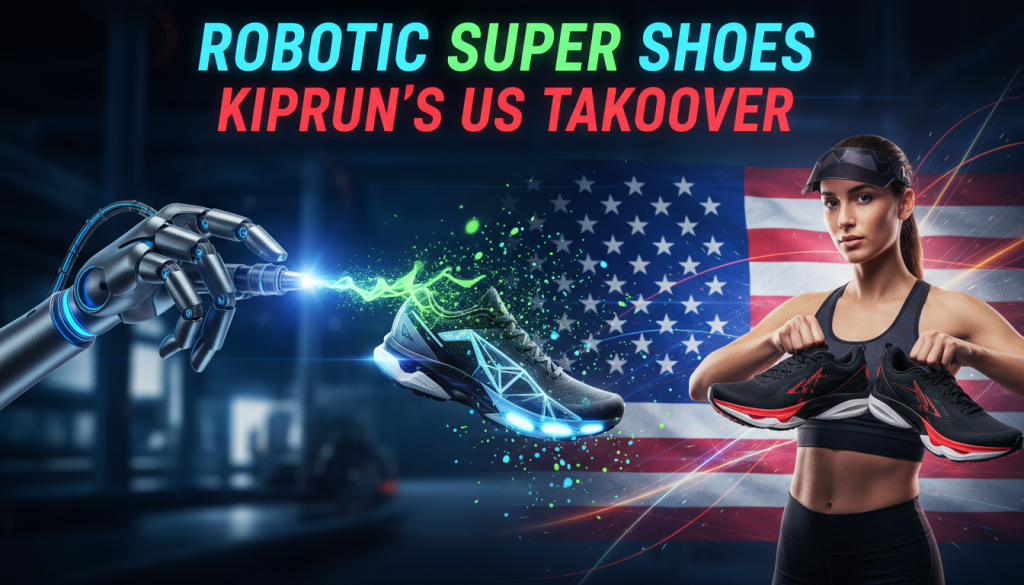
Robot-Sprayed Super Shoes Kiprun’s moment has arrived. In the same news cycle, we’re seeing a value-driven French brand storm the U.S. market while a Swiss upstart uses robots to “spray” futuristic uppers onto a new super trainer. Add New Balance’s fresh everyday workhorse and hints of Nike’s next Alphafly, and you’ve got one of the most interesting running-shoe weeks in recent memory.
This running news blog dives into what each launch means for your training, racing, and budget—plus how to choose the right shoe from this new wave.
Table of Contents
- Kiprun’s Bold US Debut: Value Meets Performance
- On’s LightSpray Cloudmonster 3 Hyper: Robot-Sprayed Super Shoes for the Masses
- New Balance Ellipse: The New Daily-Driver Cushion King
- Alphafly 3 Today, Alphafly 4 Tomorrow: Reading Nike’s Racing Signals
- How These Four Stories Fit Together: What Runners Should Actually Do
- RunV Tips: Matching Shoes to Training and Racing Goals
- Conclusion: A New Era of Choice, Cushion, and Carbon
Kiprun’s Bold US Debut: Value Meets Performance
Who is Kiprun, and Why Should US Runners Care?
Kiprun is Decathlon’s performance running brand, long known in Europe for surprisingly capable shoes at prices that undercut most competitors. Until now, American runners mostly heard about Kiprun through word of mouth, travel, or niche reviews.
That changes this April. According to Tom’s Guide, Kiprun is bringing at least three of its best-performing models to the U.S., positioning them among the standout shoes of 2026 so far. This is not just another brand launch—it’s an attack on the crowded mid-price segment.
The Three Kiprun Models to Watch
Tom’s Guide doesn’t only tease the launch; it highlights three specific models as genuine contenders. While the article focuses on broad impressions rather than deep specs, the pattern is clear: one daily trainer, one more responsive option for tempo or long runs, and a lighter, faster model.
Taken together, these three create a full rotation for many runners: easy days, quality sessions, and race-leaning efforts, all designed to stay under the price of many marquee rivals.
Where Kiprun Fits in Today’s Market
Kiprun is entering a landscape where max-stack, non-plated “super trainers” and plated racers dominate headlines. But not every runner wants—or can justify—$200+ shoes. Kiprun’s pitch is simple: modern geometry, quality cushioning, and durability for significantly less.
That makes the brand particularly appealing if:
- You’re building your first serious shoe rotation and don’t want to spend $500+ on three pairs.
- You run high mileage and need durable, cost-effective trainers.
- You prefer tried-and-true foams and conservative drops over wild experiments.
This is one reason Robot-Sprayed Super Shoes Kiprun’s narrative is so interesting: in the same week we see hyper-futuristic robots making shoes, a budget-savvy brand arrives to remind everyone that smart value still matters.
How US Runners Might Use Kiprun Shoes
Think of Kiprun’s US lineup as a foundation around which you can sprinkle more exotic models. For example:
- Daily trainer Kiprun: Easy runs, recovery days, base mileage.
- Firmer or lighter Kiprun option: Tempo runs, long runs with pace changes.
- Racing or speed-focused Kiprun model (if offered): Parkruns, 5Ks, and tune-up races.
If you’re building toward your first or fastest Marathon, a Kiprun daily trainer could handle 70–80% of your miles while freeing up budget for a plated race-day shoe from Nike, On, or another brand.
On’s LightSpray Cloudmonster 3 Hyper: Robot-Sprayed Super Shoes for the Masses
What Is the LightSpray Cloudmonster 3 Hyper?
On’s latest headline-grabber, the LightSpray Cloudmonster 3 Hyper, is a maximal-cushion, laceless “super trainer” using robotic LightSpray technology to build a seamless upper. The shoe launched in North America on March 5, 2026, and T3’s coverage emphasizes that this isn’t a one-off concept—it’s manufacturing at scale.
The name might be long, but the idea is simple: combine high-stack cushioning with cutting-edge automated construction to create a shoe that’s light, soft, and less wasteful to produce.
How LightSpray Technology Works (and Why It Matters)
LightSpray uses robotic arms to spray fibers or materials directly onto a last, building the upper with minimal seams and overlays. Compared with traditional cut-and-sew mesh, this can:
- Reduce material waste by eliminating excess off-cuts.
- Improve consistency, since each upper is built by the same precise machinery.
- Allow On to iterate designs quickly with software tweaks instead of new physical patterns.
For runners, that means smoother comfort, potentially fewer hotspots, and the possibility of rapid, data-driven refinements.
Why a Laceless Super Trainer Is a Big Deal
Laceless running shoes aren’t new, but most have been niche or lifestyle-oriented. By putting LightSpray on a Cloudmonster 3 Hyper—a “super trainer” meant for real mileage—On is signaling that this is mainstream performance tech, not just a gimmick.
Expect the fit system to rely on an engineered compression upper, sculpted collar, and strategic reinforcement zones. The question is less “Can this stay on my foot?” and more “Can this adapt to different foot shapes as well as laces do?”
Robot-Sprayed Super Shoes Kiprun’s Moment vs. On’s Hyper Future
The juxtaposition is striking. On is betting that robot-sprayed uppers and laceless designs will define the future of sustainable, performance footwear. Kiprun, meanwhile, enters the U.S. with more traditional constructions but aggressive pricing.
For runners, the Robot-Sprayed Super Shoes Kiprun’s storyline is not about choosing “futuristic” or “budget” in the abstract. It’s about deciding where to spend:
- High-tech LightSpray super trainer for harder, longer runs.
- Value-driven Kiprun shoes as daily workhorses and backups.
If you’re curious about the broader landscape of max-cushion trainers that stop short of full racing plates, On’s move aligns with trends covered in Max-Stack, No Plate: The Next Super-Trainer Era Begins.
Who Is the Cloudmonster 3 Hyper For?
Based on the profile from T3 and On’s history, this shoe is ideal if:
(ISPO Award for Kiprun glue-free shoe)
- You want max cushioning for long runs and back-to-back training days.
- You like the idea of a premium, futuristic trainer for your main workload.
- You already have (or don’t want) a plated racer but still want “super shoe” feel.
If you’re logging 40–80 miles a week and want a single, luxurious shoe for everything except all-out racing, the LightSpray Cloudmonster 3 Hyper is a strong candidate in 2026’s super-trainer wars.
New Balance Ellipse: The New Daily-Driver Cushion King
Ellipse Overview: Specs That Matter
New Balance’s new Ellipse is a global launch that flew slightly under the radar amid carbon chatter, but it’s a vital addition for real-world runners. Debuting March 5, 2026, the Ellipse is a neutral everyday trainer built around New Balance’s Fresh Foam X.
Key details from Tom’s Guide and Sole Retriever:
- Midsole: Fresh Foam X for soft, responsive cushioning.
- Drop: 8 mm—versatile for most runners.
- Upper: Breathable engineered mesh.
- Weight: ~9.6 oz for men (moderate, not ultra-light).
- Price: $145—a solid mid‑range point.
Rockered Profile for Smooth Transitions
One standout feature is the rockered geometry, designed to roll you from heel or midfoot to toe-off with less muscular effort. Rockers have become nearly standard in high-stack shoes, but New Balance tunes them to feel smooth rather than “tippy.”
For many runners, that means:
- Less calf and Achilles strain on long, flat runs.
- Smoother turnover at easy-to-moderate paces.
- A forgiving feel as fatigue builds late in a long run.
Who Should Consider the Ellipse?
The Ellipse is a strong choice if:
- You want one shoe that can handle 80–90% of your weekly training.
- You’re a newer runner who values comfort and stability over razor-thin weight.
- You prefer a stable, rockered trainer before dabbling in carbon plates.
At $145, it’s competitively priced against stalwarts like the Pegasus, Ghost, or Cumulus, but with a bit more modern geometry and cushioning feel.
Ellipse vs. Kiprun vs. Cloudmonster: Everyday Use Cases
Stack the three daily-trainer style stories:
- Kiprun: Value-first, good enough for most, ideal for rotation building.
- New Balance Ellipse: Mid-priced, comfort-oriented, highly accessible.
- On Cloudmonster 3 Hyper: Premium, futuristic, targeted at heavy trainers.
For many runners, the best pairing might be a Kiprun or Ellipse for daily miles and an eventual super trainer or racer for workouts and races. Daily comfort builds consistency, and consistency beats tech if you’re trying to PR in 6–12 months.
Alphafly 3 Today, Alphafly 4 Tomorrow: Reading Nike’s Racing Signals
Alphafly 3: Still a Top-Tier Racing Weapon
Tom’s Guide’s “Best Carbon Plate Running Shoes 2026” reminds everyone that the Nike Alphafly 3 remains a benchmark. Kelvin Kiptum used it to set his Chicago Marathon world record, and the shoe is still among the most advanced carbon-plated racers available.
Yet, the piece notes it’s now “one of the older carbon shoes on the market,” a subtle but important hint in the current rapid-update environment.
Why an Implied Alphafly 4 Matters
When a major outlet implies that an Alphafly 4 is likely later in 2026, it signals a few things:
- Nike doesn’t want to cede innovation headlines to Adidas, On, or other rivals.
- Expect improvements in weight, stability, and energy return.
- We may see geometry influenced by super-trainer trends (higher stacks, softer foams).
For competitive runners, this is critical intel. If your A‑race is late 2026, you might time your purchase to coincide with a possible Alphafly 4 drop, rather than over-committing now.
How to Think About Buying Now vs. Waiting
Use this rough guide:
- Racing in the next 3–4 months: Buy the Alphafly 3 if it fits and feels right; it’s proven.
- Main race in late 2026: Consider training in a super trainer (Cloudmonster 3 Hyper, similar models) now and waiting to see if an Alphafly 4 appears.
- On a budget: Snag Alphafly 3 on sale once a successor is announced; it will still be plenty fast.
Remember, the shoe is only one part of performance. How you structure your training, protect your routine, and manage fatigue matter more than one model update—see how safer training and smart structure drive gains in Why Safer Training Produces 5 Proven, Powerful Running Gains.
How These Four Stories Fit Together: What Runners Should Actually Do
The Big Picture: 2026 Is About Choice
Kiprun’s launch, On’s robot-sprayed super trainer, New Balance’s Ellipse, and hints of Alphafly 4 together signal a maturing landscape:
(Official Kiprun KIP X technology)
- Value brands are stepping up global presence (Kiprun).
- Manufacturing innovation is moving from concept to mass-market (LightSpray).
- Daily trainers remain central to brand identity (Ellipse).
- Racing lines keep evolving rapidly (Alphafly series).
Robot-Sprayed Super Shoes Kiprun’s story is ultimately about choice: you can now mix high-tech, mid-priced, and value shoes in one rotation tailored to your goals.
Building a Modern Shoe Rotation From These Launches
A practical rotation inspired by this week’s news could look like:
- Daily Trainer: Kiprun model or New Balance Ellipse.
- Super Trainer / Long-Run Shoe: On LightSpray Cloudmonster 3 Hyper.
- Race-Day Carbon Shoe: Nike Alphafly 3 now, with an eye on Alphafly 4 later.
This gives you:
- Durable comfort for base and recovery days.
- High cushioning and responsiveness for long runs and tempos.
- Maximum speed and efficiency for race day.
Where Value Still Wins
Even with robot-sprayed uppers and implied future Alphas, remember:
- A well-fitting $120–$150 daily trainer used consistently will out-perform a $300 racer left in the box.
- Rotation variety reduces repetitive stress and injury risk.
- Better training habits trump marginal shoe upgrades over the long term.
If your budget is tight, invest first in a solid daily trainer like the Ellipse or a Kiprun, then add premium models as your mileage, goals, and finances allow.
RunV Tips: Matching Shoes to Training and Racing Goals
1. Start With Your Goal, Not the Technology
Decide what you’re aiming for over the next 6–12 months:
- Finishing a first 5K or 10K comfortably.
- Running a half or full marathon with confidence.
- Chasing time goals and PRs at all distances.
Then choose gear that serves that goal:
- Comfort and consistency focus: New Balance Ellipse or Kiprun daily trainer.
- High-volume or advanced plan: Add a super trainer like Cloudmonster 3 Hyper.
- PR-focused: Eventually add a carbon plate like Alphafly 3/4.
2. Pair Shoes With Training Structure
Don’t just swap shoes at random—align them with your training blocks:
- Base phase: Mainly Ellipse/Kiprun, occasional Cloudmonster for long runs.
- Build phase: More frequent Cloudmonster use, plus some race-shoe workouts.
- Peak phase: Race shoe once a week, plus your usual trainers.
Structured usage spreads wear, keeps legs fresher, and mirrors the logic behind how pros rotate their shoes.
3. Use Super Trainers to Bridge Training and Racing
Robot-Sprayed Super Shoes Kiprun’s contrasting positions highlight a useful strategy: let super trainers be your bridge between daily trainers and carbon racers. For example:
- Ellipse/Kiprun for easy and recovery runs.
- Cloudmonster 3 Hyper for steady-state efforts, long runs, and tempo segments.
- Alphafly for key race-pace workouts and race day only.
That balance can help you preserve your racing shoe’s foam, while still adapting your muscles and tendons to race-day mechanics.
4. Lean on Tech and Coaching, Not Just Foam
New shoes won’t fix inconsistent training, lack of structure, or chronic overreaching. If you’re serious about progress, pair your shoe decisions with a smarter plan and better recovery habits. A good starting point: learn How to Train for 7 Powerful, Proven Speed and Endurance Gains and apply those principles with whichever shoes you choose.
Conclusion: A New Era of Choice, Cushion, and Carbon
The past week of equipment news underlines how diverse the running-shoe world has become. Robot-Sprayed Super Shoes Kiprun’s U.S. arrival, On’s LightSpray Cloudmonster 3 Hyper, New Balance’s Ellipse, and the Alphafly’s evolving legacy offer more choice than ever across price points and performance tiers.
You don’t need every new model. You do need:
- A comfortable daily trainer that fits your foot and budget.
- A plan for when to add a super trainer or carbon racer, if your goals demand it.
- Training habits that make the most of whichever shoes you own.
As new releases keep dropping, we’ll continue tracking which innovations actually matter for your running—not just your gear shelf. To stay ahead of the next wave of super trainers, racers, and value disruptors, keep an eye on the RunV Blog and get ready to make smarter choices for your next training block and race day.