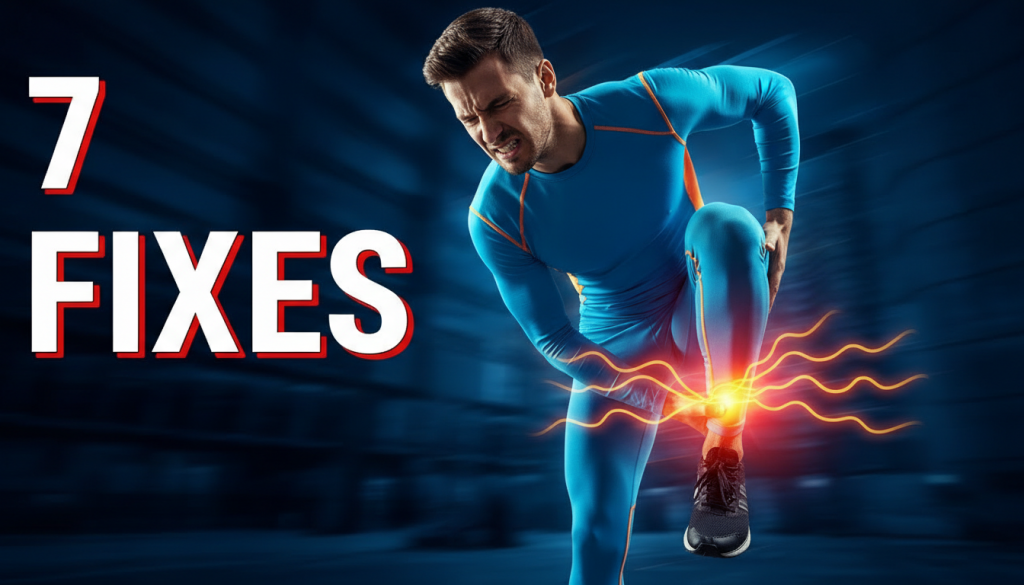
Achilles Tendon Pain Runners: three words that can turn a dream race season into a frustrating stop‑start grind. If you run regularly—whether you’re chasing a 5k PB, training for a marathon, or just logging stress‑relief miles—your Achilles is under constant load. When it starts to hurt, it can feel like everything is suddenly at risk: your fitness, your race plans, even your identity as “a runner.”
This guide breaks down exactly what’s going on, why it happens, and the 7 essential fixes that actually work, based on current sports science and real‑world experience with runners.
—
Table of Contents
1. Understanding Achilles Tendon Pain in Runners
2. When Achilles Pain Is Serious: Red Flags to Watch
3. Fix 1 – Reduce Load Without Losing Fitness
4. Fix 2 – Eccentric & Heavy-Slow Calf Strength Work
5. Fix 3 – Footwear, Surfaces & Smart Gear Choices
6. Fix 4 – Mobility, Flexibility & The Right Kind of Stretching
7. Fix 5 – Running Form Tweaks That Protect Your Achilles
8. Fix 6 – Recovery, Sleep & Load Management Tech
9. Fix 7 – Returning to Training & Building a “Bulletproof” Achilles
10. Long-Term Prevention: Keeping Achilles Pain Away
11. Key FAQs About Achilles Tendon Pain in Runners
—
1. Understanding Achilles Tendon Pain in Runners
For most runners, Achilles pain isn’t a “mystery injury.” It’s usually a predictable response to too much load, too soon, on a tendon that wasn’t ready.
Your Achilles tendon connects your calf muscles (gastrocnemius and soleus) to your heel bone. It stores and releases elastic energy every time you run—especially during push‑off. That makes it incredibly strong, but also vulnerable to repeated overload.
Most issues fall under “Achilles tendinopathy,” not simple “tendonitis.” Tendinopathy means a longer‑term overload problem, where the tendon structure and its ability to handle force are affected, not just one brief flare of inflammation.
Short version: Achilles Tendon Pain Runners experience is usually about load management and tendon capacity—not just “tight calves” or “old shoes.”
—
Common causes of Achilles tendon pain in runners
Typical triggers include:
– Sudden mileage spikes (e.g., jumping from 20 to 40 miles per week)
– Rapidly adding hills, stair work, or speed sessions
– Switching to lower‑drop or minimalist shoes overnight
– Hard or cambered surfaces, especially when tired
– Previous calf or Achilles strains that never fully rehabbed
– Weak calf or glute muscles that can’t handle your current workload
Most runners don’t have just one cause; it’s usually a combination of training error, weakness, and sometimes gear decisions.
—
Key types of Achilles problems you might face
Knowing which type of problem you have helps you pick the right fix:
– Mid-portion Achilles tendinopathy
Pain and thickening 2–6 cm above the heel. Common in runners logging lots of miles or increasing intensity.
– Insertional Achilles tendinopathy
Pain right where the tendon attaches into the heel bone. Often more sensitive to stretching and hills.
– Paratenon irritation
Pain and creaking around the tendon sheath, usually soon after a sharp load increase.
– Partial tear or rupture
Sudden sharp “pop,” immediate pain, difficulty or inability to push off. This is an emergency.
The 7 fixes below focus primarily on tendinopathy (the chronic overload category), which is by far the most common in runners.
—
2. When Achilles Pain Is Serious: Red Flags to Watch
Most Achilles issues are manageable with smart self‑care and load changes. But some symptoms mean you should seek a sports medicine or physical therapy assessment quickly.
Watch for:
– A sudden “gunshot” or “whip‑like” sensation in the back of the leg
– Immediate difficulty walking or standing on tiptoe
– Visible gap or dent in the tendon
– Significant swelling and bruising within hours
– Pain that wakes you at night, not just with activity
– Achilles pain plus calf swelling and warmth after long travel or illness (rule out clot)
If you suspect a tear or rupture, don’t “test it with a run.” Get it checked first.
—
3. Fix 1 – Reduce Load Without Losing Fitness
This is the step most runners resist—and the one that makes the biggest difference.
You don’t have to stop running forever. But you do need to adjust how much and what kind of loading your Achilles gets while it calms down and you rebuild strength.
—
How much should you cut back?
Use a simple pain‑guided model:
– Pain during run: aim for pain less than 3/10 and not progressively worsening as you continue.
– Pain the next morning: your first steps shouldn’t be dramatically worse than before the run.
– Function: you can walk normally without limping, especially after warming up.
If your pain is higher than that, or if your stiffness and soreness are clearly worse the next morning, your load is still too high.
Practical cutback ideas:
– Reduce weekly mileage by 30–50% initially.
– Remove hills, sprints, and plyometrics.
– Choose flatter routes and softer surfaces where possible.
– Split longer runs into two shorter runs or run/walk intervals.
—
Cross-training that keeps you fit
Protecting your Achilles doesn’t mean losing all your conditioning. Smart cross‑training maintains your aerobic engine while you rehab:
– Cycling or indoor bike (low resistance at first)
– Elliptical (if pain‑free)
– Deep‑water running
– Rowing machine (watch for calf engagement; test gently)
These are especially important if you’re targeting an upcoming Half Marathon, 10k, or marathon. You can maintain a surprising amount of fitness while your tendon recovers, as long as you stay consistent.
—
4. Fix 2 – Eccentric & Heavy-Slow Calf Strength Work
If there’s one non‑negotiable for Achilles Tendon Pain Runners need to understand, it’s this: strong tendons tolerate load better than weak ones. The gold standard treatment worldwide is progressive calf strengthening, especially eccentric and heavy‑slow work.
—
Why eccentric loading works
“Eccentric” means the muscle is lengthening under tension (like lowering your heel off a step). When done progressively over weeks, this type of loading:
– Improves tendon stiffness and resilience
– Reduces pain over time
– Increases calf strength and endurance
You’ll often feel more discomfort *during* and immediately after the exercises at first. That doesn’t mean you’re making it worse—mild, controlled pain is expected. What matters is the trend over weeks, not days.
—
Classic Alfredson protocol (mid‑portion Achilles)
If you have mid‑portion Achilles issues (not right at the heel bone):
1. Stand with the balls of your feet on a step, heels hanging off.
2. Use both legs to rise up onto your toes.
3. Shift weight to the injured leg.
4. Slowly lower your heel below step level over 3–4 seconds.
5. Use both legs to come back up (avoid pushing up with the sore Achilles).
Start with:
– 3 sets of 15 bent‑knee lowers (targets soleus)
– 3 sets of 15 straight‑knee lowers (targets gastrocnemius)
– Once daily, 5–7 days per week
If 3 x 15 is too much initially, start with fewer reps and build up.
—
Heavy-slow resistance (HSR) training
For many runners, especially those with gym access, HSR is more tolerable and equally effective:
Key exercises:
– Seated calf raises (bent knee – soleus focus)
– Standing calf raises (straight leg – gastrocnemius focus)
– Leg press calf raises (for heavier loads)
Program example:
– 3 sessions per week
– 3–4 sets of 8–12 slow reps (3 seconds up, 3 seconds down)
– Start with moderate weight, gradually increase as tolerated
Aim for some effort and mild discomfort (up to 3–4/10), but not sharp or worsening pain.
—
Insertional Achilles considerations
If your pain is right at the heel bone (insertional):
– Avoid dropping your heel below horizontal; stay on flat ground.
– Start with heel raises on the floor, not off a step.
– Emphasize slow, controlled movement and modest load at first.
For both types, stick with strength work for at least 8–12 weeks. Tendons adapt slowly. Commit for the long haul.
—
5. Fix 3 – Footwear, Surfaces & Smart Gear Choices
Gear isn’t the root cause of most injuries, but it can either help or hurt your recovery.
For Achilles Tendon Pain Runners, two shoe features matter most: heel-to-toe drop and cushioning/stability profile.
—
Heel drop and your Achilles
Lower‑drop shoes (0–4 mm) place your Achilles and calf under more stretch and load, especially if you’ve transitioned quickly from higher‑drop models.
To protect a sore tendon:
– Consider using a slightly higher drop (8–12 mm) during rehab.
– Add a short‑term heel lift insert if recommended by a therapist.
– If you love low‑drop shoes, reintroduce them very slowly once pain is stable.
If you’re in the market for updated footwear, highly cushioned, rocker‑shaped shoes from brands like Hoka can sometimes reduce strain on the Achilles. See options like The Best Hoka Running Shoes in 2025 for models that balance cushioning, support, and forward roll.
—
Surface choices and terrain
Surfaces matter less than total load, but they still contribute:
– Hard, sloped, or cambered roads increase strain.
– Constant tight turns on indoor tracks can overload one side.
– Hilly routes, especially steep downhills, are especially provocative.
Practical changes:
– Temporarily favor flat, even surfaces (trails or track in moderation).
– Reduce steep hill repeats or “mountain days” until pain is under control.
– Alternate shoes during the week to slightly vary load patterns.
—
Compression sleeves, orthotics, and taping
These tools don’t fix the underlying issue, but they may help with comfort:
– Compression sleeves: can reduce perceived stiffness and swelling.
– Orthotics: useful for specific biomechanical issues, but not mandatory for everyone.
– Kinesiology taping: short‑term pain modulation, not a cure.
Use them if they help you move and train within safe pain limits, not as an excuse to ignore the problem.
—
6. Fix 4 – Mobility, Flexibility & The Right Kind of Stretching
Achilles Tendon Pain Runners often feel desperate to stretch their calves, especially first thing in the morning. But aggressive stretching can actually irritate a sensitive tendon—especially insertional pain.
Mobility work is still important; it just has to be targeted and controlled.
—
When stretching helps—and when it doesn’t
Stretching can be useful if:
– Your ankle dorsiflexion is clearly limited.
– Your calves feel chronically tight from high mileage.
– You stretch gently after activity, not aggressively before.
It can be harmful if:
– You bounce or force deep stretches.
– You have insertional Achilles pain and push the heel too far down.
– You stretch heavily *instead* of strengthening (they’re not interchangeable).
—
Safe mobility routine for Achilles‑sensitive runners
2–3 times per week, try:
1. Gentle calf stretch (mid‑portion safe)
– Stand facing a wall, one foot back.
– Keep back heel down, knee straight, lean forward gently.
– Hold 20–30 seconds, 2–3 sets.
2. Soleus-biased stretch
– Same stance, but bend the back knee slightly.
– Keep heel down, lean into it gently.
– Hold 20–30 seconds, 2–3 sets.
3. Ankle dorsiflexion mobility
– Half‑kneeling, front foot flat.
– Gently drive knee forward over toes, heel stays planted.
– 10–15 slow reps, each side.
If your pain is insertional, shorten the stretch and keep the heel relatively neutral rather than deeply dropped.
—
Foam rolling and soft tissue work
Light foam rolling on:
– Calves
– Soleus (slightly bent knee)
– Plantar foot
can help reduce muscle tone and de‑sensitize the area. Spend 30–60 seconds per muscle group; it should feel uncomfortable but tolerable, not like you’re attacking the tissue.
Remember: mobility and soft tissue work are supporting actors. Strength and load management are still the stars.
—
7. Fix 5 – Running Form Tweaks That Protect Your Achilles
Form overhauls can backfire, but small, targeted adjustments often reduce tendon stress.
For Achilles Tendon Pain Runners, focus on changes that gently reduce push‑off load and excessive ankle motion without destroying your natural stride.
—
Helpful form adjustments
1. Slightly increase cadence
– Aim for 5–10% higher steps per minute (e.g., 160 → 168–176).
– This usually reduces overstriding and peak impact forces.
2. Land closer to your center of mass
– Think “quick, light steps under my hips,” not long, reaching strides.
– Don’t obsess over forefoot vs. heel; look at *where* your foot lands.
3. Reduce aggressive push-off
– If you’re a powerful toe‑pusher, especially in sprints or uphill, ease off slightly during rehab.
– Let your glutes and hips share more of the workload.
4. Stay tall through the torso
– A big forward lean from the hips can load calves excessively.
– Aim for a subtle forward lean from the ankles instead.
—
When to seek a gait analysis
Consider a professional gait assessment if:
– You’ve had multiple bouts of Achilles pain in the last 1–2 years.
– Different shoes don’t significantly change how you feel.
– You suspect asymmetry—one leg feeling much more “worky” than the other.
Some advanced running tech and wearables now track ground contact time, vertical oscillation, and asymmetry, which can highlight issues before they become injuries. If you’re curious how these tools are evolving, look at resources like Are Your Wearables Finally Smart Enough to Run Your Health?
—
8. Fix 6 – Recovery, Sleep & Load Management Tech
Tendons adapt over weeks and months, not days. That adaptation only happens if you balance stress with recovery.
If you’re constantly sleeping poorly, adding “just one more” workout, and ignoring low‑grade aches, your Achilles simply never catches up.
—
Non-negotiable recovery basics
– Sleep: aim for 7–9 hours per night. Tendons heal and remodel while you rest.
– Nutrition: prioritize adequate protein (1.6–2.2 g/kg bodyweight) and overall calories.
– Hydration: even mild dehydration can increase perceived effort and stiffness.
– Alcohol: limit it, especially after heavy training days; it impairs tissue repair.
—
Using tech to manage load properly
Many runners track pace and distance obsessively, but ignore training monotony and load spikes. Use your devices more intelligently:
– Track weekly mileage and avoid jumps of more than ~10–20%.
– Use training load or readiness metrics as a conversation starter, not absolute truth.
– Monitor resting HR and HRV trends—sustained changes can signal under‑recovery.
Combine this with subjective markers: energy, mood, motivation, and soreness.
—
Recovery sessions and micro‑adjustments
Well‑timed recovery strategies make your Achilles rehab more successful:
– Easy cycling or walking on non‑run days to increase blood flow.
– Short 5–10 minute mobility circuits after runs.
– Planned deload weeks every 3–5 weeks in your training.
For more ideas on structuring rest and recovery around a serious training block, you may like How to Recover Faster: 7 Proven Powerful Session Secrets, which ties in well with tendon‑friendly training.
—
9. Fix 7 – Returning to Training & Building a “Bulletproof” Achilles
Once pain improves, the temptation is to jump straight back into full mileage and speed. That’s the quickest way to end up right back where you started.
Instead, think of your return as a staged process: pain reduction → strength foundation → gradual load build → performance work.
—
Stage 1: Pain is low and stable
Criteria before ramping up:
– Morning stiffness mild and improving.
– Walking and daily activities mostly pain‑free.
– Eccentric or HSR strength work feels controlled, discomfort ≤ 3/10.
– Light, flat runs (20–30 minutes) tolerated without next‑day flare‑ups.
At this stage, keep runs mostly easy pace. Maintain strength work 2–3 times weekly.
—
Stage 2: Gradual mileage build
Progress with:
– 10–15% weekly mileage increases, if symptoms stable.
– One run per week slightly longer; others remain moderate.
– Gentle rolling terrain, but avoid steep or fast downhill.
– One light tempo or moderate interval session every 1–2 weeks as a test.
If symptoms spike, step back to the last “safe” level for 1–2 weeks before trying to progress again.
—
Stage 3: Reintroducing speed and hills
When your daily pain is negligible and your morning stiffness is minimal:
– Start with short, controlled strides on flat ground (6–8 x 15–20 seconds).
– Progress to tempo runs and then longer intervals.
– Add hills cautiously: start with short, gradual uphills; walk downhills if needed.
– Incorporate light plyometrics (skips, low hops) 1–2 times weekly, post‑strength session.
All through this stage, keep some version of calf strengthening in your routine. Don’t stop just because you feel better.
—
Planning around races and key goals
If you’re aiming for a comeback event—whether a 5k, Marathon, or trail race—plan backward:
– Give yourself at least 10–12 weeks from “mostly pain‑free” to “race‑ready.”
– Prioritize tendon‑friendly workouts early (tempo, controlled intervals) over all‑out sprints.
– Be realistic about your target pace; adjust expectations upward slightly if rehab cut into your base training.
A well‑structured plan that respects tendon health will almost always beat a hero plan that ignores pain and ends in a DNS or DNF.
—
10. Long-Term Prevention: Keeping Achilles Pain Away
Once you’ve climbed out of the hole, your job is not to fall back in. Prevention isn’t just about avoiding mistakes; it’s about building a system where your Achilles is consistently strong, resilient, and respected.
—
Core principles for long-term tendon health
1. Year-round calf strength
– Keep 1–2 strength sessions weekly, even in race season.
– Alternate heavy and moderate weeks for variety.
2. Reasonable training progressions
– Avoid stacking new stressors (e.g., new shoes + hills + speed) in the same week.
– Plan off‑seasons and down periods, not just constant build.
3. Smart shoe rotation
– Use 2–3 different pairs with slightly different profiles.
– Replace shoes before they’re completely dead, especially if you’re high‑mileage.
4. Regular soreness checks
– Monitor morning Achilles stiffness as an early warning.
– If soreness intensifies over 3–5 runs, adjust immediately—don’t wait.
5. Holistic strength
– Strong glutes, hips, and core reduce demand on calves and Achilles.
– Include squats, deadlifts, hip thrusts, and single‑leg work.
For a broader look at whole‑body strategies, see resources like Running Injury Prevention Through 7 Proven Powerful Moves, which complement everything you’re doing for your Achilles.
—
11. Key FAQs About Achilles Tendon Pain in Runners
Can I keep running with Achilles tendon pain?
Often, yes—if you:
– Keep pain during and after runs ≤ 3/10.
– Don’t see a worsening trend in morning stiffness or next‑day soreness.
– Adjust volume, intensity, and terrain appropriately.
If pain is sharp, increasing, or affecting your gait, pull back and focus on cross‑training and strength until it settles.
—
How long does Achilles tendinopathy take to heal?
Most cases improve significantly in 8–12 weeks with consistent rehab. More stubborn or long‑term issues can take 6–12 months to fully normalize. Tendons adapt slowly; your timeline depends on:
– How long you’ve had symptoms
– How well you adjust training load
– How consistently you perform strength work
—
Does complete rest cure Achilles tendon pain?
Complete rest often reduces pain—but it doesn’t improve tendon capacity. Once you start running again, the tendon is just as weak (or weaker), so symptoms usually return.
Active rehab with progressive loading is far more effective than simply stopping.
—
Should I ice or heat my Achilles?
– Ice can help with pain after runs or heavy loading.
– Heat can help with stiffness, especially before rehab exercises or easy runs.
Neither repairs the underlying tendon; they’re just tools for symptom relief. Use whichever helps you move better without masking serious pain.
—
What about injections or shockwave therapy?
These can help some runners, but they’re adjuncts—not first‑line solutions. Most sports medicine guidelines recommend:
1. Optimized load management
2. Progressive strength loading
3. Addressing biomechanics and training errors
before considering more invasive options. If you’re not improving after 3–6 months of good rehab, then explore these with a sports physician.
—
Do I need to stop all speed work forever?
No. Many Achilles Tendon Pain Runners return to full performance training once they’ve rebuilt tendon capacity and strength. The key is:
– Reintroduce speed gradually.
– Maintain strength work.
– Watch for early warning signs and adjust.
Your Achilles should eventually tolerate your desired workload—it just needs a rational path to get there.
—
Final Thoughts
Achilles tendon pain doesn’t mean your running journey is over, and it doesn’t have to derail your season. For most runners, it’s a loud but manageable signal that load, strength, and recovery have drifted out of balance.
The 7 essential fixes—load reduction, eccentric and heavy‑slow strength, smart footwear and surfaces, targeted mobility, form tweaks, better recovery, and a structured return to training—give you a clear roadmap back to pain‑reduced, confident running.
Approach your Achilles like any other long‑term project: with patience, consistency, and a plan. Over a few months, you’re not just getting rid of pain—you’re building a tendon that’s stronger and more resilient than it was before.