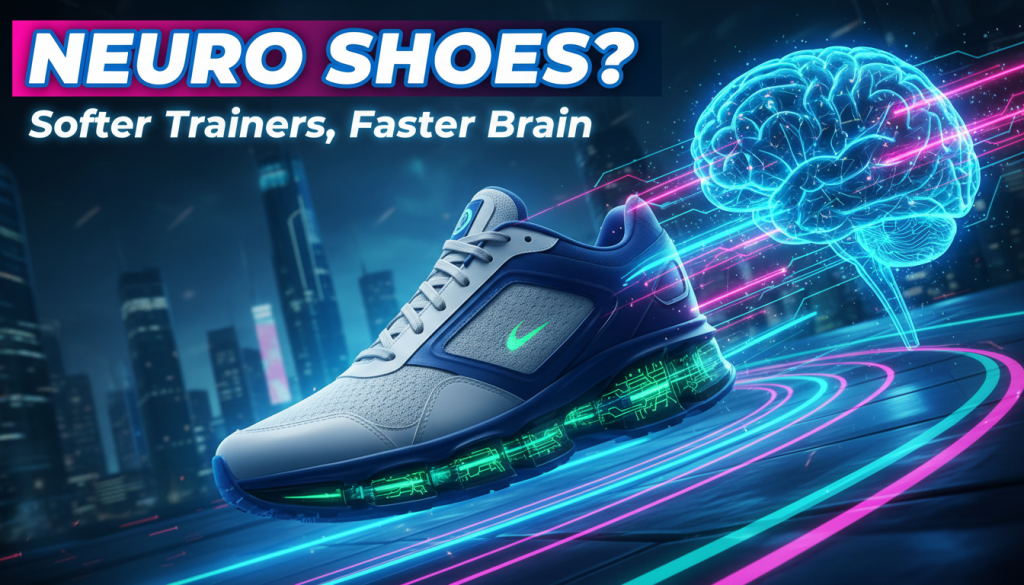
Neuroscience Shoes Softer Trainers might sound like marketing buzzwords, but this past week’s gear announcements show they’re fast becoming the backbone of modern running. From shoes designed to stimulate your brain to softer daily trainers that dial back harsh stiffness, brands are quietly redrawing what “performance” means on the run.
Below, we break down five major stories from the last seven days, explain why they matter, and help you decide what—if anything—you should change in your own shoe lineup and training strategy.
Table of Contents
- 1. Nike Mind: Neuroscience Shoes for Focus and Recovery
- 2. Brooks Glycerin Flex: The Rise of Softer, More Natural Trainers
- 3. Altra Experience 3: A Pushback Against Super Shoes
- 4. Thom Browne × Asics Gel-Kayano 14: When Performance Becomes Culture
- 5. Anta’s U.S. Push: Carbon Plates Without Carbon-Plate Prices
- 6. How to Choose Between Neuroscience Shoes and Softer Trainers
- 7. Conclusion & Call to Action
1. Nike Mind: Neuroscience Shoes for Focus and Recovery
What Nike Announced
On February 10, 2026, Nike unveiled the Nike Mind line: the Mind 001 Mule and Mind 002 sneaker. Instead of chasing more foam, higher stacks, or carbon plates, these Neuroscience Shoes focus on your brain. Both models use 22 independently moving foam nodes in the sole designed to create tactile sensory feedback.
That feedback is intended to stimulate the somatosensory cortex—the region of your brain responsible for processing touch and body position. The promise: more focus, less mental noise, and smoother transitions into and out of hard efforts.
How “Neuroscience Shoes” Actually Work
The basic idea isn’t as far-fetched as it sounds. Your feet are packed with sensory receptors. When those receptors receive varied, gentle input—like the moving foam nodes—they send rich signals to your brain. In theory, this can:
- Boost body awareness (proprioception)
- Calm pre-race anxiety by providing repetitive, grounding sensations
- Help shift your brain out of “scrolling” mode and into “ready to run” mode
Think of it as an active version of fidget tools or grounding techniques many athletes use before big performances—only built into footwear.
Why It Matters for Runners
Nike isn’t pitching the Mind line as race-day shoes, but as pre- and post-run tools to prime and decompress your nervous system. For runners who struggle with jitters on race morning or mental fatigue after hard sessions, Neuroscience Shoes like these could serve as a physical ritual to trigger focus.
Used consistently, they might also train you to associate slipping into the Mind 001 or Mind 002 with “switching on” or “winding down,” much like a warm-up song. That kind of conditioning can be powerful, especially when combined with mindset work like the strategies in
How to Reframe Missed Runs: 5 Powerful, Proven Mindset Shifts.
Who Might Benefit Most
- Anxious racers who overthink before a 5K, half, or marathon
- High-volume trainers who need better mental recovery routines
- Tech-curious runners who like integrating mental and physical tools
If you already have a solid shoe rotation, these are more of an add-on than a replacement. But they might become your go-to footwear for commutes to the track, mental reset walks, or pre-race shakeouts.
2. Brooks Glycerin Flex: The Rise of Softer, More Natural Trainers
From Stiff Super Shoes to Softer Trainers
The new Brooks Glycerin Flex, reviewed after 35 test miles and released in early February 2026, is explicitly framed as a different kind of daily trainer. At $170 with a 36 mm heel, 30 mm forefoot, and 6 mm drop, it sits in “max cushioned” territory—but with a twist.
Instead of the rigid, propulsive feel of many high-stack shoes, the Glycerin Flex uses DNA Tuned foam and a more flexible platform to create a softer, more natural ride. Energy return is not the headline; comfort and flexibility are.
What the Ride Feels Like
Early reviews describe a plush underfoot experience with plenty of protection, but without the “plank-like” sensation found in some plated or rockered trainers. The flex grooves and foam composition let your foot move and bend more freely.
This makes the Glycerin Flex a classic easy-day workhorse rather than a speed weapon. Think: recovery runs, aerobic base miles, and long runs where pace isn’t the priority but leg freshness tomorrow is.
Why Softer Trainers Are Trending Again
For the past few years, carbon-plated racers and ultra-firm superfoams dominated the conversation. But many runners discovered that training every day in stiff, aggressive shoes can:
- Increase lower-leg fatigue (calves, Achilles, plantar fascia)
- Mask early signs of overuse because impact feels “soft,” even when tissues are overloaded
- Encourage you to run too fast on easy days
Softer trainers like the Glycerin Flex help restore the training balance: using more forgiving shoes for daily miles, while saving stiff race rockets for key workouts and events. That balance is also a cornerstone of smart injury prevention, alongside strength work like the moves outlined in
Running Injury Prevention Through 7 Proven Powerful Moves.
Who the Glycerin Flex Suits Best
- Beginner runners needing comfort and forgiveness over speed
- High-mileage athletes looking to protect joints and tendons
- Runners rotating a plated shoe and wanting a contrasting, softer partner
If you’re chasing a PR in a 5k or marathon, you’ll still want a dedicated speed or race shoe. But as part of a “Neuroscience Shoes Softer Trainers” rotation, the Glycerin Flex could be your new default for easy and steady runs.
3. Altra Experience 3: A Pushback Against Super Shoes
Altra’s New Direction
On February 3, 2026, Altra launched the Experience 3 collection: Experience Flow 3, Experience Flow ST, and Experience Wild 3+. The big story isn’t carbon, stack heights, or plates; it’s a consistent 4 mm drop and an emphasis on “natural mechanics” without going fully zero-drop.
The line aims to be an approachable middle ground—lower drop than mainstream trainers, but less extreme than Altra’s traditional zero-drop offerings.
The Three Models Explained
- Experience Flow 3: Daily road trainer for neutral runners, cushioned yet responsive.
- Experience Flow ST: Adds GuideRail stability for mild overpronation or fatigue-related collapse.
- Experience Wild 3+: Trail-focused with a Vibram Megagrip outsole and toe bumper for technical terrain.
All models share the same 4 mm drop philosophy, aiming to nudge you toward a more midfoot-oriented, biomechanically efficient stride.
Why a 4 mm Drop Matters
Heel-to-toe drop subtly alters how forces travel up your body. Very high drops (10–12 mm) can offload calves but may encourage overstriding. Zero-drop can improve posture and foot strength but overload Achilles and calves if you switch too quickly.
By planting themselves at 4 mm, the Experience 3 line can:
- Encourage slightly shorter, more controlled strides
- Shift some work from your knees to your ankles and feet
- Offer a stepping stone toward more natural mechanics without fully “minimalist” risk
How This Counters the Super Shoe Trend
Where super shoes promise speed via foam and plates, Altra is betting that many runners care more about sustainable form and injury resistance. The Experience 3 collection is essentially a statement: long-term biomechanical health can be as important as raw seconds saved.
(Cushioned shoes injuries)
This aligns with the shift toward more holistic training and smarter load management, supported by data and adaptive planning tools. Understanding your real pace and effort—rather than chasing watch numbers alone—is key, a topic explored further in
Why Your Watch Pace Feels Wrong: 5 Shocking Proven Facts.
Who Should Consider the Experience 3
- Injury-prone runners wanting a gradual move to lower drop
- Trail runners looking for a secure, grippy, low-drop platform (Wild 3+)
- Existing super-shoe users adding a technique-focused trainer for form drills and easy runs
If you’re curious about lower-drop running but nervous about jumping into zero-drop, the Experience 3 line is a measured, practical entry point.
4. Thom Browne × Asics Gel-Kayano 14: When Performance Becomes Culture
The Collaboration
At the 2026 GQ Bowl on February 7, fashion designer Thom Browne unveiled a collaboration with Asics on the Gel-Kayano 14. The shoe comes in three colorways—gray, black, and white—and features Browne’s signature red-white-blue grosgrain tab, while largely retaining the classic Gel-Kayano 14 silhouette.
The release date is set for March 2, 2026, with limited quantities expected.
Why Runners Should Care About a Fashion Shoe
At first glance, this might seem like a purely lifestyle drop. But collaborations like this feed back into performance running in several ways:
- They keep legacy performance models, like the Gel-Kayano 14, relevant and desirable.
- They bring non-runners into the ecosystem, some of whom eventually become runners.
- They encourage brands to maintain dual identities: serious performance and cultural cachet.
The Gel-Kayano 14 has long been a stability workhorse, and this collaboration extends its life as a desirable object beyond pure function.
From Street to Long Run
While the Thom Browne version will likely be worn mostly as a fashion sneaker, it underscores a broader truth: the best running shoes are now designed to move between track, street, and everyday life.
For runners, this means you can own a rotation where:
- Neuroscience Shoes handle pre/post-run focus and recovery rituals.
- Softer Trainers like the Glycerin Flex handle bulk mileage.
- Fashion-forward performance silhouettes double as lifestyle shoes, stretching your gear budget further.
Should You Run in Them?
If you manage to snag a pair of the Thom Browne Gel-Kayano 14, you could technically run in them—they’re based on a legitimate stability platform. But premium pricing and limited availability mean they’ll mostly appeal as style pieces.
For everyday training, standard Kayano or other stability trainers will deliver similar biomechanical benefits at a more sensible price.
5. Anta’s U.S. Push: Carbon Plates Without Carbon-Plate Prices
Anta Steps Into the U.S. Running Spotlight
Runner’s World reported today (February 10, 2026) that Anta, a Chinese brand long known in Asia, is gaining serious momentum in the U.S. running community. Their formula: race-ready features at significantly lower prices than big-name competitors.
Key models include the PG7 (about $80), G21 Pro 3, C10 Pro, and the carbon-plated C202 7 at roughly $130. The brand’s visibility spiked after distance legend Kenenisa Bekele joined as a development collaborator, lending performance credibility.
Why This Matters for Your Wallet—and Training
Super shoes and high-end trainers regularly cross the $250 mark. That pricing shuts many runners out of the latest tech. Anta’s strategy delivers:
- Affordable daily trainers with modern foams for under $100
- Carbon-plated racers around $130, roughly half of some flagship models
- Flagship retail presence in the U.S. via a Beverly Hills store
For cost-conscious runners, this opens the door to building a full rotation—Neuroscience-style tools not included—without overextending finances.
Where Anta Fits in a Modern Rotation
Imagine a balanced lineup:
- A carbon Anta C202 7 for races and key workouts
- A soft PG7 or similar for easy miles and recovery days
- A lower-drop or form-focused shoe (like Altra’s Experience line) for technique drills
That structure gives you speed, protection, and form-focus, all under a reasonable budget. Combined with adaptive training guidance—such as what an AI Dynamic Plan can provide—you’re no longer limited by shoe prices in chasing big goals.
(Softer midsoles injury risk)
What to Watch For
- Fit and sizing differences compared to U.S. brands
- Durability of foams and outsoles over 200–300 miles
- Availability outside flagship cities or online channels
If you’re willing to experiment, Anta could be your gateway into carbon-plated racing without paying super-premium prices.
6. How to Choose Between Neuroscience Shoes and Softer Trainers
Step 1: Identify Your Primary Limiter
Before chasing any new tech, ask: What holds your running back right now?
- Mental focus or anxiety? Consider Neuroscience Shoes like Nike Mind as a ritual tool.
- Fatigue and soreness? Softer trainers like the Glycerin Flex might help your legs bounce back.
- Form and mechanics? Explore lower-drop options like Altra Experience 3.
- Budget and access to carbon tech? Look to Anta’s affordable racer line.
Match the product to the problem, not the hype cycle.
Step 2: Build a Simple, Effective Rotation
You don’t need ten pairs. For most runners, three thoughtful choices are enough:
- Daily Softer Trainer: For most of your mileage; prioritize comfort and protection.
- Workout/Race Shoe: A lighter, snappier model or carbon-plated racer.
- Mind/Mechanics Tool: Either a Neuroscience Shoe for focus or a lower-drop, form-focused shoe.
Use the Neuroscience Shoes Softer Trainers combination to define clear roles: one helps your brain, one helps your body, one helps your speed.
Step 3: Respect Adaptation and Recovery
Switching into new categories—like 4 mm drop shoes or highly cushioned trainers—requires gradual adaptation. Increase mileage in a new model slowly, and watch how your body responds.
Pair shoe changes with smarter recovery strategies, as outlined in
Why Recovery Is a Powerful Training Tool: 5 Essential Facts. Better shoes can’t save you from chronic under-recovery or poor training structure.
Step 4: Use Feel, Not Just Data
Modern gear and watches can make it tempting to outsource all decisions to numbers. But Neuroscience Shoes and softer trainers are ultimately about how you feel—more focused, more relaxed, less beat-up.
When testing new shoes, log:
- How your legs feel 24 hours after runs
- Whether you can hold form late in long runs
- Whether anxiety drops before key sessions
If the subjective experience improves, that’s as meaningful as any pace metric.
RunV-Relevant Tips for Maximizing Your Gear
- Periodize shoe use: Use your softest trainer the day after long or fast runs; reserve your stiffest shoe for sessions that truly require it.
- Track shoe mileage: Rotation works best when you retire shoes before they become dead weight on your joints.
- Sync shoes to session type: Brain-focused rituals (Nike Mind) before races; soft trainers for aerobic base; lower-drop trainers for technique-focused strides.
Layered with smart planning tools and deliberate recovery, Neuroscience Shoes Softer Trainers can become part of a coherent, progression-oriented system, not just individual purchases.
7. Conclusion & Call to Action
This week’s announcements underline a new era: performance is no longer only about plates and stack heights. Neuroscience Shoes target your brain; Softer Trainers protect your body; lower-drop designs refine your mechanics; budget brands democratize access to race technology.
The key is choosing what you actually need. If focus is your limiter, experiment with pre-run rituals and brain-focused footwear. If soreness and burnout dominate, invest in a forgiving daily trainer. If you’re stuck at a performance plateau, combine a carbon-plated racer with a smarter plan and gradual progressions.
Most of all, treat every new shoe as a tool in a broader system—one that includes solid training, realistic pacing, and intentional recovery. Let new gear work for you, not distract you.
If you’re ready to turn Neuroscience Shoes Softer Trainers, carbon racers, and natural mechanics into actual race-day gains, pair your shoe choices with adaptive planning. Start refining your training structure and gear strategy today with an
AI Dynamic Plan that evolves as you and your shoes do.