
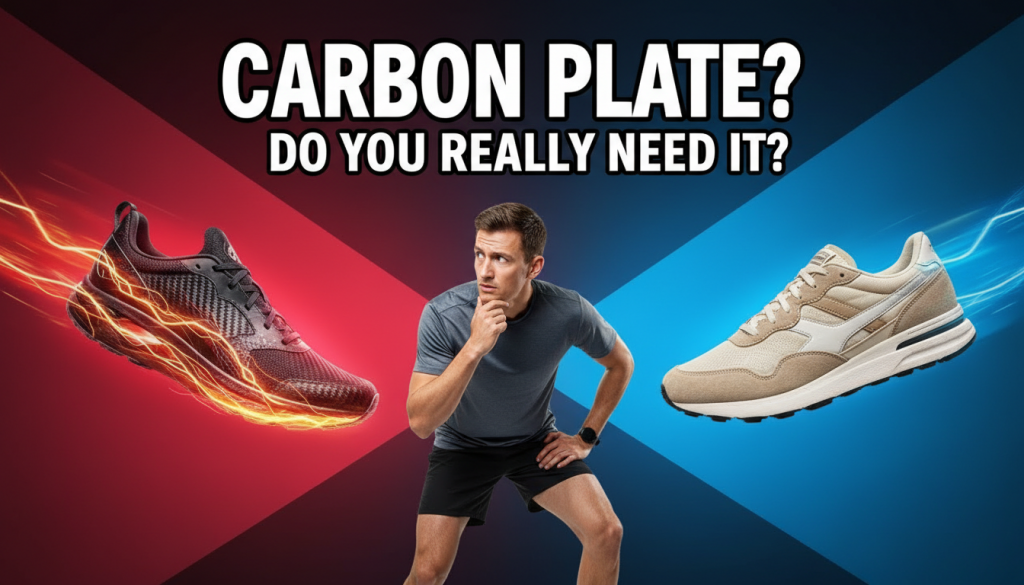
If you scroll any running forum right now, it can feel like you Really Need Carbon Plate shoes just to keep up. Super shoes dominate race photos, marketing campaigns, and even casual group runs. But the latest gear news from this week tells a very different story: brands are quietly proving that you can get speed, comfort, and durability without a stiff piece of carbon under your foot.
This running news blog pulls together five fresh equipment stories and asks a simple question: in 2025 heading into 2026, do you really need a carbon plate to run fast, train smart, and stay injury-free?
Table of Contents
- The Carbon Plate Myth: What Do You Actually Need?
- Diadora Atomo Star: Super Shoe Energy Without the Plate
- Saucony Endorphin Azura: Fast-Feeling Trainer, No Plate Required
- Brooks Launch 11: Sub-$100 Workhorse Winning Over Walkers and Runners
- Holiday Shoe Deals: Asics, Hoka, Brooks & More Up to 44% Off
- Rare Hoka Discounts: When You Actually Might Want the Max Cushion
- Who Really Needs Carbon Plate Shoes—and Who Doesn’t?
- How to Choose Your Next Shoe Based on Your Training Goals
- Conclusion & Next Steps
The Carbon Plate Myth: What Do You Actually Need?
For a few years now, brands have pushed the idea that you Really Need Carbon Plate shoes if you care about performance. But recent launches and reviews show a big shift: high-energy foams and rocker geometries are doing most of the work, while plates are becoming optional rather than mandatory.
Across this week’s news, two shoes in particular—Diadora’s Atomo Star and Saucony’s Endorphin Azura—deliver “super shoe” sensation without plates. Add in deep discounts on everyday trainers and rare sales on Hoka models, and the message is clear: the right shoe for you depends more on training style and goals than on whether there’s carbon inside.
Diadora Atomo Star: Super Shoe Energy Without the Plate
What the Atomo Star Is and Why It Matters
Runner’s World recently highlighted the Diadora Atomo Star as a shoe that delivers super shoe levels of energy return without a carbon plate. The magic comes from Diadora’s DD Anima midsole foam, a responsive compound designed to provide a propulsive feel and smooth ride.
The shoe also features:
- A structured heel collar aimed at easing Achilles strain
- An Italian-designed, breathable upper for comfort on long runs
- A stable platform that supports steady paces over distance
Why this matters: it directly challenges the idea that you Really Need Carbon Plate tech for speed. Diadora proves that modern foams and geometry can give you a fast, energetic ride while remaining more forgiving and versatile than many plated racers.
Who the Atomo Star Is Best For
The Atomo Star is an intriguing option if:
- You like the feel of super shoes but find plated models too harsh or unstable.
- You want one shoe that can handle tempo runs, long runs, and occasional races.
- You have a sensitive Achilles and need a supportive heel collar.
For runners following a structured plan—whether for a 5K, 10k, or longer—this kind of “do-it-all” performance trainer can cover most workouts without forcing you into a stiff racing shell every time you want to run fast.
Carbon vs. Foam: What This Shoe Tells Us
The Atomo Star underscores a key point: plates by themselves don’t make you faster. It’s the combination of:
- Lightweight, resilient foam
- Efficient rocker geometry
- Stable platform and secure upper
Diadora shows that if you prioritize those elements, you don’t Really Need Carbon Plate tech to get a “super shoe” feeling. For most non-elite runners, that trade-off may actually be better—more comfort, easier transitions, and often better durability.
Saucony Endorphin Azura: Fast-Feeling Trainer, No Plate Required
Details on Saucony’s New “Fastest Feeling” Trainer
T3 reports that Saucony has announced the Endorphin Azura, a high-performance daily trainer launching on February 2, 2026. It’s billed as Saucony’s “fastest feeling” Endorphin model that isn’t a race shoe—and crucially, it does this without any carbon or nylon plate.
Key tech features include:
- PWRRUN PB super foam (the same high-energy compound used in their race shoes)
- SPEEDROLL rocker geometry for a smooth, forward-rolling stride
- A design aimed at daily mileage and workouts, not just race day
This shoe is deliberately blurring the line between racer and trainer. It gives you that high-bounce sensation associated with plated shoes, yet remains more stable and durable for everyday training.
Why the Endorphin Azura Challenges the Plate Obsession
By positioning the Endorphin Azura as a “fastest feeling” shoe without a plate, Saucony is essentially admitting that you don’t Really Need Carbon Plate tech to feel quick or efficient. Instead, the brand is betting that runners care more about:
- Comfort and stability across high weekly mileage
- Versatility—one shoe that can handle easy days and speed work
- Durability for the bulk of training, not just race day
If you’re building toward a spring 2026 race—whether a Half Marathon PB or your first marathon—the Endorphin Azura is exactly the type of shoe that can anchor your training. You get the benefits of modern foam without being locked into the compromises of a rigid plate.
How to Use a Shoe Like This in Training
For performance-focused runners, a logical setup might be:
- Daily and tempo runs: Endorphin Azura
- Short intervals or race day: Optional plated racer
- Recovery days: Cushioned trainer from Asics, Hoka, or Brooks
With this structure, you only rely on plates when they truly add value. For the rest of your running, you’re using shoes that prove you don’t Really Need Carbon Plate tech to train fast and efficiently.
Brooks Launch 11: Sub-$100 Workhorse Winning Over Walkers and Runners
Why the Launch 11 Is Suddenly Everywhere
Real Simple reports that the Brooks Launch 11 has gained a devoted following among heavy walkers logging up to 300,000 steps per month, plus runners who previously favored Hoka and Saucony. The shoe is now available for under $100, making it one of the best-value performance models on the market.
Standout characteristics include: (RW: carbon plates guide)
- Lightweight build suitable for everyday runs and long walks
- Responsive cushioning that feels lively without being bouncy
- Highly breathable upper and all-day comfort—even for plantar fasciitis sufferers
What the Launch 11 Tells Us About Real-World Needs
The popularity of the Launch 11 among both walkers and runners is revealing. Most people don’t Really Need Carbon Plate performance to hit their goals. They need:
- Comfort over long durations on their feet
- Reliable cushioning that protects joints
- A price that allows rotation or replacement every 300–500 miles
For runners focused on building aerobic base or returning from injury, the Launch 11 is exactly the kind of shoe that makes sense: affordable, versatile, and friendly to high daily step counts.
How to Use Value Trainers in Your Shoe Rotation
Even if you own a plated racer, a shoe like the Launch 11 can be critical to your rotation:
- Recovery runs: Use the Launch 11 to reduce load on your calves and feet.
- Easy base miles: Save your more expensive prototype-style shoes for key workouts.
- Walking and cross-training: Keep your plated shoes reserved for running only.
This is where a structured training plan helps: you can map which shoes to use for which sessions. Platforms that offer adaptive plans, like an AI Dynamic Plan , make it easier to schedule your shoe rotation alongside your workouts.
Holiday Shoe Deals: Asics, Hoka, Brooks & More Up to 44% Off
What’s on Sale Right Now
EatingWell has rounded up significant after-holiday sales from Amazon, REI, Zappos, and other retailers, with discounts up to 44% on popular running shoes. Highlighted deals include:
- Asics Gel Kayano 30 around $90
- Hoka Skyflow around $128
- Brooks Adrenaline GTS 24 around $110
- Brooks Launch 11 at a discount
- Skechers Go Walk Glide Step 2.0 around $53
- Hoka Mach 6 and On Cloudrunner 2 also reduced
None of these are headline carbon super shoes, and that’s exactly why this sale matters. These models are the backbone of most sensible rotations: stability trainers, cushioned neutral shoes, and versatile light trainers.
What These Deals Mean for Your Shoe Strategy
If you’re on a budget, holiday sales are the perfect time to rethink the idea that you Really Need Carbon Plate shoes as your primary pair. Instead, consider:
- Using sales to pick up a second or third daily trainer.
- Investing in a stability model if you’re prone to overuse injuries.
- Adding a true recovery shoe with extra cushioning.
Once you have a strong base of comfortable, reliable trainers, adding a plated shoe—if you decide you want one—becomes a low-risk bonus rather than a high-pressure purchase.
Practical Tips for Buying in the Sales
- Know your size in key brands: Asics and Brooks often run true to size; Hoka can vary by model.
- Check drop and support level: Don’t switch from a low-drop shoe to a high-drop stability model overnight.
- Plan around your race calendar: Buy at least one pair you can use for peak training leading into your target race.
If you’re gearing up for a 5K or 10K block, build your calendar and shoe needs together so you don’t end up realizing you Really Need Carbon Plate tech—or any new shoe—two weeks before race day.
Rare Hoka Discounts: When You Actually Might Want the Max Cushion
Hoka’s Limited-Time Sale Window
Esquire reports that Hoka, a brand famous for its plush cushioning and supportive platforms, is currently offering rare discounts via Nordstrom and the official Hoka site. Stock is reportedly disappearing fast, which isn’t surprising given Hoka’s popularity among high-mileage runners.
Hoka’s lineup isn’t primarily about carbon plates (though models like the Carbon X and Rocket X exist). Instead, most Hokas focus on:
- High-stack cushioning for shock absorption
- Broad, stable bases underfoot
- Meta-Rocker designs to smooth out transitions
Why Hokas Matter in the Carbon Debate
For many runners, especially those tackling long distances or with injury history, Hokas show that you don’t Really Need Carbon Plate shoes to feel a performance benefit. Maximal cushioning can:
- Reduce impact loading on joints over high mileage
- Help with recovery days after intense workouts
- Support older runners or those returning from injury
If you’re planning a big endurance goal—whether a first marathon or a long build into a half marathon—Hoka-style models can be the unsung heroes of your cycle. For model-specific guidance, it’s worth checking curated breakdowns like The Best Hoka Running Shoes in 2025 and matching them to your training volume and surfaces.
When to Choose Hoka Over a Plated Racer
You may want to prioritize Hoka (or other max-cushioned shoes) if:
- Most of your running is easy or long-distance base building.
- You frequently experience joint or tendon soreness.
- You’re more interested in finishing strong than shaving tiny margins off a PR.
This doesn’t mean you can’t own a plated shoe for race day. It simply means you don’t Really Need Carbon Plate tech for 90% of your training—and your body might thank you for that. (Mayo: what to know)
Who Really Needs Carbon Plate Shoes—and Who Doesn’t?
When Carbon Plates Make the Most Sense
Carbon plates can provide measurable benefits in specific contexts. You are most likely to truly benefit if you:
- Race frequently at 5K to marathon distances.
- Run at paces where the foam and plate interaction is optimized (typically sub-45 min 10K, sub-3:30 marathon, though not strictly).
- Have a consistent weekly volume that justifies a race-only shoe.
In these scenarios, the combination of a super foam and a plate can reduce the energy cost of running and potentially improve race performance by a few percentage points.
When You Probably Don’t Really Need Carbon Plate Tech
You likely don’t need a plate as your primary shoe if you:
- Are new to running or building up to your first 5K or 10K.
- Run fewer than 20–25 miles (30–40 km) per week.
- Struggle with stability issues, frequent ankle rolls, or calf/Achilles problems.
In these cases, focusing on fit, comfort, and stability will move your performance forward more than chasing a marginal gain from a carbon plate. Shoes like the Diadora Atomo Star, Saucony Endorphin Azura, and Brooks Launch 11 show that you can feel fast and protected without the extra stiffness.
Risks of Over-Relying on Plated Shoes
Using plated models for all your running can contribute to:
- Increased calf and Achilles load due to aggressive rocker and stiffness.
- Reduced proprioception and foot strength over time.
- Higher replacement costs due to lower durability and higher prices.
Think of carbon shoes as a powerful but specialized tool. Use them when they matter most—key workouts and races—rather than assuming you Really Need Carbon Plate tech every time you lace up.
How to Choose Your Next Shoe Based on Your Training Goals
Start with Your Goal, Not the Plate
Before you decide whether you Really Need Carbon Plate shoes, clarify your primary goal for the next 3–6 months:
- Run your first race: 5K, 10K, or half marathon completion.
- Set a new PB: Especially in 5K/10K or half marathon.
- Build base and stay healthy: Post-injury or off-season work.
Match your shoe choices to these goals, not to marketing hype. For a first structured cycle, combining a reliable daily trainer with an optional “fun” fast shoe is usually sufficient; you rarely Really Need Carbon Plate models as a starting point.
Example Setups for Different Runners
- New Runner A: Training for a First 5K
Best choice: One versatile daily trainer (e.g., Brooks Launch 11, Asics Gel Kayano).
Why: You’ll get more from consistent training and smart progression than from plate technology. Consider pairing with a structured plan like a 5k training schedule to build safely. - Improver B: Targeting a Half Marathon PR
Best choice: Daily trainer + performance trainer (e.g., Saucony Endorphin Azura, Diadora Atomo Star) + optional plated racer.
Why: Use the performance trainer for tempos and key long runs. Introduce a plate only for specific workouts and race day once your base is solid. - Endurance C: High-Mileage Marathoner
Best choice: Max-cushion trainer (e.g., Hoka), stable daily trainer, and race-day super shoe.
Why: Here, plates may offer real benefits over 26.2, but most of your miles should still be in non-plated workhorses.
Shoes + Plan = Real Performance Gains
The common thread in all of this week’s news is that equipment only shines when paired with smart training. Using a structured plan for 5K, 10K, half marathon, or marathon, then layering shoes on top, will yield far more progress than chasing the newest carbon model alone.
Explore the range of programs and tools available in the All Plans hub and match your shoe rotation to your workout mix: easy days, long runs, tempos, and race-specific sessions.
Conclusion & Call to Action: Do You Really Need a Carbon Plate?
The latest gear news paints a clear picture: you don’t automatically Really Need Carbon Plate shoes to run fast, train well, or enjoy every mile. Diadora’s Atomo Star and Saucony’s Endorphin Azura show that super foams and clever geometry can deliver race-like feel without plates. The Brooks Launch 11 and the current Asics, Brooks, Skechers, and Hoka deals highlight affordable, reliable options that will carry you through most of your training.
Carbon plates still have a role—especially for experienced runners chasing marginal gains on race day—but they are a finishing touch, not the foundation of your progress.
Your next step: choose a clear goal, pick one or two shoes that truly fit that purpose, and back them up with a structured training plan rather than marketing promises. To map out your upcoming season, explore the coaching tools, race-focused programs, and training insights in the RunV Blog, then build a plan that lets your shoes—and your fitness—work together.
You don’t have to buy into the myth that you Really Need Carbon Plate tech for every run. Start where you are, choose gear that matches your reality, and let consistent, smart training do the heavy lifting.


One Response