
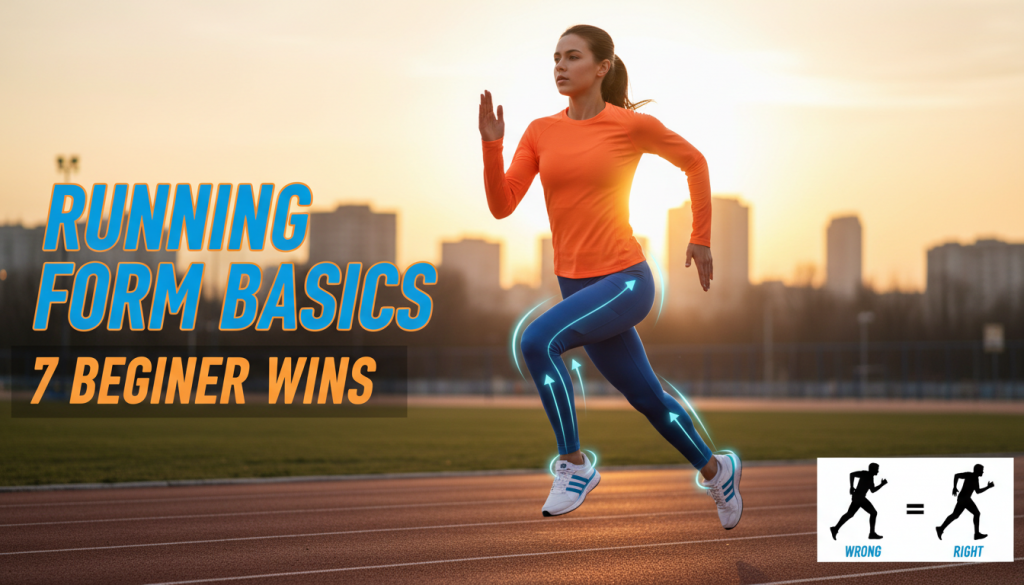
Running Form Basics Essential, is running form can feel mysterious when you’re new: elbows everywhere, feet slapping, lungs burning. The good news? You don’t need “perfect” mechanics to run well. You just need a handful of practical, proven adjustments. That’s exactly what this guide on Running Form Basics Essential will give you—7 beginner-friendly wins you can put into action on your next run.
We’ll break form down into simple pieces, connect it with pacing, shoes, and tech, and show you how to build better habits without obsessing over every step.
Table of Contents
- Why Running Form Matters More Than “Perfect Technique”
- Running Form Basics Essential: The 7 Beginner Wins
- Win 1: Posture – Tall, Relaxed, and Efficient
- Win 2: Cadence – Finding Your Natural Rhythm
- Win 3: Footstrike – Light, Under Your Center of Mass
- Win 4: Arm Swing – Your Built-In Metronome
- Win 5: Breathing – Stable Core, Steady Oxygen
- Win 6: Strength & Mobility – The Hidden Half of Good Form
- Win 7: Gear & Tech – Shoes, Sensors, and Smart Feedback
- Common Form Mistakes Beginners Make (and Fixes)
- How to Build Form Work into Any Training Plan
- Next Steps: Make Running Form Basics Essential a Habit

Why Running Form Matters More Than “Perfect Technique”
For most recreational runners, the goal isn’t textbook biomechanics; it’s staying healthy, getting faster slowly, and enjoying the process. That’s why we’re focusing on practical Running Form Basics Essential principles you can feel and repeat—no lab, no slow-motion cameras.
Better form gives you three big benefits:
- Less injury risk: Efficient mechanics reduce stress on joints, tendons, and muscles.
- More speed at the same effort: You waste less energy fighting your own movement.
- More comfort: Running feels smoother, less “bouncy” or jarring.
You’ll always have your own stride “fingerprint.” The goal is not to copy elites, but to refine what you already have with small, targeted adjustments.
Running Form Basics Essential: The 7 Beginner Wins
To keep this actionable, we’ll center everything on seven Running Form Basics Essential wins. Each one is simple enough for a beginner, but powerful enough to help experienced runners, too:
- Posture – Tall, relaxed, slight forward lean from the ankles
- Cadence – A smooth, quick rhythm that suits your pace
- Footstrike – Landing softly under, not far in front of, your body
- Arm Swing – Relaxed arms driving straight forward and back
- Breathing – Rhythmic breathing and a stable midsection
- Strength & Mobility – Hips, glutes, and calves doing their jobs
- Gear & Tech – Using shoes and wearables to support good habits
We’ll walk through each, plus drills and cues you can test this week.
Win 1: Posture – Tall, Relaxed, and Efficient
Why posture is a Running Form Basics Essential
Your posture is the foundation. If your torso collapses or leans too far back or forward, every step becomes less efficient and more stressful on your lower body.
Good posture doesn’t mean stiff and rigid; it means tall and relaxed. Think of building a straight but supple line from your ears through your shoulders, hips, and ankles.
Simple posture cues that work in real life
Try these on your next run:
- “Run tall”: Imagine a string gently lifting the crown of your head.
- “Lean from the ankles”: A tiny forward lean, starting at the ankles, not the waist. If you feel your lower back folding, you’re bending, not leaning.
- “Proud chest, soft shoulders”: Chest open for easy breathing, shoulders relaxed and slightly back, not hunched.
Check in every 5–10 minutes with a quick posture scan: head, shoulders, ribs, hips. Adjust, then let the body move naturally again.
Desk life, phone life, and your running posture
Sitting all day encourages rounded shoulders and a forward head. That posture carries into your runs unless you actively counter it. A few minutes of pre-run mobility can help:
- Chest openers against a wall
- Gentle neck stretches (chin tucks, side-to-side)
- Cat-cow or thoracic rotations for the mid-back
These small actions pay off when you start moving; your body will find “tall and relaxed” more easily.
Win 2: Cadence – Finding Your Natural Rhythm
Cadence as a Running Form Basics Essential
Cadence is how many steps you take per minute (SPM). It’s one of the few form elements you can measure with almost any GPS watch or running app. A slightly higher cadence often leads to shorter, lighter steps and less pounding.
There’s no universal magic number. Instead, think in ranges:
- Many beginners: 150–165 SPM at easy paces
- Intermediate runners: 160–175 SPM
- Elites often: 170–190+ SPM (at faster speeds)
Rather than chasing an arbitrary 180, use cadence as a tool to find smoother, less jarring strides.
How to measure and adjust cadence gradually
Use your GPS watch or app to show cadence, or count steps for 30 seconds with one foot and double it. Then:
- Find your current easy-run cadence.
- Choose a small target increase (about 3–5% at first).
- Use a metronome app or music playlist to match the beat.
Run 1–2 short segments per run (1–3 minutes) focusing on the new rhythm, then relax. Over weeks, this can naturally nudge you toward more efficient movement without feeling forced.
Tech tip: cadence on your watch
Most modern running watches can display live cadence and log it per lap or per kilometer. If you’re shopping for new tech, understanding cadence, heart rate, and pace metrics can influence your choice. This guide on how to pick the right GPS watch for your next big goal is a helpful deep dive into which features actually matter for form and training feedback.
Win 3: Footstrike – Light, Under Your Center of Mass
Running Form Basics Essential: how (and where) your foot lands
Footstrike is often overhyped. You’ll hear “you must be a forefoot striker” or “heel striking is bad.” That’s oversimplified. Many efficient, fast runners touch with the heel first; others with midfoot or forefoot. What matters more is where your foot lands relative to your body and how it loads.
Two essential principles:
- Land close to underneath your hips, not far in front.
- Land softly, with control, not slamming the ground.
Signs you might be overstriding
You may be overstriding if:
- Your foot lands visibly ahead of your knee and hip.
- You hear heavy, loud foot slaps even at easy pace.
- Your shins, knees, or hips feel beat up despite low mileage.
Overstriding usually comes with a low cadence and long, reaching steps. The fix is not forcing a forefoot strike; it’s adjusting rhythm and posture so your landing point shifts back under you.
Drills for better footstrike
Try these 1–2 times per week in your warm-up:
- Marching drills: March in place, lifting knees and landing with the foot under your hip. Then progress to a slow run with the same feel.
- Short “quick feet” strides: Run 20–30 seconds with intentionally lighter, quicker steps. Focus on sound: near-silent contact.
- Downhill control: On gentle declines, avoid overreaching by increasing cadence and keeping your body slightly ahead of your legs.
Let the footstrike evolve gradually. Often, simply fixing posture and cadence improves landing position without conscious effort.
Win 4: Arm Swing – Your Built-In Metronome
Why arm movement is a Running Form Basics Essential
Your arms aren’t just along for the ride. They help balance your stride, control rotation, and set rhythm. Wild or tense arm movements waste energy and disrupt your flow. (Proper running form)
Simple arm cues for smoother running
Key principles:
- Relax your hands: Imagine holding a potato chip you don’t want to crush.
- Elbows about 70–90°: Slightly bent, not locked straight or tucked tight.
- Drive straight forward and back: Hands move roughly from hip to lower ribcage, not crossing significantly over the midline.
- Shoulders low and loose: If they creep toward your ears, shake out your arms.
If you feel your form falling apart late in a run, focus on your arms first. A crisp, relaxed arm drive often “resets” your cadence and posture automatically.
Drills to improve arm mechanics
Try 2–3 × 20–30 seconds of:
- Arm-only running: Stand or walk, then swing only your arms at a running rhythm, feeling them drive straight back.
- Quick arms, easy feet: During an easy jog, briefly increase arm turnover while keeping effort low; let your legs follow the rhythm.
These are low-skill, high-payoff ways to reinforce Running Form Basics Essential without overthinking your legs.
Win 5: Breathing – Stable Core, Steady Oxygen
Breathing patterns and form are linked
When breathing feels chaotic, your posture and rhythm usually fall apart. A simple, controlled pattern stabilizes your torso and helps you manage effort.
You don’t need to count endlessly, but some structure helps:
- At easy pace: Try a 3–3 or 3–2 pattern (inhale for 3 steps, exhale for 3 or 2).
- At tempo or intervals: Patterns usually shorten, like 2–2.
Use your run conversations as a test: if you can’t speak in short sentences at “easy pace,” you’re likely going too hard, which sabotages relaxed form.
Diaphragmatic breathing for better form
Shallow chest breathing encourages tight shoulders and a stiff upper body. Instead, practice diaphragmatic (belly) breathing:
- Lie on your back, one hand on chest, one on belly.
- Inhale through your nose, trying to move mostly the hand on your belly.
- Exhale slowly through your mouth.
Do this 2–3 minutes before runs to prime your system. During the run, check occasionally: is your ribcage free, or clamped down? Loosen your torso and let the breath drop lower.
Breathing as a pacing guide
For beginners confused about how hard to run, breathing patterns plus form checks are your best tools. For more context on matching intensity and effort with smart pacing, this piece on aerobic vs anaerobic running explains how easier runs support both performance and better mechanics over time.
Win 6: Strength & Mobility – The Hidden Half of Good Form
Why strength work belongs in Running Form Basics Essential
Even if your brain knows the “right” cues, your body won’t hold form if the muscles can’t support it. Weak hips, glutes, and calves are common in beginners and often show up as:
- Knees collapsing inward
- Overpronation that worsens with fatigue
- Heavy, shuffling strides late in runs
Basic strength and mobility are thus a Running Form Basics Essential, not an optional extra.
Key areas to target (15–20 minutes, 2–3× per week)
Focus on:
- Glutes and hips: Squats, lunges, glute bridges, clamshells, lateral band walks.
- Calves and feet: Calf raises (straight and bent knee), single-leg balances.
- Core: Planks, dead bugs, side planks, birddogs.
Keeping the routine simple increases the chance you’ll stick with it. Three core moves + three lower body moves is plenty for most runners if done consistently.
Mobility to enable better mechanics
Mobility work is about having just enough range of motion to move freely:
- Hip flexors: Half-kneeling hip flexor stretch (gentle, no extreme arching).
- Ankles: Knee-to-wall ankle mobility drill.
- Hamstrings: Dynamic leg swings (front-to-back, side-to-side).
Use dynamic stretches before a run, static stretches after, if you like. The goal is to feel “un-stuck” rather than ultra-flexible.
Win 7: Gear & Tech – Shoes, Sensors, and Smart Feedback
How shoes interact with Running Form Basics Essential
Shoes don’t create good form, but they can support or sabotage it. A few guidelines:
- Comfort first: A shoe that feels wrong when you jog in the store will likely encourage awkward mechanics outside.
- Match purpose: Cushioned daily trainers for easy runs; lighter, snappier shoes for workouts or races.
- Transition gradually: If changing to lower-drop or more minimal shoes, increase mileage slowly as your calves and feet adapt.
If you’re interested in how the latest foams and designs influence impact and stride, this article on neuroscience shoes and softer trainers explores how modern midsoles may reduce perceived effort and alter how your body manages impact forces.
Using wearables to refine, not obsess over, form
Modern wearables can track: (Running form tips)
- Cadence
- Ground contact time
- Vertical oscillation (bounce)
- Left-right balance
Use these as trend indicators, not perfection goals. For example:
- If you see extremely low cadence and high vertical oscillation, work on smaller, quicker steps.
- If ground contact time spikes late in runs, that’s a sign of fatigue—maybe add strength, improve easy-pace discipline, or shorten the run slightly.
Form feedback vs. overthinking
Pick 1–2 metrics that matter most for you (cadence, maybe vertical oscillation) and track them weekly, not minute by minute. Periodic check-ins prevent form obsession while still giving you useful data to support your Running Form Basics Essential work.
Common Form Mistakes Beginners Make (and Fixes)
1. Running every run “too hard”
Signs:
- Shortness of breath even on supposed “easy” days
- Stiff shoulders, clenched fists
- Feeling wrecked for hours after short runs
Fix:
- Slow down until you can speak in short sentences.
- Use walking breaks if needed early on.
- Let your posture and breathing cues lead your pace, not the other way around.
2. Overstriding to “run faster”
Many new runners lengthen their stride in front to gain speed, increasing braking forces and risk of injury.
Fix:
- Think “push the ground back” rather than “reach forward.”
- Increase cadence slightly at the same pace.
- Practise short strides (20–30 seconds) where you accelerate smoothly, focusing on quick, light steps.
3. Tension everywhere
Common areas: jaw, neck, shoulders, hands. Tension wastes energy and often indicates pacing that’s too aggressive.
Fix:
- Periodic body scan: “Jaw? Shoulders? Hands?” Relax each area.
- Shake out arms for 3–5 seconds mid-run.
- Exhale longer occasionally to cue relaxation.
4. Ignoring fatigue signals
When form collapses—hips dropping, foot slapping, posture folding—that’s your body asking for a break, not more grit.
Fix:
- Shorten the run slightly or include brief walk segments.
- Build weekly mileage gradually (about 5–10% increases).
- Add strength and mobility twice a week to raise your fatigue threshold.
How to Build Form Work into Any Training Plan
Make Running Form Basics Essential part of every run
You don’t need separate “form days.” Instead, layer small, repeatable habits:
- Warm-up (5–10 minutes): Walk, then jog easily + 2–3 simple drills (leg swings, high knees, butt kicks).
- Main run: Choose one form focus (posture, cadence, arm swing) and check in every 5–10 minutes.
- Cool-down: 3–5 minutes easy jog or walk + 2–3 stretches for hips and calves.
By rotating form focuses—posture one day, cadence another—you build whole-body improvements over time without cognitive overload.
Example week for a beginner
Say you’re training for a first 5k. A simple week might look like:
- Day 1: Easy run 20–25 minutes, focus on posture and relaxed shoulders.
- Day 2: Short strength session (20 minutes), glutes and core.
- Day 3: Easy run 25–30 minutes with 4 × 30-second cadence-focus segments.
- Day 4: Rest or cross-train (bike, swim, brisk walk).
- Day 5: Run-walk intervals (for example, 5 × 3 minutes run, 2 minutes walk), focus on light footstrike.
- Day 6: Strength + mobility (hips, calves, core).
- Day 7: Optional easy run or rest; form check: arms and breathing.
This integrates all the Running Form Basics Essential elements without requiring more than a few extra minutes each session.
Using coaching or plans for structured form progress
If you like guidance and accountability, working with coaches or using a structured training plan can help ensure that form work and easy days are scheduled intelligently around harder efforts. That structure makes it easier to progress safely while your mechanics adapt.
Next Steps: Make Running Form Basics Essential a Habit
You don’t need to fix everything at once. The secret is layering one small change at a time, giving your body space to adapt. To turn these Running Form Basics Essential ideas into long-term habits:
- Choose one focus per week. For example, Week 1: posture, Week 2: cadence, Week 3: footstrike.
- Use one simple cue per run. “Run tall,” “quick and light,” or “soft shoulders” is enough.
- Track feelings, not just numbers. Note in your log how your stride felt—smoother, lighter, more controlled—as much as pace or distance.
- Respect fatigue. When you’re tired, double down on relaxation and efficiency, not heroics.
- Stay curious. View form as an ongoing experiment rather than a pass/fail test.
If you’re still working out how to blend form, pacing, and training structure, this guide on beginner runner FAQs and tips offers practical answers to common questions about volume, rest, and progression—key context for putting good mechanics into a sustainable routine.
As mileage builds and pace improves, revisit each of these seven Running Form Basics Essential wins. Your stride will continue to evolve. The goal isn’t perfection; it’s a smoother, healthier, and more enjoyable run—one better step at a time.