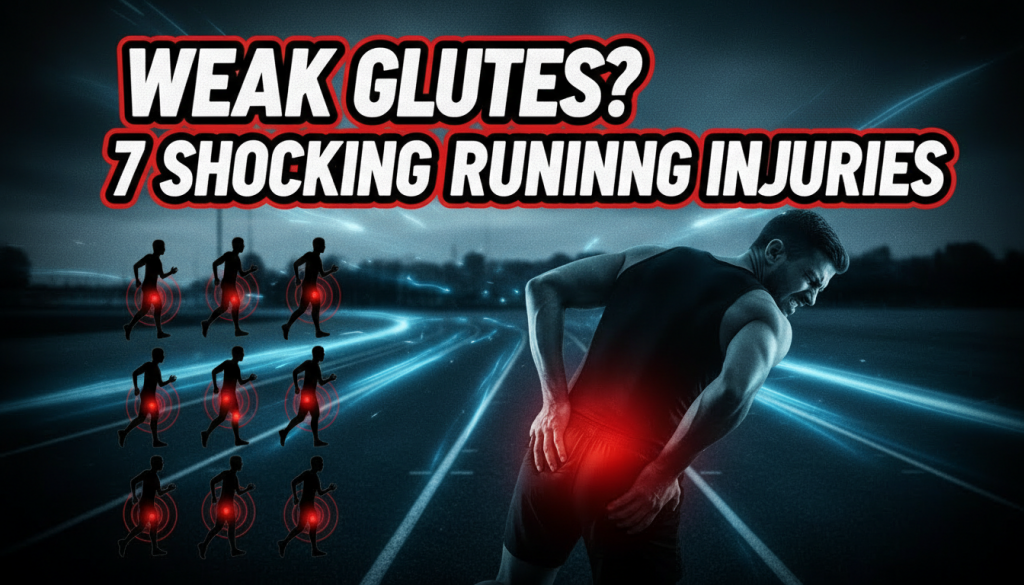
Weak Glutes Lead Shocking, is weak Glutes Lead Shocking breakdowns in your running form, and over time that can turn into a perfect storm of injuries. If you’ve ever wondered why nagging pains keep showing up in your knees, hips, or shins even when your shoes, mileage, and watch stats look fine, your glutes are often the missing link.
This article dives deep into how weak glutes quietly destroy your biomechanics and how that leads to seven *specific, proven* running injuries. Whether you’re training for a 5k, chasing a marathon PR, or just love logging daily miles with your favorite running tech, understanding your glutes is one of the most powerful injury‑prevention upgrades you can make. —
## Table of Contents
Why Your Glutes Are the Engine of Your Run
2. How Weak Glutes Change Your Running Biomechanics
3. 7 Proven Injuries Linked to Weak Glutes
– 1. IT Band Syndrome
– 2. Patellofemoral Pain (Runner’s Knee)
– 3. Medial Tibial Stress Syndrome (Shin Splints)
– 4. (Signs of weak glutes)
Why Your Glutes Are the Engine of Your Run
Your glutes (gluteus maximus, medius, and minimus) are the most powerful muscles in your running stride. They extend your hip, stabilize your pelvis, and control how your leg tracks with every foot strike. When they’re strong and firing well, your stride looks smooth, economical, and resilient.
When they’re weak, everything else must pick up the slack—hamstrings, quads, calves, low back, even the small stabilizers around your knee and ankle. That’s where the cascade begins: Weak Glutes Lead Shocking changes in your movement pattern that you can’t always feel until something hurts.
Think of your glutes as your prime movers and shock absorbers. If they fail, the “impact” debt gets paid elsewhere in your body.
—
How Weak Glutes Change Your Running Biomechanics
Weak glutes don’t just mean you can’t squat heavy. They alter your entire running gait. Here’s what typically happens when glute strength and control are poor:
– Increased hip drop (Trendelenburg sign): Your pelvis drops on the opposite side when you’re on one leg.
– Knee collapsing inward (valgus): The thigh rotates internally and the knee dives in.
– Overstriding: You land with your foot too far in front because you’re not propelling effectively behind.
– Quad and calf dominance: These muscles overwork to compensate for lazy glutes.
– Reduced hip extension: Your leg never gets fully behind you, shortening your stride.
These mechanical changes increase joint stress and tissue strain at very specific sites. That’s why Weak Glutes Lead Shocking clusters of injuries that look unrelated at first—but share the same root cause.
—
7 Proven Injuries Weak Glutes Cause in Runners
Many studies in sports medicine and biomechanics link poor hip and glute strength to common overuse injuries in runners. Below are the seven biggest culprits and how glute weakness drives each one.
—
1. IT Band Syndrome: Why Your Outer Knee Is Screaming
IT band syndrome (ITBS) is one of the most studied injuries related to glute weakness, especially in distance runners.
What it is:
Pain on the outside (lateral) part of your knee, often sharp or burning, sometimes radiating up the thigh. It usually worsens with downhill running or repeated knee flexion.
How Weak Glutes Lead Shocking IT Band Stress
The IT band is a thick band of fascia running from your hip to your shin. It’s anchored to the gluteus maximus and tensor fasciae latae (TFL). When your glute medius and maximus are weak:
– Your hip drops excessively on landing.
– Your thigh internally rotates and your knee collapses inward.
– The IT band rubs and compresses over the lateral femoral condyle at the knee.
Over thousands of steps, that friction becomes inflammation and pain. Runners often treat ITBS locally with foam rolling or massage but ignore the hip. Until you restore glute strength and control, ITBS will keep returning whenever you bump up mileage.
Key glute focus for ITBS:
– Glute medius (side hip stabilizer)
– Glute maximus (hip extension and rotational control)
—
2. Patellofemoral Pain (Runner’s Knee): The Front-of-Knee Trap
Patellofemoral pain syndrome (PFPS), sometimes called runner’s knee, is pain around or behind the kneecap.
What it is:
Diffuse ache around the front of your knee, worse with stairs, squats, downhill running, or sitting for a long time with the knee bent.
How Weak Glutes Lead Shocking Load on the Kneecap
Your kneecap sits in a groove and glides as your knee bends and straightens. For that glide to be smooth, your thigh must track straight. When your glutes are weak:
– Your thigh rotates inward with each step.
– Your knee falls into valgus (inward collapse).
– The kneecap is pulled slightly off track, increasing pressure on cartilage.
This misalignment amplifies stress on the patellofemoral joint, especially when you stack volume or speed sessions. Strengthening the glutes helps keep the knee centered, reducing compressive forces.
Key glute focus for PFPS:
– Glute medius for knee alignment
– Glute max for powerful, balanced hip extension
—
3. Medial Tibial Stress Syndrome (Shin Splints): Not Just a Foot Problem
Most runners see shin splints as purely a lower-leg issue, but the chain usually starts higher.
What it is:
Pain along the inner border of the shin, especially early in runs or after increasing mileage or intensity.
How Weak Glutes Lead Shocking Stress Down Your Shin
When your glutes can’t control hip and pelvis position:
– You may overstride and heel strike heavily in front of your body.
– Your foot lands with poor alignment, often in excessive pronation.
– The muscles and fascia along the inside of your shin work overtime to control that motion.
The tibia (shin bone) is subjected to repetitive bending and torsional forces. Initially that’s “just” shin splints; if ignored, it can progress toward stress reactions or even stress fractures.
Key glute focus for shin splints:
– Glute medius for controlling hip drop and pronation chain
– Glute max to reduce overstriding via better propulsion
—
4. Plantar Fasciitis: Where Foot Pain Starts at the Hip
Plantar fasciitis is inflammation or degeneration of the fascia on the bottom of your foot.
What it is:
Sharp, often stabbing heel pain, worst with the first steps in the morning or after sitting.
How Weak Glutes Lead Shocking Overload of the Plantar Fascia
When the hips are unstable:
– The leg rotates irregularly on landing.
– The foot is forced to compensate by pronating excessively or erratically.
– The plantar fascia repeatedly stretches and loads under poor alignment.
Add speed work or hill training to that unstable chain and the plantar fascia bears more and more repetitive strain. Addressing only the foot (orthotics, massage) without hip control often leads to partial, temporary relief at best.
Key glute focus for plantar fasciitis:
– Lateral hip strength to reduce chaotic rotational forces
– Strong hip extension to reduce braking forces at the foot
—
5. Hip Bursitis & Lateral Hip Pain: When the Side of Your Hip Burns
Lateral hip pain and bursitis (often involving the greater trochanteric bursa) are strongly linked to poor hip mechanics.
What it is:
Pain on the outside of the hip, worse with lying on that side, climbing stairs, or longer runs.
How Weak Glutes Lead Shocking Compression at the Hip
When the glute medius is weak:
– Your pelvis drops more on the opposite side when running.
– The IT band and TFL tighten to stabilize what the glutes aren’t stabilizing.
– That tight band compresses the bursa and tissues over the outer hip bone.
This is sometimes misdiagnosed or self-labeled as “hip IT band pain,” but the root is nearly always a glute stability problem, not just tightness.
Key glute focus for lateral hip pain:
– Glute medius endurance in single-leg stance
– Balance work under running‑like conditions
—
6. Hamstring Tendinopathy & High Hamstring Pain: The Back-of-Thigh Slow Burn
Hamstring issues, especially high hamstring tendinopathy near the sit bone, are common in distance and speed-focused runners.
What it is:
Deep ache at the top of the hamstring, often at the lower glute fold, worse when accelerating, running uphill, or sitting long.
How Weak Glutes Lead Shocking Overuse of Your Hamstrings
Your glute max is supposed to be the main hip extensor. When it is weak or underactive:
– The hamstrings take over hip extension duties.
– They work harder in late swing and early stance phases of running.
– Over time, the tendon at the top of the hamstring becomes overloaded.
This is especially problematic when runners add sprints or hill intervals without a glute strength base. The hamstrings are forced into a job they’re not meant to handle alone.
Key glute focus for hamstring issues:
– Glute max strength and activation
– Hip extension patterns that clearly separate glute vs. hamstring work
—
7. Low Back Pain in Runners: When Your Spine Becomes the Escape Valve
Low back pain is often brushed off as “normal” in runners, but it’s usually a compensation signal.
What it is:
Dull ache or tightness in the lumbar area, sometimes spreading into the glute region, worse after long runs or after increasing mileage.
How Weak Glutes Lead Shocking Strain on Your Spine
When your glutes fail to produce enough hip extension:
– You substitute lumbar extension (arching your back) to drive the leg behind.
– The small spinal stabilizers fatigue and tighten.
– Discs and facet joints absorb forces your hips should handle.
You may also over-rotate your torso to compensate for weak hip drive, layering additional torsional stress on the spine.
Key glute focus for low back pain:
– Glute max for powerful, hip‑driven propulsion
– Core + glute coordination to share load properly
—
7 Warning Signs Your Glutes Are Weak (Even If You’re “Fit”)
You can be fast, lean, and strong in the gym while still having glutes that underperform in running. Watch for these:
1. Visible hip drop in photos or video of your run.
2. Knees collapsing inward during squats, lunges, or landing.
3. One-sided nagging injuries that keep switching locations.
4. Feeling runs in your quads and calves only, not in your backside.
5. Struggling with hills despite good cardio fitness.
6. Difficulty balancing on one leg while staying aligned.
7. Tight IT band or outer hip that always needs rolling.
If several of these describe you, Weak Glutes Lead Shocking inefficiencies in your stride that are likely wasting energy and pushing you toward injury.
—
Simple At‑Home Glute Strength Tests for Runners
You don’t need a lab to get a basic check on glute function. Try these:
1. Single-Leg Bridge Test
– Lie on your back, one knee bent, other leg straight.
– Lift your hips by pressing through the bent leg.
– Hold for 30 seconds.
Watch for: hamstring cramping, pelvis dropping, or inability to hold position. Those suggest your glute max is weak or not firing well.
2. Single-Leg Squat to Chair
– Stand on one leg in front of a chair.
– Slowly sit down and stand back up, maintaining control.
Watch for: knee collapsing inward, hips shifting, or wobbling. That points to glute medius weakness.
3. Side-Lying Hip Abduction Reps
– Lie on your side, bottom leg bent, top leg straight.
– Lift the top leg 18–24 inches, foot neutral.
– Do as many clean reps as possible.
If you fatigue under 15–20 quality reps per side, or your hip flexors (front of hip) burn more than your side glute, you likely lack glute medius endurance.
—
How to Fix Weak Glutes: Evidence‑Based Strength Plan
You don’t need hours in the gym. You need *targeted*, progressive, running‑specific glute work 2–3 times per week. Below is a simple framework.
### Phase 1: Activation and Basic Strength (2–4 Weeks)
Goal: Get your glutes actually working and connected to your brain.
Key Exercises
1. Glute Bridges (2–3 sets x 12–15 reps)
– Squeeze glutes at the top; don’t arch your back.
– Progress to single-leg bridges when easy.
2. Clamshells with Mini-Band (2–3 sets x 15–20 reps)
– Band just above knees.
– Keep hips stacked; move from the hip, not the feet.
3. Side-Lying Hip Abduction (2–3 sets x 12–15 reps)
– Focus on slow, controlled lifts.
– No swinging or twisting the pelvis.
4. Hip Hinge Pattern (2–3 sets x 10–12 reps)
– Practice bodyweight Romanian deadlift movement.
– Push hips back, keep spine neutral, feel stretch in hamstrings and load in glutes.
### Phase 2: Functional Strength (3–6+ Weeks)
Goal: Build strength in positions closer to running—single-leg, upright, dynamic.
Key Exercises
1. Bulgarian Split Squats (3 sets x 8–12 reps per leg)
– Rear foot elevated, torso slightly forward.
– Feel glutes and quads share the work.
2. Single-Leg Romanian Deadlift (3 sets x 8–10 reps)
– Hold a dumbbell or kettlebell.
– Keep hips level, reach back with the free leg.
3. Lateral Band Walks (2–3 sets x 10–15 steps each way)
– Band around ankles or just above knees.
– Slight squat, step out sideways, don’t let feet snap together.
4. Step-Ups (3 sets x 10–12 reps per leg)
– Use a bench or stable box.
– Drive through the working leg, control the descent.
### Phase 3: Plyometrics and Running‑Specific Power (Optional but Powerful)
For experienced runners free of acute pain.
Key Exercises
1. Bounding (2–4 x 20–30 meters)
– Focus on hip drive and glute power.
– Keep landings controlled, not heavy.
2. Single-Leg Hops (2–3 sets x 8–10 hops per leg)
– Small, quick hops emphasizing stiffness and alignment.
– Land soft with stacked hip–knee–ankle.
3. Box Jumps (2–3 sets x 5–8 reps)
– Choose a moderate box height.
– Focus on quality landings, knees tracking over toes.
—
Integrating Glute Training Into Your Running Week
To actually prevent injury, glute work needs a regular place in your schedule.
Basic Template
– 2–3 days/week of glute and hip strength.
– 15–30 minutes per session, paired with easy runs or as standalone.
– Keep heavy/plyometric work away from your highest-intensity run days.
Sample Week for a 10–30 mile Runner
– Monday: Easy run + Phase 1/2 glute routine
– Wednesday: Tempo or interval session
– Thursday: Short recovery run + light glute work
– Saturday: Long run
– Sunday: Optional easy run or cross‑training + mobility
If you’re training with a structured plan—for example a dedicated 10k or half marathon cycle—drop glute strength on days when your legs already feel beat up and prioritize quality over quantity. Two smart sessions consistently beat five random sessions for results.
—
Using Data, Apps, and Wearables to Protect Your Glutes
Modern running tech can help you see when Weak Glutes Lead Shocking form breakdowns before they become injuries.
Metrics to Watch (If Available on Your Watch or App)
– Ground contact time balance: Big left-right differences can signal asymmetrical glute strength.
– Vertical oscillation: Excessive bounce may indicate poor hip drive and control.
– Cadence: Very low cadence can accompany overstriding linked to weak hip extension.
– Pace vs. effort drift: If pace drops dramatically while heart rate stays high in longer runs, fatigue in hip stabilizers may be part of the issue.
Apps with adaptive or form‑aware training can help you integrate strength and recovery intelligently. For a deep dive into how smart planning can reduce injuries, see Why Adaptive Plans Protect: 7 Essential, Proven Runner Benefits and apply those ideas to your own schedule.
—
Shoes, Surface, and Form: Supporting Stronger Glutes
Strong glutes are the core solution, but gear and surface choices matter.
### Shoes
– Choose shoes that match your biomechanics and training volume.
– Excessively soft or unstable shoes can hide, not fix, poor hip control.
– When rotating into new models (especially maximalist or plated shoes), ease in gradually so your hips and glutes adapt, not just your feet and calves.
If you like deep dives into models and tech, gear guides like The Best Hoka Running Shoes in 2025 can help you match your shoe choice to your stride and surface.
### Running Surface
– Constantly cambered roads can amplify hip and knee asymmetries.
– Mix surfaces (trail, track, treadmill, flat road) to vary loading patterns.
– Be especially careful adding downhill volume, which stresses already overworked stabilizers if glutes are weak.
### Form Tweaks that Reinforce Glute Use
– Slight forward lean from the ankles, not the waist.
– Focus on driving the ground *back* rather than reaching forward.
– Think “push behind” instead of “reach in front.”
– Keep knees tracking over the middle of the foot.
Form cues should be gentle and occasional. Let strength and stability lead, technique follow.
—
FAQ: Weak Glutes, Pace, and Running Performance
Does this only matter if I’m injured?
No. Even if you’re pain‑free, glute weakness can waste energy and limit speed, particularly late in races or long runs. Fixing it often improves pace at the same heart rate.
Can running itself strengthen my glutes?
To a point. Hills and strides help, but if your body has learned to run with quad/calf dominance, you’ll just reinforce that pattern. You still need targeted strength work to rebalance.
How long until I notice a difference?
Many runners feel better stability and less “sloppiness” in 3–4 weeks. Significant strength and durability changes usually appear over 8–12 weeks of consistent training.
What if strength work makes me sore for runs?
Reduce load, volume, or frequency. Place hardest strength on your easier run days, not right before key workouts. Start light; progress gradually.
Is it ever *not* about the glutes?
Injuries are multi-factorial: training load errors, sleep, nutrition, footwear, and previous injuries all matter. But hip and glute strength is one of the most fixable and impactful variables you control.
—
Key Takeaways: Don’t Let Weak Glutes Lead Shocking Setbacks
– Your glutes are central to hip stability, knee alignment, and efficient propulsion.
– When they underperform, Weak Glutes Lead Shocking chains of compensation that drive seven common running injuries: ITBS, runner’s knee, shin splints, plantar fasciitis, hip bursitis, hamstring tendinopathy, and low back pain.
– You can spot potential issues with simple at‑home tests and running video.
– 2–3 focused sessions per week of progressive glute strength can dramatically reduce injury risk and improve performance.
– Use your tech, training plan, and gear to support—not replace—good biomechanics.
For runners serious about performance, injury prevention is performance. Build your glutes like you build your mileage, and you don’t just avoid time off—you unlock a smoother, more economical stride that carries you further, faster, and with fewer aches along the way.