
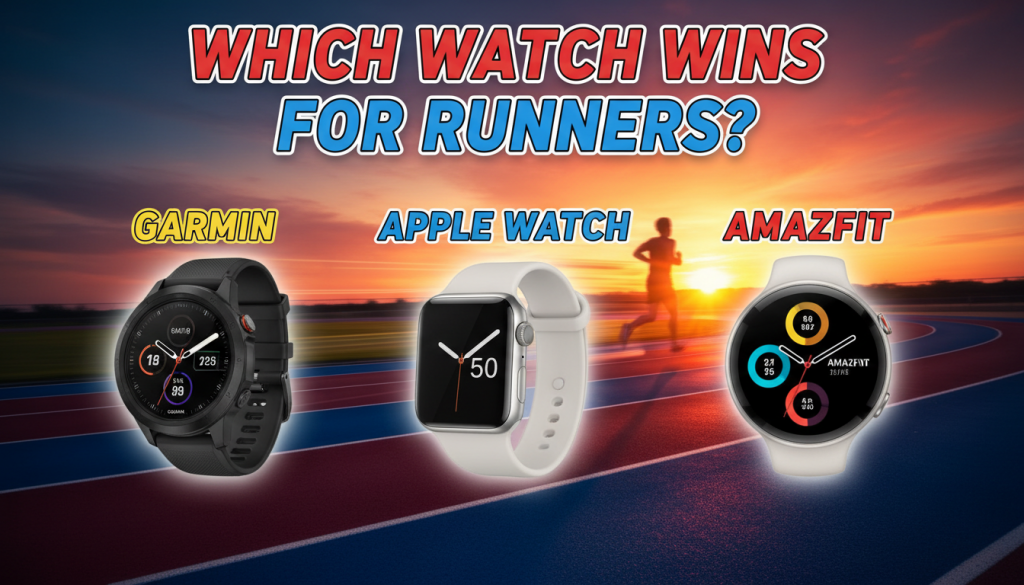
When you’re chasing a PR or just trying to stay consistent, your watch becomes a training partner. With new launches, software updates, and big discounts landing this week, many runners are asking a timely question: Garmin, Apple Amazfit: Which ecosystem actually gives you the best value and performance right now?
In the last few days alone we’ve seen Amazfit launch two premium GPS watches aimed squarely at Garmin, Apple unveil watchOS 27 with smarter running tools, Apple quietly drop support for several current Watch models, and Amazon roll out steep Prime Day–style discounts on top Garmin devices.
This running‑news blog breaks down what all of that means for your training—and which watch might be the smarter choice for your next race block.
Table of Contents
- The 2026 Running Watch Landscape: Garmin vs Apple vs Amazfit
- Amazfit Balance Ultra & Balance 3: Affordable Garmin Killers?
- watchOS 27: How Apple Just Made the Apple Watch Better for Runners
- Apple Drops Support for 5 Watch Models: What It Means for Runners
- Prime Day Garmin Deals: Best Time in 2026 to Upgrade?
- Garmin, Apple or Amazfit: Which Watch Wins for Different Types of Runners?
- Turn Watch Data Into Real Gains: Training Tips and Tools
- Conclusion & Call to Action
The 2026 Running Watch Landscape: Garmin vs Apple vs Amazfit
The battle of Garmin, Apple or Amazfit: Which brand best serves runners has never been closer. Each ecosystem is pushing in different directions:
- Garmin remains the performance and battery‑life king, especially for marathoners and ultra‑runners.
- Apple is leveraging AI and software polish with watchOS 27 to make the Watch a more serious training tool.
- Amazfit is undercutting on price while adding high‑end features usually reserved for Garmins that cost twice as much.
For runners, that competition is good news: more accurate GPS, better training features, and lower prices. The challenge is decoding which watch ecosystem actually fits your goals and budget.
Amazfit Balance Ultra & Balance 3: Affordable Garmin Killers?
What Amazfit Just Announced
On June 15, Amazfit unveiled the Balance Ultra and Balance 3, two premium sports‑oriented smartwatches clearly aimed at rivals like the Garmin Fenix and Forerunner series.
Key specs and features include:
- Titanium cases and sapphire glass for durability
- Dual‑band GPS for improved accuracy in cities and forests
- Offline maps for navigation without a phone
- Long battery life (multi‑day, depending on mode)
- Running on Zepp OS 6
- Native integrations with Strava, TrainingPeaks, Komoot, adidas Running, Intervals.icu, and more
These are exactly the features Garmin has used for years to justify premium prices. Amazfit is bringing them down to a more accessible tier.
Why This Matters to Runners
For runners comparing Garmin, Apple or Amazfit: Which offers the strongest performance‑to‑price ratio, these new watches are a big deal.
Dual‑band GPS means:
- More accurate pace and distance in urban canyons
- Better tracks on twisty trails and under tree cover
- Less “GPS wobble” on straight roads
Offline maps and navigation are huge for trail runners and marathon build‑ups on new routes. You can pre‑load a course and follow it without constantly checking your phone.
And the third‑party integrations matter if you’re serious about coaching and analytics. Being able to sync directly to TrainingPeaks or Intervals.icu puts Amazfit on the radar for data‑driven athletes.
How Amazfit Stacks Up Against Garmin and Apple
In the discussion of Garmin, Apple or Amazfit: Which is best overall, Amazfit’s new releases change the mid‑range calculus:
- Vs Garmin: Similar hardware (dual‑band GPS, offline maps, rugged build) at typically lower prices, but Garmin still leads in mature training metrics, course creation, and depth of running modes.
- Vs Apple: Amazfit wins on battery life and multi‑day GPS use; Apple wins on app ecosystem, smartwatch features, and tight integration with the iPhone.
If you’re a value‑focused runner who wants “Garmin‑like” hardware without paying full Garmin prices, these Amazfit models suddenly look compelling.
watchOS 27: How Apple Just Made the Apple Watch Better for Runners
New Running‑Relevant Features in watchOS 27
At WWDC 2026 (June 8), Apple unveiled watchOS 27, and several changes directly target runners:
- Workout Buddy upgrades, now working offline and available in Spanish
- More accurate indoor run and walk tracking via improved motion algorithms
- Better route mapping for outdoor runs
- Enhanced sleep tracking and more consistent step sync between Health and Fitness apps
- AI‑powered enhancements through upgraded Siri and on‑device intelligence (on supported models)
Apple may not market itself as a “running brand” like Garmin, but watchOS 27 is a significant step toward making the Apple Watch a more serious training tool.
Workout Buddy: Smarter Motivation on the Wrist
The offline improvements to Workout Buddy are quietly important. Runners can now get:
- Real‑time motivation prompts without carrying an iPhone
- Spanish‑language support for bilingual or Spanish‑speaking runners
- More autonomy on long runs, track sessions, or races where phones aren’t allowed or practical
This pushes Apple deeper into the realm of in‑the‑moment coaching rather than just post‑run analysis, making the Apple Watch more relevant when comparing Garmin, Apple or Amazfit: Which gives the best live guidance.
Indoor and Route Tracking: Better Data for Everyday Training
For many runners, treadmill and indoor track runs are a weekly staple. watchOS 27’s improved motion algorithms should mean:
- More realistic indoor pacing and distance
- Less guesswork moving between treadmill and outdoor training
Enhanced route mapping also matters for post‑run analysis—especially if you’re using your runs to gauge consistency on key routes, monitor efforts across hills, or compare segments.
Sleep Tracking and Recovery
watchOS 27 is also tightening up sleep data and syncing between the Health and Fitness apps. For runners, this touches one of the most overlooked performance levers: recovery.
Monitoring sleep stages and duration in a more consistent way can help you:
- Spot patterns before burnout hits
- Time hard workouts after better sleep nights
- Adjust volume during high‑stress weeks
If you’re using structured plans or adaptive systems, better sleep data feeds into smarter training choices. For context on how recovery and adaptation tie together, you can dig into How Adaptive Training Helps 5 Proven Safe Mileage Gains. (Garmin vs Apple Watch)
Apple Drops Support for 5 Watch Models: What It Means for Runners
The Controversial Compatibility News
On June 9, reporting highlighted that five current‑generation Apple Watch models, including some Ultra and SE variants, will not support watchOS 27.
Those watches will miss out on:
- The newest AI‑powered features
- The advanced Siri integration
- Some of the more sophisticated workout enhancements (depending on model)
This effectively makes several still‑current devices feel obsolete much sooner than many buyers expected.
Implications for Runners
For runners deciding between Garmin, Apple or Amazfit: Which brand to invest in, Apple’s move raises questions about long‑term value.
- If you bought an Apple Watch recently, you may be locked out of watchOS 27’s top features.
- Coaching apps and running platforms may increasingly build around AI‑enhanced tools that your device can’t access.
- Resale value and perceived lifespan of your watch may drop more quickly.
In contrast, Garmin and Amazfit typically support their devices with firmware and feature updates for longer periods, even if they’re not as flashy as Apple’s yearly OS revamps.
Upgrade or Hold?
If your Apple Watch is on the compatibility chopping block, you now have a decision:
- Stay put and accept a “frozen” feature set, but still benefit from solid base tracking.
- Upgrade within Apple to a watchOS 27‑ready model to stay in the ecosystem and leverage new AI features.
- Jump to Garmin or Amazfit if multi‑year training stability and battery life matter more than iOS integration.
This news may push performance‑oriented runners to ask again: for the next 3–5 years, Garmin, Apple or Amazfit: Which brand will likely deliver the best combination of features, support, and value?
Prime Day Garmin Deals: Best Time in 2026 to Upgrade?
Up to 50% Off: What’s on the Table?
With Amazon’s Prime Day event (June 23–26) looming, early deals have already gone live offering up to 50% off select Garmin GPS watches, including:
- Fenix series (rugged, multi‑sport workhorses)
- Venu line (AMOLED screens, lifestyle‑plus‑fitness)
- Forerunner models (run‑focused, lighter designs)
For runners who’ve been eyeing a Garmin but hesitant due to price, this could be the best window this year to buy.
Why the Deals Matter for Runners
Garmin watches are often the default pick when someone asks, “For serious training, Garmin, Apple or Amazfit: Which should I get?” The hurdle is usually cost.
These pre‑Prime Day discounts change that equation by offering:
- Flagship features (dual‑band GPS, advanced performance metrics, long battery) at mid‑range prices
- Older but still excellent models at entry‑level price points
- An opportunity to upgrade from a basic tracker or older Forerunner without over‑spending
If you plan to race a fall marathon or a late‑summer half, a June upgrade gives you months to dial in your data screens, training paces, and comfort with the device.
What Type of Garmin to Look For
Broadly, runners can think in three tiers:
- Forerunner: Best for road runners, track athletes, and those focused primarily on running metrics.
- Fenix / Epix: Ideal for trail runners, mountain athletes, and multi‑sport users wanting maps, navigation, and rugged builds.
- Venu: For runners who also want a vibrant screen, lifestyle features, and casual daily wear appeal.
If you’re unsure how to decide between AMOLED screens and classic MIP displays—or if dual‑band GPS is worth the jump—this fits perfectly with the guidance in Should You Upgrade Your Running Watch for AMOLED and Smarter GPS?.
Garmin, Apple or Amazfit: Which Watch Wins for Different Types of Runners?
Key Criteria for Runners
To answer the question of Garmin, Apple or Amazfit: Which is “best,” you need to define “best” for your use case. Consider:
- Battery life (daily runs vs ultras)
- GPS accuracy (city vs trail vs treadmill)
- Training tools (VO2 max, training load, adaptive workouts)
- Smartwatch features (apps, notifications, payments, ecosystem)
- Budget and expected lifespan
For Data‑Obsessed Road and Marathon Runners
If your calendar revolves around half and full marathons, you’re building training blocks, and analyzing performance trends, then in the comparison of Garmin, Apple or Amazfit: Which to trust with your peak race prep, Garmin still has an edge.
Why? (Amazfit vs Garmin running)
- Rich performance metrics (training load, recovery time, HRV status)
- Custom workout creation and deep interval programming
- Long battery life across hard training weeks
Pair a Garmin with a well‑designed plan and fueling strategy—like the strategies outlined in Advanced Fuel Timing for 7 Proven, Powerful Marathon PRs—and you have a powerful race‑day combo.
For Everyday Runners Who Live on iPhone
If you’re already locked into the Apple ecosystem and value smartwatch features as much as pure running metrics, then in the debate of Garmin, Apple or Amazfit: Which offers the best all‑round experience, Apple Watch with watchOS 27 becomes very compelling—assuming you own a compatible model.
- Excellent app ecosystem and integration with Apple Health
- Workout Buddy for coaching‑like encouragement
- Improved indoor and route tracking for mixed training
- Strong notifications, music, and everyday usability
If you plan to use Apple Health data alongside running apps, see also How to Use Apple Health: 7 Powerful, Proven Running App Tips for getting more from that ecosystem.
For Budget‑Conscious Runners Who Want High‑End Features
For runners comparing Garmin, Apple or Amazfit: Which delivers the most tech per dollar, the new Amazfit Balance Ultra and Balance 3 may be the sweet spot.
- Dual‑band GPS and offline maps at lower prices than comparable Garmin models
- Lightweight but durable titanium and sapphire builds
- Solid battery life and growing training ecosystem
They’re especially attractive if:
- You already use third‑party platforms like Strava, Komoot, or TrainingPeaks
- You want accurate tracking and navigation but don’t need the very deepest performance metrics
- You’re willing to live outside the Apple and Garmin “walled gardens”
For Trail and Ultra Runners
When it comes to off‑road, long‑duration runs, the question of Garmin, Apple or Amazfit: Which handles 10–20‑hour events without sweating is often answered by Garmin first, with Amazfit now entering the chat.
- Garmin’s Fenix/Epix series: robust maps, excellent battery, advanced navigation tools.
- Amazfit Balance Ultra: promising hardware spec with dual‑band GPS and offline maps at a friendlier price.
- Apple Watch: still limited by battery for very long trail races, unless you heavily manage power modes.
If you race 50Ks or 100Ks, battery and mapping reliability often outweigh smartwatch convenience, tilting the scales away from Apple.
Turn Watch Data Into Real Gains: Training Tips and Tools
Your Watch Is Only as Good as Your Plan
Whether you land on Garmin, Apple or Amazfit: Which device you strap on, the real performance gains come from how you use the data.
Key principles:
- Use heart rate and pace to keep easy runs truly easy.
- Track weekly mileage trends to avoid big jumps in volume.
- Leverage GPS data to monitor progress on repeat routes and workouts.
Adaptive training systems that react to your actual sessions, not just a static schedule, can make all three ecosystems more powerful.
Adaptive and Real‑Time Feedback
Modern watches and training apps can adjust based on:
- Completed mileage vs planned
- Heart rate trends and fatigue signals
- Sleep and recovery data
Using an ecosystem or platform that reads your real performance and modifies your plan can mean the difference between steady progress and burnout.
Look for training tools that integrate smoothly with your chosen watch, offer clear guidance on easy vs hard days, and help you interpret metrics rather than just dumping numbers on you.
Match the Watch to the Goal
To make the most of your decision between Garmin, Apple or Amazfit: Which platform to train with, align watch choice with specific racing goals:
- 5K/10K speed focus: Any brand works—lean toward Apple for smartwatch features, Garmin for precision intervals, or Amazfit for value.
- Half/full marathon: Battery life, training load metrics, and reliable GPS matter—Garmin or Amazfit stand out here, with Apple closing the gap via watchOS 27.
- Trail and ultras: Prioritize battery, navigation, and ruggedness—Garmin first, Amazfit as the budget contender.
Conclusion & Call to Action
The running‑tech news of the past week reshapes the answer to Garmin, Apple or Amazfit: Which watch wins for runners right now:
- Garmin stays on top for serious performance tracking and endurance use, especially with Prime Day discounts easing the price barrier.
- Apple becomes a more credible training tool with watchOS 27, but the compatibility cuts may frustrate recent buyers.
- Amazfit has stepped up with the Balance Ultra and Balance 3, offering high‑end hardware at aggressive prices that challenge Garmin in the mid‑range.
Your best choice depends on your goals, budget, and ecosystem. Decide what matters most—battery, data depth, smart features, or cost—and pick the watch that aligns with the way you actually train.
Once you’ve chosen your side in the Garmin, Apple or Amazfit: Which battle, the next step is making the most of it with smart training, fueling, and recovery strategies. Explore training resources, structured plans, and tools that plug into your chosen device so every run moves you closer to your next PR.