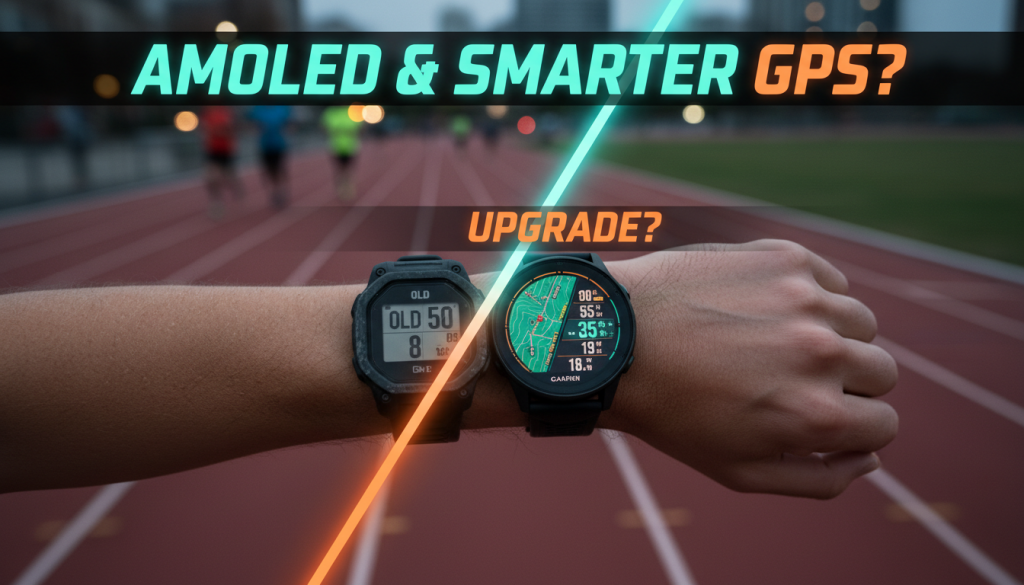
If you’ve been wondering whether now is the time to upgrade your running watch, the past week of tech news just tipped the scales. From Garmin’s new AMOLED Forerunners to smarter navigation fixes and Apple’s satellite‑ready Ultra 3, the running watch landscape is shifting fast—and in ways that directly affect your training, safety, and race‑day confidence.
This running news blog pulls together the most important developments from the last seven days and helps you decide if you should upgrade your running watch now or wait for the next cycle.
Table of Contents
- Why Now Might Be the Moment to Upgrade Your Running Watch
- Garmin Fixes a Major Navigation Headache on Flagship Watches
- Forerunner 70 & 170: AMOLED for Everyone and the Full Physio Stack
- Forerunner 570 vs Apple Watch Ultra 3: Why Metrics Matter More Than Just Pace
- Fenix 8’s Big Discount: High-End Endurance Value in 2026
- Apple Watch Ultra 3: Satellite, Safety, and Serious Training
- AMOLED vs MIP, Battery Life, and Real-World Visibility
- How to Decide: A Practical Upgrade Checklist for Runners
- Conclusion: Should You Upgrade Your Running Watch Right Now?
Why Now Might Be the Moment to Upgrade Your Running Watch
For years, the advice was simple: keep your watch until the battery dies or the strap cracks. But 2026 is different. If you upgrade your running watch now, you’re not just getting a prettier screen—you’re stepping into smarter GPS routing, safety features like satellite SOS, and advanced training metrics once reserved for elites.
The big story this week is convergence: entry‑level devices now have pro‑level analytics, while premium models are gaining serious navigation fixes and outdoor capabilities. Whether you’re targeting a new 10k PR or an ultra, your next upgrade can directly change how you train, not just how your wrist looks.
Garmin Fixes a Major Navigation Headache on Flagship Watches
What Garmin Just Fixed (and Why It Matters)
On May 11, 2026, Garmin released beta software version 22.29 for its top‑end outdoor line: Fenix 8, Enduro 3, Quatix 8, and Fenix 8 Pro/MicroLED. Hidden inside the release notes is a fix for one of the most frustrating issues trail and ultra runners have faced: navigation sessions abruptly ending after GPS loss or route recalculation.
Previously, if you ducked under trees, through a tunnel, or took a wrong turn and triggered a reroute, your navigation could stop entirely. In city marathons or mountain ultras, that’s more than annoying—it’s a safety and performance problem.
How the Navigation Fix Changes Real Runs
This update makes navigation more “sticky”: your route should keep running even if your watch momentarily loses signal or needs to recalculate. For runners who frequently follow GPX routes, this reduces the mental overhead of constantly checking if the watch is still navigating.
If you’re running technical trails or exploring new urban routes, this alone could justify staying in the Garmin ecosystem when you upgrade your running watch. Stability matters more than another new metric when you’re tired, lost, and low on daylight.
Should You Upgrade Your Running Watch Just for This Fix?
- Already own a Fenix 8 / Enduro 3 / related model? Install the beta (or wait for stable) and you’re set—no need to upgrade yet.
- On an older Fenix / Forerunner without this fix? If navigation is central to your running (long mountains, multi‑day adventures), this may be one of the strongest arguments to upgrade your running watch in 2026.
Combined with features like ClimbPro, multi‑band GPS, and robust mapping, Garmin just tightened its grip on the serious navigation niche.
Forerunner 70 & 170: AMOLED for Everyone and the Full Physio Stack
Garmin Drops the Old Screens and the Old Price Point
The headline from May 12, 2026: Garmin has launched the Forerunner 70 (~$249.99/£219.99) and Forerunner 170 (~$299.99/£259.99), and in doing so, it quietly exited the under‑$240/£200 market. More importantly, every 2026 Forerunner now ships with an AMOLED display instead of the older MIP screens.
If you upgrade your running watch from an older Forerunner or Fenix, the difference in clarity, color, and glanceability is immediate. Bright pace fields, sharp heart‑rate graphs, and maps you can actually read mid‑interval are now standard, even at the “entry” level.
Full Physio Stack on Entry-Level Watches
The real surprise isn’t the screen, though—it’s the brain. Both the Forerunner 70 and 170 get Garmin’s full “physio stack,” including:
- Training Readiness – Uses sleep, HRV, load, and recovery to tell you how prepared you are to train.
- HRV Status – Tracks long‑term autonomic stress and adaptation.
- Training Load / Load Focus – Helps balance low‑intensity base work with threshold and VO₂ sessions.
- Trail VO₂ Max – Adjusts for trail conditions to avoid underestimating your fitness.
These tools used to require higher‑tier models. Now, a runner buying their first watch can get guidance that aligns closely with principles of consistency‑based training and progressive overload, instead of guesswork.
What This Means for Budget-Conscious Runners
If you’re on an older basic watch that only shows pace, distance, and a recovery advisor, upgrading to the Forerunner 70/170 is a qualitative jump, not a minor spec bump. You’ll have enough data to:
- Plan smarter easy days vs. hard days with Training Readiness.
- Track whether you’re accumulating sustainable training load.
- Avoid overtraining before key races like your next half marathon or 10k.
In other words, you can upgrade your running watch and, at the same time, upgrade your entire approach to structuring training cycles without hiring a coach.
Forerunner 570 vs Apple Watch Ultra 3: Why Metrics Matter More Than Just Pace
The 5K Test: Pace Parity, Insight Disparity
Tom’s Guide recently pitted the Garmin Forerunner 570 against the Apple Watch Ultra 3 in a 5K head‑to‑head. Both devices reported nearly identical pace data—a result that should reassure anyone worried about GPS accuracy in modern premium watches.
The real difference emerged after the finish line. Garmin’s additional insights—especially exercise load and vertical ratio—made the workout analysis much more actionable for performance‑driven runners.
Why Training Load and Biomechanics Matter
Exercise load quantifies how hard a session is on your aerobic system, while vertical ratio helps you evaluate running economy by comparing your vertical oscillation to stride length. Taken together, they provide critical feedback for:
- Balancing hard workouts across a week or block.
- Improving form efficiency, especially at race pace.
- Spotting early signs of overreaching or poor recovery.
Pair this with guidance from resources on fixing common form issues—like these essential running form mistakes and fixes—and you start turning numbers into actual performance gains.
Should You Upgrade Your Running Watch for Metrics Alone?
If you already own a modern GPS watch with basic pace and heart‑rate, the question is whether advanced metrics will change your behavior. You should consider upgrading your running watch if: (Best running watches guide)
- You’re plateaued at current race distances (5K–half marathon).
- You’re training more than four days per week and want better load management.
- You’re experimenting with form cues, cadence, or stride changes.
In those cases, richer metrics can help translate your training intent into measurable execution. Otherwise, you risk either under‑training or repeating the same training mistakes without realizing it.
Fenix 8’s Big Discount: High-End Endurance Value in 2026
$250 Off a Premium Outdoor Watch
The Garmin Fenix 8—47mm, rugged, loaded with mapping and multi‑band GPS—just got a rare price cut on Amazon, dropping by about $250 to $749.99 (~25% off). That’s still premium territory, but it shifts the value equation for serious outdoor and ultra runners.
If you upgrade your running watch to a Fenix 8, you’re buying more than a nicer screen. You’re investing in:
- Excellent battery life for ultra‑distance events.
- Robust mapping and navigation features.
- A durable build that can survive years of trail abuse.
Who Actually Needs a Fenix 8 in 2026?
The discount makes sense if you:
- Regularly run long trail races (50K, 50‑mile, 100K) or mountain ultras.
- Train outdoors in tough weather where durability and battery trump slim design.
- Use multisport features (trail running, hiking, ski touring, cycling) in one device.
If your main focus is road 10K or half marathon races, a Forerunner series watch will cover almost everything you need at a lower price and with a lighter feel. But if you’re expanding into ultras, this discount is a strong nudge to upgrade your running watch into the Fenix category while the price dip lasts.
Apple Watch Ultra 3: Satellite, Safety, and Serious Training
Apple’s Top Watch Is Now a Legit Adventure Tool
TechRadar’s 2026 Apple Watch roundup crowned the Apple Watch Ultra 3 as the best overall model, and not just for iPhone power users. For runners, three aspects stand out:
- Satellite connectivity for Emergency SOS and Find My.
- Brighter display with strong outdoor visibility.
- Battery life up to ~42 hours (even more in low‑power modes).
The Ultra 3 also posts heart‑rate accuracy within ~1 bpm of a chest strap in many tests, which is impressive for wrist‑based sensors.
Why Satellite Matters for Runners
Satellite connectivity is still rare in wearables, but it’s a huge step forward for runners training in remote or mountainous areas without cell coverage. If you upgrade your running watch to the Ultra 3, you’re not just getting a training tool; you’re gaining a safety device that can call for help well beyond LTE range.
Combine that with blood oxygen and elevation data—especially useful for altitude adaptation and long climbs—and you’re looking at an all‑in‑one adventure companion. For more detail on leveraging Apple’s ecosystem for training, see how features like blood oxygen can boost your runs at both sea level and altitude.
Ultra 3 vs Garmin: It’s About Ecosystem, Not Just Features
In 2026, the Apple vs Garmin choice is less about which is “more accurate” and more about what ecosystem you want around your data and training. If you live inside Apple’s fitness and health stack and value daily smart features as much as running metrics, upgrading your running watch to the Ultra 3 is an easy justification.
Runners deeply invested in Garmin Connect, advanced metrics, and long‑event battery life may still lean Garmin. But the gap is narrower than ever, and Apple is clearly targeting serious endurance athletes, not just casual activity trackers.
AMOLED vs MIP, Battery Life, and Real-World Visibility
The Great Screen Shift: What You Actually Gain
One of the clearest trends this week is Garmin’s full jump to AMOLED in the Forerunner lineup. The practical question: should you upgrade your running watch purely for an AMOLED screen?
AMOLED brings:
- Higher contrast, deeper blacks, and more readable maps.
- Better data legibility at a glance, especially in dark early‑morning runs.
- More attractive watch faces and widgets you’re more likely to use off‑run.
MIP (memory‑in‑pixel) displays, long beloved for outdoor visibility and battery efficiency, are now increasingly limited to specific rugged or budget lines.
Battery vs Brightness: Trade-Offs in 2026
Historically, AMOLED meant worse battery. But with optimized software and smarter power management, the gap is much smaller. When you upgrade your running watch, you should ask: (Coros Pace 4 upgrade review)
- Do you frequently run multi‑hour sessions (3h+) without access to charging?
- Do you race ultras or multi‑day events where every hour of battery counts?
- Do you prioritize screen readability at all times of day over absolute runtime?
For most road runners training up to marathon distance, modern AMOLED watches offer plenty of battery. Only dedicated ultra and expedition athletes still truly “need” MIP‑style efficiency.
Smarter GPS and Navigation Stability
The navigation fix on Garmin’s flagship line and continued improvements in multi‑band GPS are also central to this decision. If your current watch frequently produces zig‑zag routes, inaccurate distances, or route dropouts in cities and forests, that’s a tangible performance hit—especially when you’re training with tight pace bands.
Upgrading your running watch in 2026 often means stepping into:
- Multi‑band GNSS for improved accuracy in urban canyons and under trees.
- Better route following with fewer dropouts (as seen in the 22.29 Garmin beta).
- More stable distance and pace, which improves workout structure and race‑day execution.
How to Decide: A Practical Upgrade Checklist for Runners
1. What Problem Are You Trying to Solve?
Before you upgrade your running watch, define the primary issue that’s limiting your running right now:
- Poor GPS accuracy in city or trail environments?
- Lack of training guidance (load, readiness, recovery insights)?
- Insufficient battery for your longest runs or races?
- No safety features like incident detection or satellite SOS?
- Data overload without meaningful analysis?
Your answer should guide whether you look at an AMOLED Forerunner, a Fenix/Enduro, or an Apple Watch Ultra 3—or whether you instead need better training structure and social support rather than new hardware.
2. Match Watch Tier to Training Style
Rough guide for 2026:
- New or returning runners (2–4 runs/week): Forerunner 70 / 170 class. Focus on building habits, using Training Readiness and simple workouts.
- Intermediate road runners chasing PBs at 10K–half marathon: Forerunner 270/570, or Ultra 3 if you want Apple’s ecosystem. Prioritize structured training and detailed post‑run analysis.
- Trail / ultra runners: Fenix 8, Enduro 3, or Ultra 3 depending on platform preference and battery requirements.
Whatever you choose, the real power comes from how you use the data. Pair your device with a strong data environment—like the setups in the best data platforms for powerful runner setups—and your upgrade will have a much bigger impact.
3. Consider How You’ll Train, Not Just What You’ll Wear
It’s easy to upgrade your running watch and then train exactly as before. To avoid that trap, decide now how your new device will change your behavior:
- Will you finally stick to easy paces on recovery days?
- Will you schedule structured intervals based on training load, not mood?
- Will you adapt your plan if your Training Readiness is low for several days?
Align your new watch with a smarter approach to consistency and recovery. For social runners, combining data with community support—like the ideas in these social running tips—can make your watch upgrade a genuine lifestyle shift, not just a tech refresh.
4. Timing Your Upgrade Around Your Race Calendar
Don’t switch platforms or radically new watch models right before an A‑race. Ideally, you should:
- Upgrade your running watch at least 8–12 weeks before a goal race.
- Use a full training block to learn metrics, alerts, and battery behavior.
- Test navigation and safety features on your longest training sessions.
This gives you time to adjust to new data fields, refine screens for race day, and ensure there are no surprises mid‑marathon or in the last hours of an ultra.
Conclusion: Should You Upgrade Your Running Watch Right Now?
In 2026, upgrading your running watch is no longer a vanity move. The past week of news makes it clear that:
- Navigation is getting more reliable on top‑end Garmins.
- Entry‑level Forerunners now offer AMOLED screens and full physio stacks.
- Advanced metrics like training load and vertical ratio can meaningfully improve training efficiency.
- Premium devices like the Fenix 8 and Apple Watch Ultra 3 bring serious battery, safety, and outdoor capabilities.
You should upgrade your running watch if your current device is limiting your training insight, navigation reliability, or safety—especially if you’re pushing toward longer distances or performance goals. But the upgrade only pays off if you also commit to using the new data to guide smarter, more consistent training.
Next step: decide what you’re training for and how your watch will support that goal. If you’re targeting performance at specific distances, explore structured resources like a dedicated 10k focus or other distance‑specific plans, then choose the watch that best powers that journey. Make 2026 the year you don’t just run more—you run smarter.