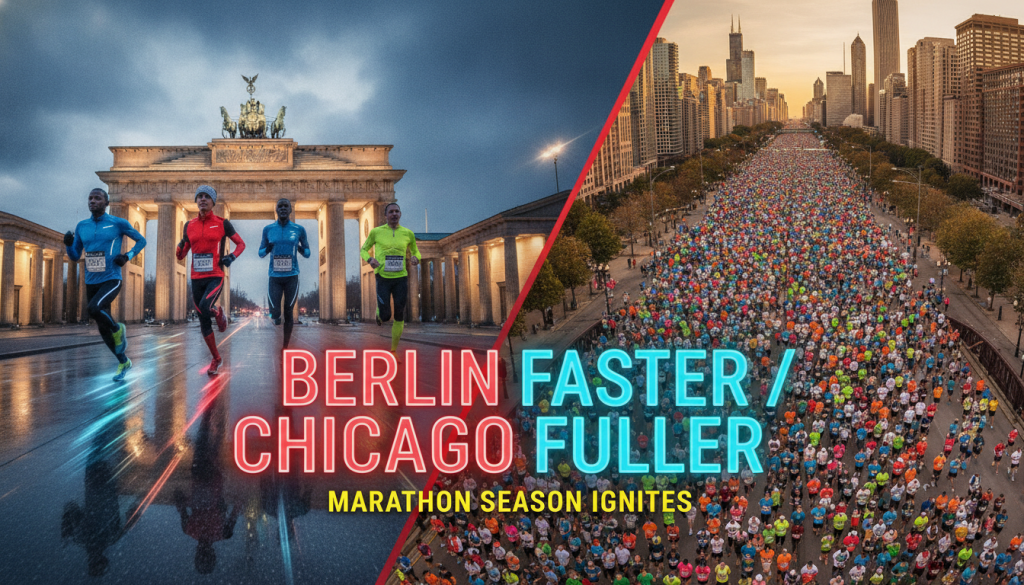
The phrase “Berlin Gets Faster, Chicago Gets Fuller” perfectly captures how the next marathon season is shaping up. One city is pushing the frontiers of human speed, while another is opening its streets to record-breaking crowds. Add Boston’s smart new crowd-management strategies, and you have a season that’s redefining what major marathons look and feel like for every level of runner.
Table of Contents
- Berlin Gets Faster: Sawe Returns to the Record Factory
- Sawe’s Sub‑2 Legacy and What It Means for Berlin 2026
- How Everyday Runners Can Train for Berlin-Level Speed
- Chicago Gets Fuller: The People’s Major Expands
- Understanding Chicago’s New Qualification Standards
- Training and Race-Strategy Tips for a Crowded Chicago
- Boston’s Crowd-Science Revolution
- What Runners Can Learn from Boston’s Logistics Makeover
- Gear, Fueling, and Tech for the New Era of Big-City Marathons
- Conclusion & Call to Action
Berlin Gets Faster: Sawe Returns to the Record Factory
When you hear “Berlin Gets Faster, Chicago” in the same breath, the “Berlin” part is easy to understand. The BMW Berlin Marathon has long been known as the world’s fastest marathon course, and 2026 is shaping up to reinforce that reputation.
On May 13, 2026, World Athletics confirmed that world record-holder Sabastian Sawe will return to Berlin on September 27 to defend his title. Sawe shocked the world by running an officially recognized sub‑2 marathon in London earlier this year, clocking 1:59:30 at the 2026 London Marathon.
Now, he’s heading back to the flat, wind-sheltered streets of Berlin—the site of so many previous world records—with both the title and another historic performance on the line.
The Stakes for Berlin 2026
Sawe isn’t just coming back as a former champion; he’s coming back as the man who shattered one of the sport’s biggest psychological barriers. His presence instantly raises the stakes for the entire elite field.
- Record pressure: Berlin’s history of world records means every split will be watched with suspicion that another global mark could fall.
- Pacing tactics: Expect a carefully structured pace team designed to keep Sawe on an aggressive but controlled schedule.
- Depth of field: Other elites will see Berlin 2026 as a rare chance to line up against the current benchmark of marathon running.
For spectators and age-groupers, this is the kind of storyline that transforms an already iconic race into a once-in-a-generation spectacle.
Berlin’s History as the Marathon Laboratory
Even before “Berlin Gets Faster, Chicago Gets Fuller” became a fitting headline, Berlin was where marathon limits got rewritten. Multiple men’s world records have fallen here over the last two decades, thanks to:
- Minimal sharp turns and an almost entirely flat profile.
- Typically cool late-September temperatures.
- Deep pacing teams and world-class race organization.
Sawe’s return underscores Berlin’s role as a testing ground for the future of the marathon, just as his London performance marked a turning point for what’s possible in real-world race conditions. For context on that historic London run, see London Shatters Limits: Sub‑2 Marathon and New WR Announced.
Sawe’s Sub‑2 Legacy and What It Means for Berlin 2026
Sawe’s 1:59:30 in London wasn’t just another world record—it was a line in the sand. A sub‑2 marathon, run in a major city race with standard conditions, changes the psychology of distance running.
Why the London Record Changes Berlin’s Dynamics
When a barrier like two hours falls, the effect is contagious. For Berlin 2026, that means:
- More aggressive racing: Elites may be more willing to go out fast, knowing sub‑2 is no longer theoretical.
- Different risk calculus: Coaches and agents might encourage riskier splits in hopes of massive payoffs.
- Elevated expectations: Fans and media will frame Berlin 2026 around whether Sawe can improve his own record.
Even if conditions on the day aren’t perfect, the mindset shift alone matters. Once one person breaks through, others often follow—and Berlin is the prime venue to do it.
What This Means for Age-Group Runners
While most runners won’t be targeting sub‑2, Sawe’s London-Berlin double has a real impact on everyday athletes:
- Motivation: Witnessing another giant leap in performance can be the push some runners need to finally chase a Boston, Berlin, or Chicago qualifying time.
- Technology and preparation: The methods and tools used by elites—super shoes, advanced fueling strategies, real-time pacing—tend to trickle down quickly.
- Race-day pacing guides: Expect more precise race calculators and pacing plans tuned to fast courses like Berlin.
In this sense, “Berlin Gets Faster, Chicago Gets Fuller” is more than a slogan. It’s a snapshot of how elite performances and inclusive policies are reshaping the sport from the top and bottom simultaneously.
How Everyday Runners Can Train for Berlin-Level Speed
You don’t need to chase a world record to learn from what’s happening in Berlin. If you’re aiming to PR in Berlin—or on any flat, fast course—your training should reflect the demands of sustained, even pacing.
Build a Course-Specific Plan
Berlin’s flats reward runners who can lock into a steady pace and hold it. That means:
- Plenty of marathon-pace workouts on flat terrain.
- Long runs that include extended sections at marathon pace.
- Dress rehearsals with the exact shoes and gels you’ll use on race day.
If you’re combining your race with travel, a Custom Running Plan for 7 Powerful, Proven Travel Runs can help you balance sightseeing, recovery, and peak training so you’re not sacrificing performance for the experience—or vice versa.
Fuel Like the Course Demands
Fast courses like Berlin often produce fast bonks if you don’t respect the distance. You’ll likely be on your feet for anywhere from 2.5 to 6 hours, depending on your pace.
- Practice your carb intake during long runs.
- Learn how much your stomach can tolerate per hour.
- Use the same brands and flavors you’ll have on race day.
To dial in timing and dosage, consider frameworks like those detailed in Advanced Fuel Timing for 7 Proven, Powerful Marathon PRs, then adjust based on your body and goals.
Don’t Forget the Taper
A fast course can only help if you’re fresh. A properly structured taper in the last two to three weeks will sharpen your fitness while allowing fatigue to drop.
- Gradually reduce volume while maintaining some intensity.
- Practice race pace during shorter sessions.
- Use extra time for sleep, mobility, and mental preparation.
In an era where Berlin gets faster, Chicago grows bigger, and Boston gets smarter, taper discipline might be the simplest competitive advantage available to everyday runners.
Chicago Gets Fuller: The People’s Major Expands
If Berlin gets faster, Chicago gets fuller—and that’s official. The 48th Chicago Marathon, scheduled for October 11, 2026, has drawn more than 200,000 applications, a record surge driven largely by changes to qualification standards.
Organizers have reduced automatic qualification times, making one of the World Marathon Majors more accessible than ever. Approximately 53,000 runners are expected to make it to the start line, making this one of the largest marathon fields on the planet.
Why Chicago’s Expansion Matters
Chicago has long billed itself as a runner-friendly major: flat, well-organized, and deeply supported by the city. Now it’s signaling even more clearly that it’s the “people’s major.” (Adios Pro Evo 1 Chicago)
- Accessibility: Softer time standards give more runners a realistic shot at guaranteed entry.
- Diversity of ability: Fields are likely to include more first-timers alongside seasoned Boston and Berlin qualifiers.
- Community impact: More runners translates into more fundraising, more spectators, and larger local economic benefits.
The headline “Berlin Gets Faster, Chicago Gets Fuller” is therefore about inclusivity as much as performance. Success isn’t just measured by records, but by how many people get to experience the magic of 26.2 miles.
Understanding Chicago’s New Qualification Standards
By lowering the bar for automatic qualification, Chicago is offering a middle path between fully open lotteries and very strict time-based entry.
What Lower Standards Actually Do
Reduced time standards don’t mean “easy” so much as “reachable.” For intermediate runners, this changes the long-term planning landscape.
- More attainable goals: You may be able to qualify for Chicago within a season or two, rather than over many years.
- More strategic race choices: Many runners will plan their year around a “qualifier marathon” on a fast course.
- Increased competition: Larger fields make for deeper age-group competition and more pace groups.
Where Berlin gets faster at the sharp end, Chicago gets fuller across the entire field—creating a powerful draw for both aspirational and recreational runners.
Balancing Growth and Experience
Bringing 53,000 runners onto city streets is no small task. For runners, this raises questions:
- Will aid stations be crowded?
- How long will it take to cross the start line?
- Will pace groups be too congested?
The Chicago Marathon’s strong organizational history suggests the race will evolve systems—wave starts, corral enforcement, and improved on-course logistics—to keep pace with demand. Still, as a runner, you’ll need strategies to thrive in such a dense environment.
Training and Race-Strategy Tips for a Crowded Chicago
When Chicago gets fuller, your preparation must account not just for pace and fitness, but also for navigating other runners. Think of it as “performance plus traffic management.”
Train for Start-Line Patience
In a field of over 50,000, the opening miles will rarely feel smooth and open. To prepare:
- Include runs where you deliberately start slower than goal pace, then gradually accelerate.
- Practice weaving and accelerating safely during group runs, without sudden zig-zags.
- Rehearse mental scripts that remind you: “The race starts after 5K, not at the first step.”
This mirrors Boston’s evolution with bigger fields and is part of the broader pattern where Berlin gets faster and Chicago gets fuller, each demanding different skill sets from runners.
Use Tech to Stay on Pace in Crowds
GPS watches and real-time pace alerts are invaluable in crowded races, but you must use them wisely:
- Rely on lap pace (e.g., per kilometer or mile) over instantaneous pace.
- Set alerts to keep you from surging or slowing too much in congested sections.
- Use auto-lap splits and mentally anchor your effort to how they feel.
For help choosing the right device for this kind of environment, see How to Choose the Right Next‑Gen GPS Watch for Your Runs, especially if you’re considering an upgrade ahead of a major like Chicago.
Respect Recovery When Training for Big-City Majors
Larger races often mean heavier training loads as runners zero in on PR attempts. That makes recovery, injury prevention, and consistency more important than ever.
- Increase mileage gradually, especially when building from half-marathon to marathon distance.
- Prioritize at least one full rest day per week.
- Schedule cutback weeks where you reduce volume by 15–25%.
Planning for races where Berlin gets faster and Chicago gets fuller means thinking in seasons, not just weeks. Your body—and your performance—will thank you.
Boston’s Crowd-Science Revolution
While Berlin gets faster at the front and Chicago gets fuller overall, Boston is tackling a different challenge: how to move a massive, tradition-bound race into a more efficient and safer future.
For the 2026 Boston Marathon, organizers brought in a crowd-science expert to help manage a field of over 32,000 runners. The goal: optimize runner flow and safety along the iconic point-to-point course spanning eight Massachusetts towns.
Why Boston Turned to Crowd Science
Boston’s format—narrow roads, historic neighborhoods, and a point-to-point route—creates unique bottlenecks and safety considerations.
- Start-town compression: Hopkinton can feel overwhelmed as waves stack up.
- Narrow sections: Certain early and mid-race segments are prone to congestion.
- Finish-area strain: Downtown Boston must absorb tens of thousands of fatigued runners and spectators.
A crowd scientist analyzes data on density, movement speed, and flow to redesign corral layouts, adjust wave timings, and refine course operations. The outcome: smoother starts, less jostling, safer aid stations, and a more predictable racing environment. (Assefa Berlin marathon shoe)
What This Means for Boston Runners
Runners lining up in Boston can expect:
- More efficient transport and staging processes in the start area.
- Potential tweaks to corral assignments and wave timing.
- Improved signage and on-course communication.
Where Berlin gets faster at the level of seconds per kilometer and Chicago gets fuller by tens of thousands of entries, Boston evolves by making the same 26.2-mile route smoother and safer for everyone who runs it.
What Runners Can Learn from Boston’s Logistics Makeover
Even if you never run Boston, its crowd-management upgrades hold lessons for any big race you enter.
Arrive Early and Move with the System
At huge events, going “against the flow” rarely works. Respect the race’s logistics design:
- Arrive in the start area early enough to navigate security and bag check.
- Follow designated entry points for your corral.
- Use assigned waves and start times rather than trying to sneak into faster corrals.
Big races depend on predictable patterns. When Berlin gets faster, Chicago gets fuller, and Boston gets more scientifically organized, the best thing you can do personally is cooperate with the system.
Safety in Numbers—If You’re Prepared
More runners and better flow can be an advantage if you’re ready for it:
- Study the course map and note narrow sections and turns.
- Know where official aid stations are and have backup fueling if they’re crowded.
- Practice running in groups so you’re comfortable with pack dynamics.
Preparation turns a potentially chaotic mega-event into a controlled, even enjoyable, experience where you can focus on your goal.
Gear, Fueling, and Tech for the New Era of Big-City Marathons
As Berlin gets faster and Chicago gets fuller, gear, fueling, and technology are playing a bigger role than ever for both elites and recreational runners.
Super Shoes and Long-Run Comfort
Carbon-plated shoes and high-stack foams are now standard at the front of the pack and increasingly common in mid-pack fields.
- Use them in at least a few long runs and key workouts to adapt your legs.
- Don’t make marathon day your first outing in a new model.
- Pay attention to fit; long races amplify tiny discomforts.
Dialing in Fueling for PR Efforts
In a world where Berlin gets faster and Chicago gets fuller, running a strong marathon requires precise fueling regardless of pace.
- Plan your carb intake per hour based on body weight and intensity.
- Use a mix of on-course offerings and your own gels or chews.
- Test everything on multiple long runs.
Even small improvements in fueling can translate into minutes saved, especially over the final 10K when most runners fade.
Harnessing Data Without Overthinking
GPS watches, HR monitors, and footpods can turn your race into a real-time lab, but they can also distract.
- Decide in advance which metrics matter: pace, heart rate, or power.
- Set simple alerts to keep you within a sensible effort range.
- Learn to cross-check: how does your perceived exertion match the numbers?
Used well, technology is the bridge between your training and the evolving demands of major marathons as Berlin gets faster, Chicago gets fuller, and Boston gets smarter every year.
Conclusion & Call to Action
“Berlin Gets Faster, Chicago Gets Fuller” isn’t just a catchy headline—it’s a snapshot of a sport in motion.
- Berlin is doubling down on its identity as the world’s speed lab, with Sabastian Sawe returning to chase more history on its famously fast streets.
- Chicago is opening its doors wider than ever, welcoming a record field and redefining what a truly inclusive major looks like.
- Boston is quietly revolutionizing how big races manage crowds, making safety and flow as central as pace and performance.
As a runner, this is your moment. Whether your goal is a PR in Berlin, a first-time finish in a fuller Chicago, or a smooth experience in Boston, the tools and knowledge have never been more accessible.
Start by choosing your target race, then build a course-specific plan, refine your fueling, and commit to consistent, sustainable training. The future of marathoning is being written right now—on the streets of Berlin, Chicago, Boston, and wherever you lace up next.
Ready to turn inspiration into action? Pick your race, map your next 16–20 weeks, and start your build today. The next big performance story might be yours.