
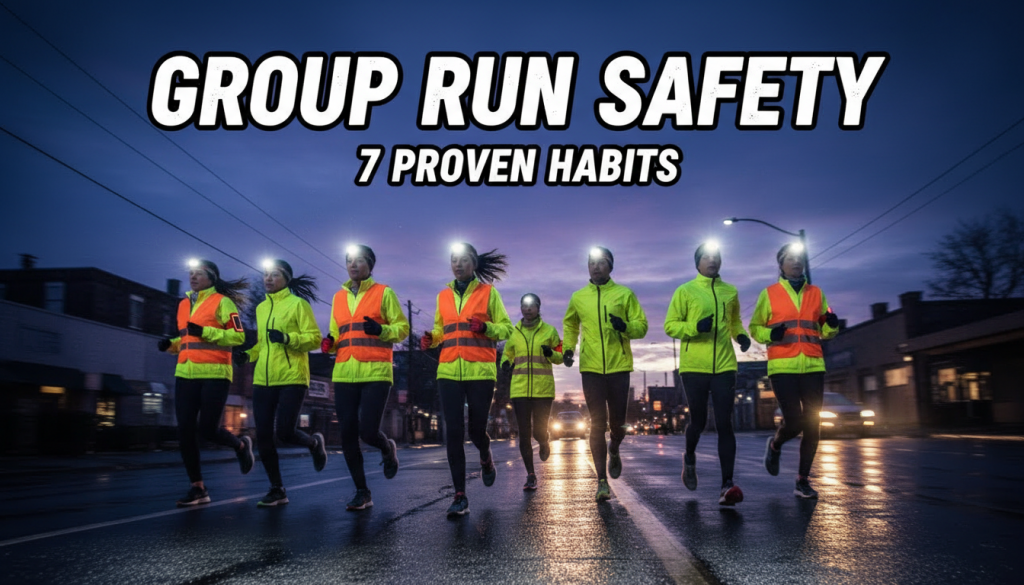
Running with a group can transform your training: you get accountability, motivation, and often faster progress than running alone. But it also introduces new risks and responsibilities. Understanding key Running Group Safety Tips: and turning them into habits is crucial if you want the benefits of group runs without the downsides.
This guide dives deep into seven proven habits that keep you, your group, and everyone around you safe—while still having fun and improving your performance.
—
Table of Contents
- Why Group Safety Matters (Even for Experienced Runners)
- Habit 1 – Plan the Route, Pace, and Roles Before You Run
- Habit 2 – Master Communication Signals and Group Etiquette
- Habit 3 – Use Gear, Wearables, and Tech Intelligently
- Habit 4 – Control the Pack: Formations, Road Rules, and Space
- Habit 5 – Prioritize Visibility and Environmental Awareness
- Habit 6 – Build Medical, Emergency, and ID Readiness
- Habit 7 – Create a Culture of Inclusion, Check-Ins, and Debriefs
- Bonus: Tech-Enabled Safety – Using Apps, Plans, and Real-Time Data
- Final Thoughts: Turn These Tips into Automatic Habits
—
Why Group Safety Matters (Even for Experienced Runners)
Group running feels safer than solo running—but that can be misleading. You have more eyes and support, but also more moving parts: varied paces, different fitness levels, and a larger footprint on roads and trails.
Structured Running Group Safety Tips: don’t just prevent worst-case scenarios. They also:
– Reduce near-misses with cars, cyclists, and other runners.
– Minimize trips, falls, and collisions within the group.
– Protect new runners who may not yet know basic etiquette.
– Keep your club or group welcome in local neighborhoods and parks.
Whether you’re training for a 10k, marathon, or casual weekend runs, safety habits let you focus on performance and camaraderie instead of constant firefighting.
—
Habit 1 – Plan the Route, Pace, and Roles Before You Run
Many group mishaps start before anyone takes a step: vague plans, unclear pace expectations, or routes nobody knows. A few minutes of planning locks in several key Running Group Safety Tips: in one shot.
Define the Route Clearly
Always know:
– Start and end locations.
– Distance and estimated time.
– Key turns, intersections, and tricky sections.
– Bail-out points (places where runners can safely cut the route short).
Share the route in advance via a map link or screenshot. If your group uses GPS watches or apps, encourage everyone to load the route to their devices. This limits confusion when runners get strung out.
Set Pace Expectations and Subgroups
“Easy run” means very different things to different people. Unsafe group runs often happen when slower runners feel forced to hang on and faster runners feel boxed in.
Before you start:
– Announce the intended pace range (e.g., “6:00–6:30 min/km”).
– Create pace subgroups if necessary.
– Appoint a leader for each subgroup.
This keeps people from redlining to stay with the group, a major cause of sudden fatigue, falls, and injuries.
Assign Roles: Leader, Sweeper, and Buddy System
Borrow a page from trail and hiking groups:
– Leader: Knows the route, sets pace, and calls out hazards.
– Sweeper: Runs at the back, making sure no one is left behind.
– Buddy pairs: Everyone has at least one person to communicate with.
A strong sweeper is often the difference between “we lost someone” and “everyone got home safe.”
—
Habit 2 – Master Communication Signals and Group Etiquette
Good communication is the backbone of all Running Group Safety Tips:. Verbal and nonverbal signals prevent pile-ups, trips, and awkward collisions with the environment.
Use Simple, Consistent Verbal Cues
Agree on a small set of standardized calls:
– “Car up / Car back” – Traffic approaching from the front or behind.
– “Bike!” – Cyclist approaching; usually from behind on paths.
– “Stopping!” – Coming to a stop or sudden slowdown.
– “Slowing!” – Reducing pace significantly.
– “Hole / Rock / Branch” – Ground hazard.
– “On your left / On your right” – When passing other trail or path users.
Keep these concise and loud enough to travel down the line. Encourage runners to repeat calls so those farther back get the message.
Hand Signals and Body Language
Verbal calls often get lost in wind, traffic, or busy routes. Supplement with:
– Arm raised: preparing to stop or slow.
– Hand pointing down at the ground: hazard at your feet.
– Hand sweeping to the side: move to that side of the path or road.
– Two fingers pointing to eyes then ahead: “look up, pay attention.”
Teach these signals to new members explicitly. Don’t assume everyone “just knows.”
Etiquette: Don’t Be “That” Group
Your group shares space with walkers, cyclists, dogs, and kids. Show respect:
– Run no more than two abreast on narrow paths.
– Single-file when paths are busy, in blind corners, or on roads.
– Yield space politely; thank people who make room.
– Keep conversations and music volume considerate.
Groups with good etiquette are welcome in more places and face fewer complaints, which keeps your training options open.
—
Habit 3 – Use Gear, Wearables, and Tech Intelligently
Modern runners have powerful tools—GPS watches, smart safety features, live tracking, and performance analytics. Used correctly, tech can supercharge your Running Group Safety Tips:; used poorly, it can distract or give a false sense of security.
Leverage GPS Tracking and Live Location
Encourage group members to:
– Share live location with a trusted contact for long or remote runs.
– Use group tracking features where available.
– Save emergency contacts in their devices.
If your group often runs with different paces or complex routes, live tracking gives peace of mind if someone gets separated or cut off at a traffic light.
Optimize Watch and App Settings for Safety
Many wearables now include:
– Fall detection or incident detection.
– SOS/emergency calling.
– Low-battery alerts.
– Route guidance and back-to-start navigation.
Before long group runs, check that watches are charged and properly set up. If you rely on an Apple Watch, correct calibration improves distance and pacing, which matters when groups plan exact turnaround points. Learning How to Calibrate Apple Watch: 5 Proven Tips for Amazing Runs can reduce discrepancies that might split your group unintentionally.
Use Audio Safely: Hear the World Around You
Headphones in a group can be risky:
– You may miss verbal calls or signals.
– You react more slowly to traffic or cyclists.
– You disconnect from the group dynamic.
Safer options:
– Bone conduction or open-ear buds.
– One ear only at low volume.
– “No music” rules in high-risk sections (busy roads, dark trails).
Agree as a group where full awareness is mandatory.
Tech for Coaching and Pacing
Safety also includes training safety—avoiding overexertion, dehydration, or late-run collapses. Dynamic training plans and real-time guidance can smooth out effort across a group.
If your club trains with structured workouts, consider using an AI Dynamic Plan to balance intensity, recovery, and individual needs. When runners follow appropriate pacing for their current fitness, you dramatically cut the risk of mid-run blowups or injuries that endanger the whole group.
—
Habit 4 – Control the Pack: Formations, Road Rules, and Space
How your group physically moves through space is one of the most critical Running Group Safety Tips:. Formations and positioning can turn a chaotic pack into a predictable, low-risk unit.
Choose the Right Formation for the Situation
Common, practical formations:
Side-by-side pairs
– Great for conversation on wide paths.
– Still leaves room for others to pass.
– Instantly switch to single-file in crowded or narrow sections.
Single-file
– Mandatory on:
– Narrow trails.
– Busy bike paths.
– Roads with no sidewalk or shoulder.
– Reduces the risk of forcing cars or bikes into unsafe maneuvers.
Compact pack with gaps
– For larger groups (10+ runners).
– Break into small pods with a few meters between pods.
– Reduces footprint and makes it easier for traffic to pass safely.
Road Running: Direction and Positioning
If you must run on the road:
– Run facing traffic (where local laws allow).
– Keep as far left (or as designated in your country) as safely possible.
– Use sidewalks where available, even if they’re not perfect.
Group leaders should:
– Anticipate blind corners, narrow sections, or parked cars.
– Call for single-file early, not at the last second.
– Cross at well-lit, visible points—even if it adds a few seconds.
Crossing Intersections as a Group
Intersections are high-risk moments:
– Never assume cars see the whole group.
– Do not “block” intersections as lights change.
– Cross only if everyone can realistically make it.
Practical rules:
– “Green now or we wait” policy: don’t sprint through at the last second.
– Leaders and sweepers communicate: if the group splits, both halves stop and regroup soon after.
Trail Running: Adaptation and Terrain Awareness
On trails, Running Group Safety Tips: need even more nuance:
– Downhills: space out to avoid collisions.
– Technical sections: slow down, allow walking.
– Stream crossings or obstacles: one at a time, wait for “clear” calls.
Remember that on many trail systems, uphill runners yield to downhill runners or vice versa—check local norms and share them with your group.
—
Habit 5 – Prioritize Visibility and Environmental Awareness
Many group runs happen early in the morning or after work, when light and visibility are poor. Additional environmental factors—heat, cold, wet roads—multiply risks.
Be Seen: Clothing, Lights, and Reflective Gear
For low-light runs:
– Use headlamps or chest lights to see and be seen.
– Rear-facing red lights for the last runner(s) in the group.
– Reflective vests or bands for everyone, especially near roads.
– Bright, contrasting colors instead of all-black kits.
Visibility is not just about cars; cyclists and other runners need to see you too. Studies consistently show that multiple points of small reflectors (ankles, wrists, torso) are more visible than one big reflective panel.
Environmental Scanning: Not Just the Ground
Many falls happen because runners stare at their feet. Train yourself to scan:
– 3–5 meters ahead for terrain changes.
– Side streets and driveways for emerging cars.
– Overhanging branches or signs at head height.
Leaders can periodically call out upcoming features: “Sharp right in 100 meters,” “Uneven pavement ahead,” “Steep downhill coming.”
Weather-Specific Strategies
Heat:
– Encourage lighter clothing, hats, and sunglasses.
– Shorten routes or add water stops in heat waves.
– Watch for signs of heat illness (confusion, stop sweating, chills).
Cold:
– Layer properly, with moisture-wicking base layers.
– Avoid long stops in the cold—keep moving after regrouping.
– Recognize early signs of hypothermia or frostbite in others.
Rain or Snow:
– Slippery surfaces demand shorter strides and slower pace.
– Puddles can hide potholes—treat them cautiously.
– Extra caution for painted crosswalks, metal grates, and bridges.
Environmental awareness isn’t just individual; it’s a constant, group-wide responsibility.
—
Habit 6 – Build Medical, Emergency, and ID Readiness
Preparedness is one of the most underappreciated Running Group Safety Tips:. Most runs will be uneventful—but your planning pays off on the day something goes wrong.
Collect Key Info (Without Being Creepy)
For regular groups or clubs, keep a simple, secure record:
– Emergency contact name and phone.
– Known medical conditions (e.g., asthma, diabetes).
– Allergies, especially to medications.
– Medications carried (like inhalers or EpiPens).
You can do this with a simple opt-in form. Explain clearly why you’re collecting it and how it will be used.
Use Visible ID and Contact Info on the Run
Encourage runners to:
– Wear ID bracelets with name, contact, and any critical conditions.
– Use shoe tags or wristbands with emergency info.
– Add “ICE” (In Case of Emergency) contacts in their phones, and label appropriately.
If a runner is separated or loses consciousness, visible ID dramatically speeds up effective help.
Basic First Aid Knowledge and Kit
At least leaders and sweepers should know:
– CPR basics.
– How to recognize signs of stroke, heart attack, or severe allergic reactions.
– How to manage minor cuts, scrapes, or sprains.
A minimal first aid kit that someone carries or leaves in a nearby car can include:
– Bandages and blister plasters.
– Antiseptic wipes.
– Elastic wrap.
– Emergency blanket for cold environments.
Even urban groups benefit from having a designated first-aid resource.
Clear Emergency Protocols
When something serious happens:
– One person stays with the injured runner.
– Another calls emergency services with a precise location.
– Others may direct responders or go to meet them.
Predefine:
– Who calls emergency services?
– How does the group notify the rest of the pack?
– Does the rest of the group continue, cut the run short, or assemble at a known point?
Practice running through a hypothetical scenario at least once or twice a year. It feels awkward—but pays off massively if needed.
—
Habit 7 – Create a Culture of Inclusion, Check-Ins, and Debriefs
The best Running Group Safety Tips: aren’t only about rules; they’re about culture. You want a group where people feel comfortable speaking up—about pace, route changes, or when something feels off.
Normalize “No Heroics” and Honest Check-Ins
Encourage runners to say:
– “This pace is too fast for me today.”
– “I’m not comfortable with that dark section alone.”
– “I need to stop and walk for a minute.”
Leaders should:
– Ask at regular intervals: “Everyone ok with the pace?”
– Be ready to split the group or adjust when someone is struggling.
A culture that punishes honesty will end up with hidden problems—overexertion, dehydration, or runners secretly dropping off the back.
Buddy Checks and Count-Offs
Simple habits:
– Count off before departure and after major intersections or route changes.
– Use buddy pairs to ensure no one disappears unnoticed.
– At meeting points, confirm everyone who started is accounted for—no assumptions.
For larger clubs, you may assign small pods of 4–8 people that always check on each other.
Post-Run Debriefs: Improve Every Week
After group runs, ask:
– Did we have any close calls today?
– Was any section confusing or risky?
– Did we lose anyone or overly stretch the group?
Take feedback seriously:
– Adjust routes to avoid dangerous intersections.
– Change meeting points for better lighting.
– Modify start times for better visibility or temperature.
Over time, this continuous improvement approach makes your safety habits automatic and robust.
Welcome and Educate New Runners
New members won’t know your systems unless you teach them:
– Provide a short “orientation” before they join their first group run.
– Share a written summary of your core Running Group Safety Tips:.
– Pair them with a more experienced runner for their first few sessions.
New runners trying to go from casual walking to consistent training have unique needs. Pointing them to structured resources like How to Go From Walking to Running: 7 Proven, Powerful Steps can help them build enough base fitness to participate safely in group runs.
—
Bonus: Tech-Enabled Safety – Using Apps, Plans, and Real-Time Data
Modern running technology can be a powerful ally in implementing your Running Group Safety Tips:. When used with intention, it supports better pacing, safer routes, and smarter training decisions.
Real-Time Pacing and Heart Rate Control
Many groups push too hard on “easy days,” which increases injury risk and burnout. Real-time feedback from wearables can:
– Keep easy days truly easy.
– Prevent novice runners from being pulled into paces they can’t handle.
– Ensure interval or tempo sessions are executed within safe effort ranges.
If your group uses an app or watch that supports structured workouts, you can program sessions in advance so everyone knows the intervals, recoveries, and intended effort.
Adaptive Training Across the Group
Not every runner should be doing the same workload. Personalized planning can:
– Reduce overuse injuries.
– Help runners progress at appropriate rates.
– Keep people from ramping intensity suddenly because of peer pressure.
Tools like an 10K Training Plan With 7 Proven, Powerful Recovery Secrets can be adapted to individuals within your group. When each runner follows a plan that respects their recovery and background, group sessions become safer by default.
Route Planning with Data
Apps and mapping tools can highlight:
– Traffic patterns and safer crossings.
– Well-lit vs. poorly lit areas.
– Elevation profiles to avoid overly steep descents on icy days.
Leaders should use analytics after runs:
– Where did pace spike or slow dramatically?
– Where did GPS scatter indicate underpasses or signal loss?
– Were there frequent stops at certain intersections?
Refining routes using this data further supports your overall safety strategy.
Event and Race Preparation as a Group
Many running groups form around race preparation. Safe group training:
– Reduces the risk of overtraining and pre-race injuries.
– Keeps long runs controlled, with planned nutrition and hydration.
– Ensures the group respects taper periods and recovery needs.
When you blend smart planning, technology, and culture, race build-ups become both more effective and safer for everyone.
—
Final Thoughts: Turn These Tips into Automatic Habits
The best Running Group Safety Tips: are the ones you don’t have to think about—they’re built into how your group runs every single time.
To embed these seven essential habits:
1. Document your safety standards. Create a short, clear guideline for your group.
2. Teach and repeat. Go over key points with new members and remind regulars periodically.
3. Lead by example. Group leaders must model the behaviors they expect.
4. Adjust over time. Use feedback, data, and experience to refine routes, rules, and roles.
A safe group is a sustainable group. When runners trust the environment, they show up consistently, push themselves appropriately, and stick with the sport for years. That’s where the real progress—fitness, friendships, and performance—happens.
If your group wants to take structure and safety even further, consider combining a clear safety framework with a personalized training system, like a Custom Plan that accounts for each runner’s fitness level, schedule, and recovery patterns. The more intentional you are with how you train together, the safer—and more successful—your group runs will become.