
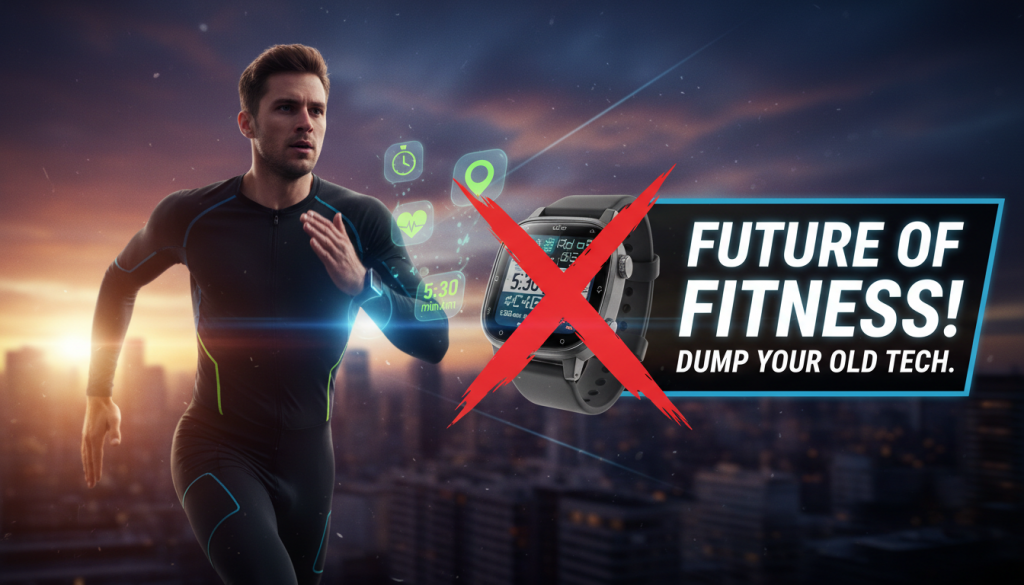
The phrase “Screenless Fitness Bands Future” sounds like a marketing slogan, but over the last week it has become a very real question for runners. With Garmin and Fitbit both moving toward display‑free wearables—while Amazfit and AGM double down on high‑value GPS watches—the next generation of running tech is being pulled in two opposite directions: more screen, or no screen at all.
This running news blog pulls together four key stories from the last seven days and asks what they really mean for your training, your data, and your long‑term running goals.
Table of Contents
- The New Split in Running Tech: Max Screens vs No Screens
- Garmin CIRQA: Garmin’s First Big Bet on Screenless Bands
- Fitbit’s Screenless Comeback: Steph Curry and a Return to Roots
- Amazfit Active Max: High‑End GPS Power at $169
- AGM Legion Pro: Sub‑$100 Rugged GPS for Outdoor Runners
- Screenless Fitness Bands Future: Where Do Runners Actually Benefit?
- Practical Recommendations: Which Device Fits Your Run?
- Conclusion & Call to Action
The New Split in Running Tech: Max Screens vs No Screens
In just a few days, the running‑tech landscape has split into two visible camps. On one side: bright, map‑heavy, smartwatch‑style GPS watches like the Amazfit Active Max and AGM Legion Pro. On the other: quiet, almost invisible screenless bands, with Garmin CIRQA and a new Fitbit tracker hinting that the Screenless Fitness Bands Future might be more than a niche trend.
For runners, this isn’t just a fashion choice. It’s about how often you look at your wrist, how much you rely on real‑time pace, and whether your wearable helps you focus—or constantly distracts you. The big story is that all four of these products target different solutions to the same problem: better training decisions with less friction.
Garmin CIRQA: Garmin’s First Big Bet on Screenless Bands
What We Know So Far
Garmin has filed a trademark for “CIRQA” with the U.S. Patent and Trademark Office (February 25), and reporting from TechRadar on April 10 strongly suggests it will be a screenless, Whoop‑style fitness band. There’s no official spec sheet yet, but the branding and leaks point clearly to a stripped‑back wrist device focused on performance and recovery metrics without an on‑device display.
If that sounds familiar, it’s because Whoop 5.0 and Amazfit’s Helio Strap already occupy this display‑free space. Garmin joining them is a strong signal that the Screenless Fitness Bands Future is not an experiment—it’s a serious new product category.
Why CIRQA Matters for Runners
Garmin’s ecosystem already dominates serious running with the Forerunner and Fenix lines. CIRQA, however, looks aimed at a different use case:
- Minimal weight and bulk for long runs and races.
- Continuous wear for round‑the‑clock HRV, sleep, and recovery data.
- No beeps, no alerts, no doomscrolling mid‑tempo run.
For runners who already log structured workouts with a primary GPS watch, a screenless band like CIRQA could become the always‑on body sensor that feeds deeper insights into readiness, fatigue, and long‑term load—while a separate device (or phone) handles real‑time pace and navigation.
That’s where the Screenless Fitness Bands Future gets interesting: instead of “one giant watch that does everything,” Garmin seems to be exploring “one small band that knows your body, plus whatever screen you prefer.”
How CIRQA Could Fit Into Real Training
Imagine using CIRQA in tandem with your main GPS watch:
- Wear CIRQA 24/7 for HRV, sleep staging, and recovery scores.
- On run days, pair its data with a watch or app that adjusts your plan—easing off intervals if your recovery is poor.
- During runs, ditch needless notifications and focus on feel, only checking splits when it actually matters.
Used this way, a band like CIRQA complements modern adaptive training tools that tweak volume and intensity day by day. If you’re curious how that approach works in practice, it’s worth reading about how adaptive training prevents workload spikes and why that matters for injury prevention.
Fitbit’s Screenless Comeback: Steph Curry and a Return to Roots
The Steph Curry Teaser and What It Signals
On April 13, TechRadar reported that Google/Fitbit dropped a teaser video featuring Steph Curry wearing a conspicuously screenless wristband. No display, no obvious smartwatch UI—just a clean band that screams “fitness tracker” in the old‑school sense.
Fitbit built its brand on near‑invisible pedometers and slim trackers, then spent years chasing full‑blown smartwatch glory. The new teaser signals a pivot: if the Screenless Fitness Bands Future is real, Fitbit wants to reclaim its original territory.
Why a Screenless Fitbit Could Be a Big Deal for Runners
Runners have long had a love‑hate relationship with Fitbit. Step counts and sleep metrics were handy, but GPS accuracy, training metrics, and serious run‑tracking often lagged behind Garmin and Coros. A screenless tracker gives Fitbit a cleaner target:
- Make all‑day and sleep tracking world‑class.
- Deliver simple, reliable HR and load metrics.
- Offload complex run analytics to the app and broader Google ecosystem.
If Fitbit gets this right, the device could be ideal for:
- Beginner runners who just want to build a habit, not micromanage every split.
- Multi‑sport athletes who don’t want a heavy watch on their wrist 24/7.
- Tech‑tired runners who prefer to run by feel while still collecting solid health data.
This loops directly into the Screenless Fitness Bands Future conversation: for many runners, the battle is not “watch vs band” but “how much tech is enough?” Fitbit’s new band suggests that “less on the wrist, more in the app” might be a new default.
How Fitbit Could Support Smarter Training
If the band integrates tightly with Google’s data platforms and coaching tools, it could help you:
- Track recovery trends against your weekly mileage.
- Spot sleep‑debt patterns before race build‑ups.
- Align easy, tempo, and long runs with your daily readiness.
Pair that with a structured training plan—like a targeted 10K training plan with smart pace tweaks—and a screenless Fitbit could quietly guide you toward better performance without ever lighting up your wrist mid‑run.
Amazfit Active Max: High‑End GPS Power at $169
Specs That Punch Above Their Price
While Garmin and Fitbit look to a Screenless Fitness Bands Future, Amazfit is pressing forward with full‑featured GPS watches that undercut the big names on price. The Amazfit Active Max, reviewed by Tom’s Guide on April 13, brings some serious hardware for $169:
- 1.5” AMOLED display with a dazzling 3,000 nits brightness.
- Battery life of up to 25 days in typical use.
- 170+ sport modes for everything from road running to niche gym work.
- Offline map support—rare at this price point.
It’s being touted as a budget “Garmin dupe,” particularly when compared to high‑end models like the Forerunner 965 that cost several times more.
(Polar screen-free wearable)
Why the Active Max Matters for Runners
For runners who still want a screen—big, bright, and loaded with data—the Active Max provides:
- Clear pace and heart‑rate visibility in sun‑blasted conditions.
- Route navigation for long runs and trail adventures.
- A wide range of sport profiles so your cross‑training is logged correctly.
This is where the debate with the Screenless Fitness Bands Future becomes nuanced. For pacing workouts, race‑day tactics, and complex intervals, having that data on your wrist can be valuable. The trick is making sure the extra information improves your decisions instead of derailing your concentration.
How to Use a Full‑Screen Watch Without Overthinking
If you go with a device like the Active Max, you can still borrow some of the screenless philosophy:
- Disable non‑essential notifications during runs.
- Limit your main data screen to 2–3 metrics: pace, heart rate, time.
- Use map screens only when truly needed (new routes, trail runs).
Train this way for a race cycle and you may find your mental game improves too. Combining “just enough” live data with deeper post‑run analysis—like in a complete performance‑focused training approach—gives many runners the best of both worlds.
AGM Legion Pro: Sub‑$100 Rugged GPS for Outdoor Runners
What the AGM Legion Pro Offers
On April 15, TechRadar highlighted the AGM Legion Pro as an “incredibly cheap” rugged smartwatch that gives you Garmin‑style durability for less than $100/£100. Key points:
- MIL‑STD‑810H toughness for harsh environments.
- 1.43” AMOLED display with solid visibility.
- Accurate GPS for outdoor runs and hikes.
- Slower activity start times and some lag in HR accuracy at high intensity.
For trail runners and outdoor‑focused athletes, that combination is compelling: you get dependable location tracking and a tough build at a fraction of flagship prices.
Who the Legion Pro Is Best For
The AGM Legion Pro is unlikely to be your choice if you obsess over VO2 max estimates or want cutting‑edge heart‑rate sensors for interval work. But it hits a sweet spot for:
- New runners buying their first GPS watch on a tight budget.
- Trail runners who value durability and don’t mind some sensor lag.
- Adventure runners needing a “beater” watch for mud, rain, and scrapes.
In the context of the Screenless Fitness Bands Future, the Legion Pro is a reminder that many runners still want a visible pace and route without paying premium prices. Budget wearables in this tier are getting smarter and more robust every year.
Comparing AGM and Amazfit: Two Budget Paths
Stack the Legion Pro against the Amazfit Active Max and you see two flavors of “budget smart”:
- Amazfit Active Max: More polished, feature‑rich, brighter screen, better training potential.
- AGM Legion Pro: Tougher build, ultra‑low price, “good enough” sensors for steady efforts.
Either could pair well with a flexible training plan approach that adjusts to your weekly reality. If you’re trying to squeeze maximum value out of a budget device, it’s smart to align your hardware choice with flexible training plans that adapt around work and life, not just with the spec sheet.
Screenless Fitness Bands Future: Where Do Runners Actually Benefit?
Core Advantages of Screenless Bands
The Screenless Fitness Bands Future isn’t just about fashion or minimalism. For runners, screenless bands bring several very concrete benefits:
- Less distraction during workouts—no constant “What’s my pace now?” checking.
- Lighter and more comfortable for 24/7 wear and long training blocks.
- Better adherence to recovery recommendations because you’re actually wearing the device overnight.
- Reduced notification stress, which can make easy runs genuinely easy.
When combined with good coaching, adaptive training, and smart race‑day planning, a screenless band can quietly support the decisions that matter most: how hard to run today, how much to sleep tonight, and when to back off.
Where Screenless Struggles
Still, the Screenless Fitness Bands Future is not a universal solution. Limitations include:
- No instant pace feedback if you’re targeting a specific split.
- No easy checks on distance in unfamiliar routes.
- More reliance on your phone or secondary devices for live data.
For runners training toward sharp time goals—like hitting a sub‑45‑minute 10K—having on‑wrist metrics can be a crucial tool. In those cases, a screenless band might be best used in parallel with a screen‑based watch or app, not instead of one.
(Polar screenless tracker)
Who Should Seriously Consider Screenless Right Now?
A screenless band (Garmin CIRQA, the upcoming Fitbit, or Whoop‑style competitors) is most attractive if:
- You’re easily distracted by data and find yourself over‑analyzing mid‑run.
- You want better sleep and recovery tracking more than on‑wrist metrics.
- You already own a decent GPS watch or use your phone for route and pace.
For those runners, the Screenless Fitness Bands Future could look like this: a tiny, always‑on health sensor on your wrist, plus an app that ties your readiness and training load into the structure of your weekly sessions and races.
Practical Recommendations: Which Device Fits Your Run?
If You’re a Data‑Driven Road Racer
You’re targeting PBs and care about every second. In that case:
- Favor a bright GPS watch like the Amazfit Active Max or a higher‑end Garmin.
- Use structured workouts and pace alerts for tempo and interval days.
- Keep your device layout simple during races to avoid over‑thinking.
Pair this with a race‑specific plan—especially for popular distances like the 10K—so your device supports a coherent build‑up instead of random hard efforts.
If You’re a Minimalist or “Run by Feel” Athlete
You crave simplicity and focus. For you, the Screenless Fitness Bands Future is particularly compelling:
- Consider waiting for Garmin CIRQA or Fitbit’s band if you want big‑brand ecosystems.
- Use your phone in a pocket or belt only when necessary for pace or maps.
- Review your data after the run, not during it, to preserve rhythm and feel.
When combined with a structured but flexible plan that emphasizes perceived effort and recovery, this can be a powerful way to build fitness without burning out.
If You’re a Trail or Adventure Runner on a Budget
You spend more time worrying about rocks and roots than about your latest VO2 number:
- The AGM Legion Pro offers rugged, budget GPS for under $100—ideal for rough conditions.
- Accept the HR and start‑time limitations; focus on distance, elevation, and route.
- Back up your long‑run data with a solid training app that makes sense of the mileage.
In this world, the Screenless Fitness Bands Future might appear later as a second device: a dedicated recovery band you wear all week, while your rugged watch handles the dirt and rain.
If You’re Moving from Beginner to Intermediate
You’re logging regular miles and wondering what to buy next:
- Ask first: Do I need live pace, or do I mostly need consistency?
- If consistency is the priority, a coming screenless Fitbit or CIRQA plus a simple app might be enough.
- If you’re chasing time goals, consider a value GPS watch like the Amazfit Active Max.
Either way, the device is only half the story. Matching your tech choice to a smart progression—so you avoid classic mileage mistakes—is just as crucial. It’s worth digging into a complete guide to performance and progression strategies to make sure your gadget is actually moving you toward your goals.
Conclusion & Call to Action
The rush of news around Garmin CIRQA, Fitbit’s upcoming band, Amazfit Active Max, and AGM’s Legion Pro makes one thing clear: the future of running wearables is not a single road. For some of us, the Screenless Fitness Bands Future—quiet, light, and distraction‑free—will be the next logical step. For others, bright full‑screen GPS watches will remain essential for hitting precise paces and exploring new routes.
The smartest move you can make right now is not to chase every new device, but to decide what kind of runner you are and how much on‑wrist information actually helps you. Then choose hardware that supports that style, and back it up with a training system that translates all those metrics into smarter decisions week after week.
As more details on Garmin CIRQA and Fitbit’s band emerge, we’ll see whether the Screenless Fitness Bands Future becomes the new default or settles in as a powerful specialist tool. In the meantime, audit your own setup: are your current devices helping you run better, or just buzzing more? If it’s the latter, this might be the perfect moment to simplify your tech, refine your plan, and focus on the data that truly moves the needle.
Ready to make your tech and training work together instead of competing for your attention? Start by clarifying your goals and your racing distance, then choose a device and plan that match. Whether that means a rugged budget watch, a bright GPS display, or a quiet screenless band, the key is the same: let the tech serve the run, not the other way around.