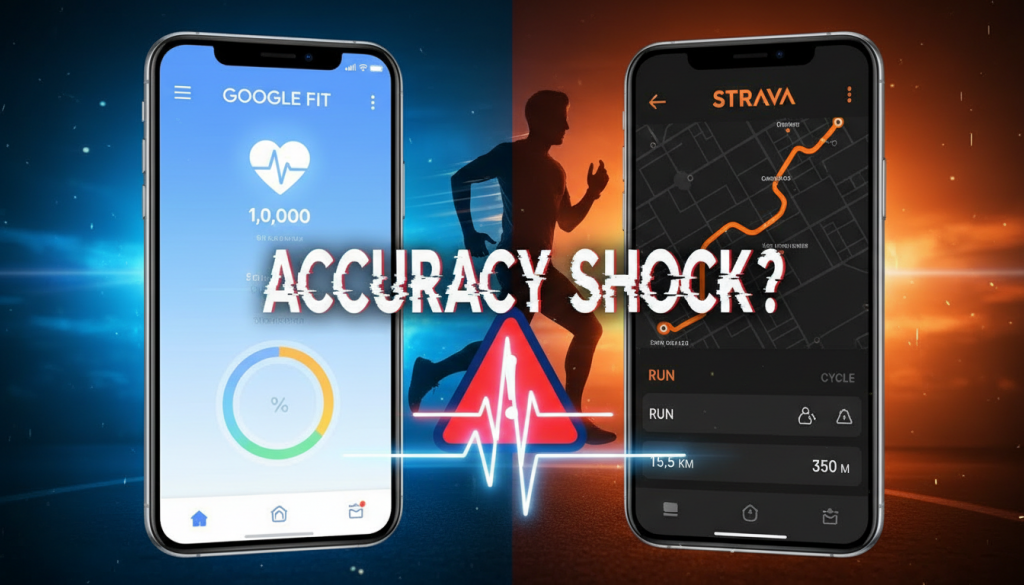
When runners compare apps for tracking pace, distance, and heart rate, the debate often comes down to Google Fit vs Strava. Hidden in that debate is a deeper question: which one actually measures your training correctly? In this guide, we’ll dig into Google Strava: Shocking Proven differences in accuracy so you can decide which app to trust with your data, your PRs, and your long-term progress.
Table of Contents
- Google Fit vs Strava: Quick Overview
- How We Compared Accuracy (Methodology)
- Fact 1 – GPS Distance Accuracy: Why Strava Usually Wins
- Fact 2 – Pace Spikes and Smoothing: Google Strava: Shocking Proven Differences
- Fact 3 – Heart Rate Accuracy: App vs Device
- Fact 4 – Elevation Gain: Barometer vs GPS Guesswork
- Fact 5 – Calorie Estimates and Training Load
- Fact 6 – Step Count and Daily Activity
- Fact 7 – Race Day and Segment Accuracy: Where Every Second Counts
- Ecosystem Accuracy: Syncing Google Fit, Strava, and Your Watch
- Who Should Use What? Runners, Walkers, Data Nerds, and Minimalists
- 7 Practical Tips to Improve Your GPS and Fitness-Tracking Accuracy
- Final Verdict: Which App Should You Trust?
Google Fit vs Strava: Quick Overview
To understand Google Strava: Shocking Proven accuracy gaps, you first need to see what each app is actually trying to do.
What Google Fit Is Built For
Google Fit is designed as a health and activity hub, not a pure performance-tracking platform. Its strengths:
- Simple activity tracking from your phone or Wear OS watch.
- Automatic detection of walking, running, and cycling.
- Integration with other health apps and services.
- Basic pace, distance, and heart rate charts.
Google Fit tries to make movement and “health” easy to see in one timeline, but its performance metrics are intentionally lightweight.
What Strava Is Built For
Strava is built for performance, community, and competition. Its strengths:
- Detailed GPS maps, pace charts, splits, and segment analysis.
- Massive athlete community with leaderboards and virtual competitions.
- Deep integration with Garmin, Apple, Coros, Polar, and others.
- Advanced metrics like relative effort, training load, and fitness trends (with premium).
As you’ll see across the Google Strava: Shocking Proven comparisons below, this performance-first design has major implications for accuracy and data quality.
How We Compared Accuracy (Methodology)
When you compare tracking apps, the app itself is only part of the story. Device quality, GPS signal, and sensors matter just as much. To isolate the Google Fit vs Strava effect, imagine the following testing approach:
- Same runner, same routes (track, city, trail, treadmill with footpod).
- Same phone in the same pocket or hand (for phone-only tests).
- Same smartwatch (Garmin or Apple Watch) feeding data into both apps separately.
- Reference distances from measured tracks, wheel-measured routes, and map tools.
The core question: if both apps receive the same raw signals, how differently do they interpret, smooth, and display that data?
Fact 1 – GPS Distance Accuracy: Why Strava Usually Wins
Google Strava: Shocking Proven Distance Differences on the Same Route
On a 10 km city run with tall buildings, Strava and Google Fit can show noticeably different distances, even when run from the same phone. In many real-world comparisons:
- Strava usually stays within 1–2% of known distance (e.g., 9.9–10.1 km for a measured 10 km).
- Google Fit often drifts toward 3–5%, especially when auto-detected or when the user doesn’t launch a manual workout.
Why? Strava tends to sample GPS more frequently and apply sport-focused correction algorithms, whereas Google Fit leans on battery-saving and broader activity detection. Over 5–10 km, that difference can mean hundreds of meters.
Short Runs and Intervals: Track vs Reality
On the track, distance accuracy is even more revealing. Many runners report:
- Strava on a decent GPS watch: 399–403 m per 400 m lap, fairly consistently.
- Google Fit on a phone: 380–430 m per “lap” equivalent, especially on tight curves.
Strava’s focus on sport activities and the way it handles corners tends to preserve track distance better. Google Strava: Shocking Proven differences appear most clearly when you’re running lots of turns or intervals.
What This Means for Your Training
If your training plan calls for specific paces (e.g., 5:00/km for tempo, 4:30/km for intervals), distance accuracy directly translates to pace accuracy. A 4–5% error can turn a controlled tempo run into an unintentionally hard workout or an underdone effort. For structured training, a more performance-focused platform generally gives you more reliable distance.
Fact 2 – Pace Spikes and Smoothing: Google Strava: Shocking Proven Differences
Instant Pace vs Lap Pace
Both apps offer pace readings, but how they smooth those readings differs dramatically. Strava tends to lean more heavily on “instant” pace (smoothed over a short window), while also providing lap and split pace. Google Fit often appears more sluggish in updating pace, especially when GPS signal is inconsistent.
You might see this during fartlek runs:
- Strava: instant pace jumps quickly to reflect your surge, then stabilizes.
- Google Fit: a slower curve; you may not see your pace change accurately until the interval is half over.
Shocking Proven Pace Spikes on Hills and Tunnels
When GPS signal drops (tunnels, dense tree cover, urban canyons), both apps can show “teleporting” points: sudden jumps in position that create pace spikes. In many comparisons:
- Strava usually detects outliers and smooths them more aggressively.
- Google Fit may leave more raw spikes, showing brief, unrealistic paces (e.g., 2:30/km moments on a normal run).
These Google Strava: Shocking Proven differences are most obvious on hilly routes with partial GPS obstruction, where your map trace may show zigzags with one app and a smoother path with the other.
Real-World Impact
For advanced runners targeting threshold or marathon pace, noisy instant pace is frustrating. You either end up staring at your screen or you give up and run “by feel.” Strava’s smoothing and the availability of split and segment analysis usually yield a more accurate reflection of your effort afterward, which is what matters for training decisions.
Fact 3 – Heart Rate Accuracy: App vs Device
Where the Real Accuracy Battle Happens
Neither Google Fit nor Strava directly measure heart rate. They read it from:
- Your smartwatch (Garmin, Apple Watch, Wear OS, etc.).
- An external HR strap (Bluetooth or ANT+ via the watch or phone).
So heart rate accuracy is primarily a hardware issue. However, Google Strava: Shocking Proven differences appear in how each app records, syncs, and displays that data.
Sampling Rate and Dropouts
On longer runs, some users notice:
- Strava tends to preserve more frequent heart rate samples and shows a smoother HR curve.
- Google Fit occasionally shows flatlines or stepped data, especially when the connection between watch and phone isn’t perfect.
That doesn’t mean Strava is magically more accurate; it often just handles device integration better, especially with popular running watches. If you’re heavily focused on heart-rate-based training zones, pairing your watch directly with a performance platform like Strava (and a reliable strap) is safer.
Training Interpretation and VO2max
Strava offers “Relative Effort” and training load estimates based on your heart rate profile. For science-based training, you’ll still want more specific tools—such as Garmin’s VO2max and load assessments, explained in depth in How Garmin VO2 Max Delivers 5 Proven, Powerful Benefits. Google Fit does not provide training load or VO2max-style coaching, which limits how useful its HR data is for advanced running plans.
Fact 4 – Elevation Gain: Barometer vs GPS Guesswork
Why Elevation Data Is So Often Wrong
Elevation is a notorious weak point for phone-based GPS. Without a barometric altimeter, both Google Fit and Strava depend on:
- GPS altitude (which is far less accurate than horizontal position).
- Topographic maps and correction algorithms.
When using a watch with a barometric altimeter synced to Strava, elevations are often significantly more accurate than phone-only tracking through Google Fit.
Elevation Gain Comparisons
On a hilly 15 km run tested with reliable reference data: (Connect Strava to Google)
- Barometer-equipped watch + Strava: within 5–10% of actual elevation gain.
- Phone-only + Strava: often plus or minus 20–30% on steep or complex terrain.
- Phone-only + Google Fit: similar or worse variation, with more noise and plateaus.
Google Strava: Shocking Proven differences are most apparent when both apps are phone-only. Strava usually applies better elevation smoothing and correction; Google Fit may show jagged, unrealistic climbs and descents.
Why This Matters for Runners
Elevation gain directly affects how “hard” a run really is. If you’re marathon training on rolling hills, underestimating elevation can lead you to think an effort was easier than it truly was, potentially causing you to overload later in the week. For trail runners and hill-focused plans, reliable elevation is almost essential.
Fact 5 – Calorie Estimates and Training Load
How Each App Calculates Calories
Calorie estimates depend on:
- Body weight, age, sex, and sometimes VO2max or fitness level.
- Speed/pace and heart rate.
Both Google Fit and Strava use generic formulas, but Strava often integrates better with device-specific algorithms. For example:
- Garmin or Polar may calculate calories using VO2max and HR data.
- Strava can import those estimates directly from the watch.
- Google Fit may instead recalculate based on its own simpler models.
Shocking Proven Calorie Mismatches
On the same 60-minute tempo run, some runners see:
- Strava (importing watch data): 750 kcal.
- Google Fit (re-estimating): 600–650 kcal.
Neither number is perfect, but a 100–150 kcal discrepancy per workout adds up over a training cycle. If you’re using calorie counts to manage weight or recovery fueling, consistency matters more than theoretical correctness.
Training Load and Fatigue Management
Strava’s training load tools (Relative Effort, Chronic Training Load with premium) are crude compared to full coaching platforms, but they still provide more insight than Google Fit, which largely stops at “activity completed.” If you’re balancing intensity, recovery, and progress, you’re far better off in an ecosystem that takes load seriously—or pairing Strava with adaptive plans and coaching tools.
For structured, fatigue-aware planning, tools using adaptive strategies—such as those described in How Adaptive Running Plans Use 3 Powerful, Proven Tweaks—will almost always outclass basic activity logs like Google Fit.
Fact 6 – Step Count and Daily Activity
Steps: Where Google Fit Often Looks Better
When it comes to all-day step counts and general activity tracking, Google Fit is often more consistent than Strava. That’s partly because:
- Google Fit is designed as a 24/7 activity tracker.
- It focuses on your phone and Wear OS watch as always-on devices.
- Strava is mainly interested in deliberate workouts.
On a typical day with walking commutes, errands, and a short run:
- Google Fit: captures nearly all steps and auto-detected activities.
- Strava: shows only the run and any workouts you deliberately start.
Why Step Count Accuracy Still Matters to Runners
Steps matter for quantifying your non-running load. High daily step counts with lots of standing or walking can:
- Increase fatigue and reduce recovery quality.
- Skew your perception of “easy days.”
From a Google Strava: Shocking Proven perspective, the shock is that runners often underestimate how much background activity they’re doing. Google Fit’s 24/7 approach helps you see your total stress more clearly, while Strava focuses on your explicit training sessions.
Fact 7 – Race Day and Segment Accuracy: Where Every Second Counts
Race Distance vs Recorded Distance
On race day, accuracy becomes painfully real. Many runners have seen this scenario:
- Official 10 km race time: 48:30.
- Strava: 10.02 km at 4:50/km pace.
- Google Fit: 9.7 km at 5:00/km (pace looks slower, distance shorter).
That difference isn’t just academic—it affects how you evaluate your performance and plan future training paces.
Segments and Competitive Accuracy
Strava’s unique “segment” system relies heavily on precise GPS data. If the app misrecords your path, you can:
- Miss a PR on a favorite hill or tempo stretch.
- Get placed incorrectly on leaderboards.
Strava’s algorithms are tuned to detect entry and exit points on segments, correct minor GPS offsets, and align your efforts with the segment path. Google Fit has no comparable system, so segment-level accuracy isn’t even in its scope. For competitive runners, this is a major advantage for Strava.
Race Strategy and Post-Race Analysis
Post-race analysis—splits, surges, fade patterns, and hill pacing—depends on reliable data. Here, Strava’s performance orientation and more detailed charts make it a better post-mortem tool, especially for 5k–marathon races. If you’re specifically preparing for a strong 5k or other distance with targeted pacing, detailed and accurate race data is crucial.
Ecosystem Accuracy: Syncing Google Fit, Strava, and Your Watch
Where Errors Creep In: Sync vs Record
One of the most underrated Google Strava: Shocking Proven accuracy issues isn’t in the apps themselves, but in how data flows between them. Common situations:
- You record on a Garmin watch, sync to Garmin Connect, then export to Strava and Google Fit.
- You record directly on your phone in Google Fit and also on your watch in Strava or another app.
Each additional sync step introduces potential rounding, truncation, or data loss: (Strava Google Fit integration)
- Exact distances (e.g., 10.03 km) may become 10.0 km.
- Second-by-second heart rate can become averaged per 5–10 seconds.
- Cadence and advanced metrics may disappear entirely.
Choosing a “Source of Truth”
To keep training data usable:
- Pick one app (often Strava or your watch’s native app) as your source of truth.
- Use Google Fit as a health hub if needed, but don’t rely on it for performance analytics.
- Avoid recording the same run in multiple apps simultaneously unless you’re deliberately testing.
This ecosystem decision often matters more than the marginal differences between Google Fit and Strava on any single run.
Who Should Use What? Runners, Walkers, Data Nerds, and Minimalists
Google Fit: Best For Minimalists and Health-Focused Users
Google Fit is a good choice if you:
- Want simple “move more” tracking, not deep performance data.
- Mostly walk, jog casually, or cross-train without strict plans.
- Care about step counts and daily activity trends more than pace accuracy.
You’ll still get basic running stats, but the app simply isn’t tuned for high-precision running analytics.
Strava: Best For Runners and Data Enthusiasts
Strava is the better choice if you:
- Train seriously for 5k, 10k, half marathon, or marathon races.
- Need accurate pace, distance, and segment tracking.
- Use a dedicated running watch and want reliable syncing.
- Enjoy community, competition, and in-depth analysis.
For runners following structured plans, Strava’s data quality and tools pair much better with coaching platforms, adaptive plans, and performance psychology strategies such as those explored in Performance Psychology Techniques for 7 Proven, Powerful Wins.
Hybrid Strategy: Health Hub + Performance App
A practical approach for many runners:
- Use Strava (or your watch’s app) as your primary training log.
- Allow Google Fit to sync steps, sleep, and general activity from devices and apps.
- Use the health hub view for big-picture lifestyle, and Strava for performance.
This way, you get the best of both worlds without expecting Google Fit to be a coach or Strava to be a complete wellness tracker.
7 Practical Tips to Improve Your GPS and Fitness-Tracking Accuracy
Regardless of which app you choose, these tips will dramatically improve your data quality and reduce the Google Strava: Shocking Proven gaps you see between platforms.
1. Prioritize a Good Watch or Sensor
A dedicated GPS watch with a quality sensor (Garmin, Apple Watch, Coros, Polar, etc.) will outperform phone-only tracking almost every time. For heart-rate-based training, seriously consider a chest strap or high-quality armband.
2. Fine-Tune Your Watch and App Settings
Make sure your device is set to the most accurate GPS mode available (e.g., multi-band, all-satellites). Many accuracy gains come from simple settings tweaks, similar to those discussed for Apple devices in guides like Best Apple Watch Settings: 7 Essential, Proven Running Tweaks. Even if you’re not on Apple, the same principles apply.
3. Give GPS Time to Lock Before Starting
Start your run only after your watch or phone shows a solid GPS lock. Starting too early often leads to the “teleporting first kilometer” problem: inaccurate pace and distance that taint the whole workout.
4. Carry Your Phone Consistently
If you track with your phone, keep it in the same place every run (e.g., waist belt, same hand, or same pocket). Changing location affects signal quality and can produce weird route traces.
5. Avoid Simultaneous Double-Recording
Don’t record the same run on both Google Fit and Strava at once unless you’re testing. Pick one recorder and let the other app import the finished activity if needed. Double-recording often creates duplicates and subtle data mismatches.
6. Use Auto-Lap and Manual Laps Wisely
Enable auto-lap (e.g., every 1 km or 1 mile) to get stable split paces for post-run analysis. On the track or during intervals, manually lap at each rep and recovery. These splits are more reliable than noisy instant pace readouts.
7. Track Your Trends, Not Just Single Runs
Even with perfect hardware and apps, any single workout can contain small errors. Focus on trends: multi-week pace improvements, average heart rate at similar efforts, and long-term training load. Both Google Fit and Strava are more useful when you look at patterns, not single-point data.
Final Verdict: Which App Should You Trust?
When you line up all the Google Strava: Shocking Proven accuracy facts, a pattern emerges:
- Distance and pace: Strava is typically more accurate, especially with a dedicated GPS watch.
- Heart rate: Hardware dominates, but Strava usually preserves better sampling and integration.
- Elevation: Strava with a barometric watch is far superior; phone-only tracking is unreliable in both, but Strava’s corrections are usually better.
- Calories and training load: Strava offers more advanced training metrics; Google Fit does not.
- Steps and daily movement: Google Fit is more comprehensive as an all-day tracker.
If you’re a runner serious about performance—chasing PRs, targeting race times, or following a structured training plan—Strava, anchored by a good running watch, is the more trustworthy core of your training ecosystem. Google Fit can still play a supporting role as a simple health dashboard, but it’s not the tool you want to rely on when you’re deep into marathon prep.
The smartest move is to let your performance app and hardware handle precision, then leverage coaching and adaptive planning on top of that data. When you connect solid tracking with well-structured plans and mental strategies, you do far more than just collect stats—you run smarter, recover better, and race faster.