
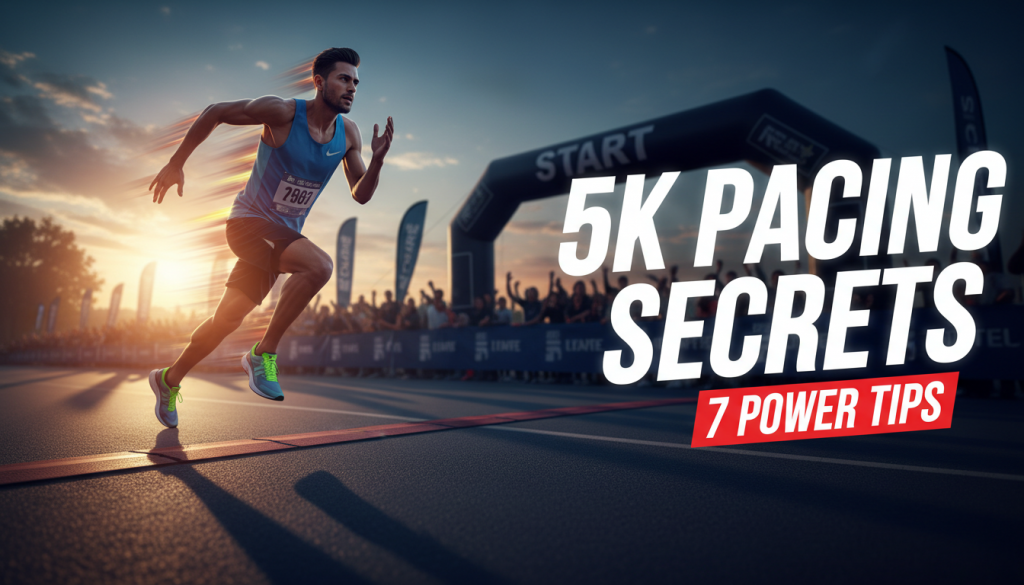
5K Race Pacing Strategy: 7 Proven Tips for Powerful Starts
If you want your next 5K to feel powerful instead of painful, you need a Race Pacing Strategy: Proven approaches that balance aggression with control. A 5K is short enough to hurt the whole way, but long enough that a reckless first kilometer can destroy your finish. The art is in starting strong, but not so strong that you fade. This guide breaks down exactly how to pace, what to watch on your watch, and how modern gear and tech can help.
Table of Contents
- Why 5K Pacing Is Different from Other Distances
- Overview: Race Pacing Strategy: Proven Framework
- Tip 1 – Set a Smart Goal Pace from Training Data
- Tip 2 – Nail the First 400–800m with Controlled Aggression
- Tip 3 – Use Tech and Gear to Lock In Pace Early
- Tip 4 – Kilometer-by-Kilometer Race Pacing Strategy: Proven Splits
- Tip 5 – Master Effort Levels and Breathing as Live Feedback
- Tip 6 – Adjust for Course, Weather, and Crowds
- Tip 7 – Practice Your Powerful Start in Training
- Common 5K Pacing Mistakes and How to Fix Them
- Shoes, Watches, and Tech That Support Better Pacing
- Example Pacing Plans for Different 5K Goals
- Race-Morning Checklist for a Powerful 5K Start
Why 5K Pacing Is Different from Other Distances
A 5K sits in a brutal sweet spot: too long to sprint, too short to “just jog it out.” For beginners, it’s often the first race where pacing errors are obvious. Start too fast, and by 2 km your legs feel like concrete. Start too slow, and you finish with too much left.
Unlike half marathons and marathons, 5K pacing leans heavily on your VO₂ max and your tolerance for discomfort. The goal is to run just below your red line for most of the race—then cross it in the final kilometer. A Race Pacing Strategy: Proven to work will help you surf that line instead of crashing over it at the first hill.
Overview: Race Pacing Strategy: Proven Framework
Before breaking down the seven tips, it helps to see the whole pacing framework. An effective Race Pacing Strategy: Proven across thousands of runners usually includes:
- Clear target pace tied to recent training, not wishful thinking.
- Disciplined first 400–800m that feels “too easy.”
- Steady middle kilometers locked around target pace.
- Small, intentional surges past halfway instead of random panicked bursts.
- A final kilometer push that turns controlled discomfort into a hard drive.
- Real-time feedback from effort, breathing, and watch data.
- Practice via race-pace workouts and dress rehearsals.
The rest of this article walks through each part in practical detail so you can build your own version around your fitness, gear, and race goals.
Tip 1 – Set a Smart Goal Pace from Training Data
Race Pacing Strategy: Proven Starts with Reality-Based Goals
Your race-day pace should be earned in training, not guessed on the start line. To build a realistic target, use recent hard efforts:
- Recent 5K or parkrun: If you’ve raced in the last 4–6 weeks, use that time as a baseline and aim for a small improvement.
- Time trial: Run a solo 3 km all-out test a few weeks before race day. Add roughly 8–10% to your 3 km pace to estimate 5K pace.
- Training intervals: If you can manage 4–6 x 800m at a certain pace with short rests, that pace is very close to your 5K goal speed.
Once you have a rough pace, translate it into per-kilometer or per-mile splits. For example, a 25-minute 5K means 5:00/km or about 8:03/mile. Write it down. Memorize it. Everything in your 5K Race Pacing Strategy should be anchored to this number.
Use Performance Zones and Effort Levels
If you’re newer, it helps to connect pace to effort. Learning effort levels makes it easier to adjust when GPS is off or when the course gets hilly. A great resource for this is Why Beginners Should Learn 5 Essential, Proven Effort Levels, which breaks down intensity zones in simple language you can feel, not just calculate.
On race day, your 5K should mostly sit in a “hard but sustainable” zone—where you can speak in 2–3 word bursts but not sentences.
Tip 2 – Nail the First 400–800m with Controlled Aggression
Race Pacing Strategy: Proven Starts Are Slightly Under Goal Pace
The first 400–800m is where most 5Ks are ruined. Adrenaline, crowds, and fresh legs can make goal pace feel like jogging. Your job is to ignore that feeling.
A powerful start is not the same as a fast start. It’s about controlled aggression:
- First 200m: Smooth acceleration. Get off the line cleanly without sprinting. Think “fast but relaxed.”
- Next 200–800m: Intentionally settle into a pace that’s slightly slower than goal pace, about 3–5 seconds per kilometer slower.
For a 25-minute 5K (5:00/km), your first kilometer might be 5:03–5:05. This tiny sacrifice early often buys you 15–20 seconds in the last kilometer.
Use Form Cues to Stay Smooth
To avoid overstriding and hammering early, focus on simple form checks:
- Short, quick steps instead of long lunges.
- Relaxed shoulders and hands—no fists.
- Breathing through nose and mouth, steady rhythm.
If you feel like you’re “holding back” a little in the first 800m, you’re doing it right. That’s what a disciplined Race Pacing Strategy: Proven across fast runners actually feels like.
Tip 3 – Use Tech and Gear to Lock In Pace Early
Race Pacing Strategy: Proven Tech Habits
Your watch, shoes, and even earbuds can all support better pacing—if you set them up carefully. Here’s how to use modern running tech without becoming a slave to the numbers:
- Watch data screens: For a 5K, set a simple screen with current pace, lap pace, and distance. Avoid clutter.
- Auto-lap: Most runners do best with 1 km or 0.5 mile auto-laps, so you get regular split feedback.
- Pace alerts: Set a “too fast” alert slightly under your goal pace to prevent a reckless start.
If you’re considering upgrading your watch before race season, check out New Running Tech That Might Finally Replace Your Old Watch for insights into devices that handle pacing, heart rate, and structured workouts especially well.
Super Shoes and Pacing Sensations
Modern plated shoes and super foams can distort your sense of speed. You may feel effortless at paces that used to feel hard. This is both a gift and a risk.
To manage it:
- Do at least 2–3 race-pace sessions in your race shoes.
- Notice what your “too fast” form feels like in them—often choppier and more vertical.
- On race day, trust both the watch and your practiced feel.
Tip 4 – Kilometer-by-Kilometer Race Pacing Strategy: Proven Splits
Breaking Down the 5K by Segments
Here’s a widely used Race Pacing Strategy: Proven across many ability levels. Adjust times to your goal pace, but keep the structure: (Negative split strategy)
Start to 1 km: Conservative Power
- Target: 3–5 seconds per km slower than goal pace.
- Focus: Relaxation, position in the pack, smooth breathing.
- Checklist: “Can I hold this for 20+ minutes?” If the answer is “no way,” slow down.
1–2 km: Lock In Goal Pace
- Target: Right at goal pace.
- Focus: Even, rhythmic effort, maintaining gaps to nearby runners.
- Checklist: Short body scan—no tension in jaw, hands, or shoulders.
2–3 km: The Mental Toughness Zone
- Target: Goal pace, maybe 1–2 seconds quicker/km if you feel strong.
- Focus: Breaking the race into micro-goals (to the next corner, hill, or landmark).
- Checklist: Expect discomfort here. Remind yourself this is the hardest part and it will pass.
3–4 km: Controlled Aggression Returns
- Target: Tiny negative split—2–4 seconds faster per km than goal pace if possible.
- Focus: Picking off one runner at a time ahead of you.
- Checklist: Ask, “Can I push just 5% more?” not “Can I sprint?”
4–5 km: Empty the Tank
- Target: Strongest pace of the race, especially last 500m.
- Focus: Short, quick strides; strong arm drive; fixed point near the finish.
- Checklist: With 400m left, it should feel like a long sprint. You should not be able to talk at all.
This structure allows the first kilometer to build a runway, the next two to hold the line, and the final stretch to cash out everything you saved.
Tip 5 – Master Effort Levels and Breathing as Live Feedback
Race Pacing Strategy: Proven Beyond the Watch
GPS can glitch. Courses can tunnel through trees or underpasses. That’s why a bulletproof 5K plan uses internal cues as a backup pacing system.
Effort and Breathing Guide by Segment
- Start–1 km: Breathing slightly faster than easy pace; you can say short sentences if needed.
- 1–3 km: Hard effort; 2–3 word phrases only. Breathing is strong but rhythmic, not gasping.
- 3–4 km: Very hard; you can maybe speak a single word.
- 4–5 km: Maximal sustainable; speech is basically impossible.
Use posture as feedback: if you’re collapsing at the hips or your arms are crossing your body wildly, you’re probably pushing beyond what you can hold. Slight adjustments—taller posture, relaxed hands, faster but smaller steps—can restore efficiency and help maintain goal pace.
Tip 6 – Adjust for Course, Weather, and Crowds
Race Pacing Strategy: Proven Adjustments for Real-World Conditions
No 5K is perfectly flat, perfectly cool, and perfectly uncrowded. A smart pacing plan flexes just enough to handle reality without collapsing.
Hills
- Uphills: Run by effort, not pace. Let the pace slow slightly while maintaining your “hard but sustainable” feel.
- Downhills: Use gravity. Open your stride a bit, but avoid pounding. This is where you can gain back lost seconds.
Heat and Humidity
When it’s hot or very humid, even short races feel harder. Consider:
- Starting 3–5 seconds per km slower than your cool-weather goal.
- Drinking a few sips pre-race; dumping water over your head at aid stations if available.
- Focusing more on effort and breathing than exact pace.
Crowds and Congestion
In big races, it can be hard to hit your ideal pace in the first 400–800m. Don’t panic. Weaving wastes more time and energy than a slightly slow first split. Stick with the flow while looking for clean lines, then use the middle kilometers to edge down toward your target pace.
Tip 7 – Practice Your Powerful Start in Training
Race Pacing Strategy: Proven Workouts for Strong Starts
You can’t expect to execute a perfect pacing strategy if you never rehearse it. Build these sessions into your 5K training block:
Workout 1: Progressive 5K Simulation
- Warm-up: 10–15 minutes easy + 3 x 20-second strides.
- Main set:
- 1 km at 3–5 sec/km slower than goal pace.
- 2 km at goal pace.
- 1 km at 2–4 sec/km faster than goal pace.
- Final 500m hard push if you’re feeling good.
- Cool down: 5–10 minutes easy jog.
Workout 2: Controlled-Start Intervals
- Warm-up as above.
- 4–6 x 800m where:
- First 200m slightly slower than 5K pace.
- Middle 400m at 5K pace.
- Final 200m slightly faster than 5K pace.
- Recovery: 200–400m easy jog between reps.
If you’re looking for a structured plan that fits around a busy life, the 5K Training Plan for Busy People: 3 Proven, Powerful Runs shows how to weave key workouts—including pacing practice—into just a few weekly sessions.
Common 5K Pacing Mistakes and How to Fix Them
1. Sprinting the First 400m
Problem: You get sucked into the crowd and run far faster than goal pace right off the line.
Fix: Start a few rows farther back than you think you need. Commit to checking your watch at 200m. If you’re more than 10 seconds ahead of target pace, actively slow your turnover and lengthen your breath for 10–20 seconds.
2. Ignoring the Middle Kilometers
Problem: After the excitement of the start, you lose focus from 1–3 km and your pace drifts slower than you realize.
Fix: Use mental checkpoints every 500–800m. At each, do a micro body scan and check your watch. Ask, “Am I at goal pace, feeling hard but manageable?” If not, gently adjust—not with a sudden surge, but with slightly faster cadence.
3. Saving Too Much for the Finish
Problem: You finish with an enormous sprint and feel like you could have run a lot faster overall.
Fix: Use progressive workouts to practice pushing earlier—around 3 km instead of waiting until you see the finish line. On race day, when you hit the 3 km marker feeling okay, deliberately increase your effort slightly. (Race pacing strategies)
4. Chasing Other Runners Blindly
Problem: You let someone else’s pace dictate yours, especially early.
Fix: Before the race, decide on effort and pace “guardrails.” If someone passes you but you’re already above your planned intensity (breathing too hard, form collapsing), let them go. Once you’re into the final kilometer, it’s safer to chase aggressively.
Shoes, Watches, and Tech That Support Better Pacing
Shoes for 5K Power and Control
For most runners, 5K race shoes should be:
- Light enough to feel snappy.
- Cushioned enough to keep your legs fresh through the whole hard effort.
- Responsive so you get instant feedback when you change pace.
Today’s “super shoes” with carbon plates and advanced foams can give you a boost, but they change ground feel. Make sure you do multiple race-pace runs in them first so you can still sense small pace changes. For insights into how modern designs affect speed and feel, see Supercharged Trail and Road Shoes Are Redefining Your Run.
Watches, Apps, and Data
Your tech setup should support, not distract from, your execution. Minimalism usually works best for a 5K:
- Primary screen: Current pace, lap pace, distance.
- Secondary screen: Heart rate (if you’re used to training with HR), time of day.
- Alerts: “Too fast” alert in the first kilometer; auto-laps every 1 km.
If your app or watch offers structured workouts, program your race segments (e.g., first km slightly slower, next 2 at goal, then slight negative split) so you get simple buzz cues to adjust in real time.
Example Pacing Plans for Different 5K Goals
Below are sample pacing profiles for three common goals. Adjust the numbers, keep the pattern.
Goal: First 5K, Just to Finish Strong (No Time Target)
- Start–1 km: Easy-moderate. You should easily chat.
- 1–3 km: Comfortable but focused; short sentences possible.
- 3–4 km: Slightly harder; 3–4 word phrases.
- 4–5 km: Hard effort; no talking. If you still feel very comfortable at 4 km, push more.
Think of this race as a learning lab for future 5Ks.
Goal: Sub-30-Minute 5K (Target 5:59/km pace)
- 0–1 km: 6:05–6:10/km.
- 1–3 km: 5:55–6:00/km.
- 3–4 km: 5:50–5:55/km if you feel strong; otherwise hold 5:55–6:00/km.
- 4–5 km: Push whatever you have left; try to edge toward 5:45–5:50/km at the end.
Goal: Sub-20-Minute 5K (Target ~4:00/km pace)
- 0–1 km: 4:02–4:05/km.
- 1–3 km: 3:58–4:02/km.
- 3–4 km: 3:55–3:58/km if sustainable.
- 4–5 km: Commit fully; pace should be your fastest kilometer or close to it.
At faster levels, margins are small. Tiny errors early compound quickly, which is why sticking to your Race Pacing Strategy: Proven in training matters so much.
Race-Morning Checklist for a Powerful 5K Start
On race morning, keep things simple, repeatable, and calm. Here’s a concise checklist to follow:
Pre-Race (60–90 Minutes Before)
- Eat a light, familiar snack if needed (banana, toast, small bar).
- Hydrate, but don’t chug—sip steadily.
- Review your goal pace and segment plan briefly.
- Set your watch screens and pace alerts.
Warm-Up (25–35 Minutes Before Start)
- 10–15 minutes easy jog.
- 3–4 short strides (15–20 seconds) near race effort with full recovery.
- A few light drills (skips, leg swings) to wake up your stride.
On the Start Line (5–10 Minutes Before)
- Line up roughly according to your expected finish time.
- Take 3 deep, slow breaths to settle nerves.
- Remind yourself: “First 800m smooth, not fast.”
The First Kilometer
- Look at your watch at 200–300m; correct if you’re way ahead.
- Check your body: relaxed shoulders, steady breathing.
- Commit to your conservative split, even when others fly past.
Bringing It All Together
A powerful 5K start isn’t about bravado; it’s about discipline. The best Race Pacing Strategy: Proven across recreational and competitive runners looks almost boring in the first kilometer and devastatingly effective in the last.
To recap, your path to a smarter 5K is to:
- Base your target pace on real training data.
- Practice controlled starts in specific workouts.
- Use tech and effort levels together, not in isolation.
- Adapt pace to hills, heat, and crowds, while preserving the overall structure.
- Finish hard—but because you paced well, not because you under-raced.
If you want to go deeper into building all-round running performance—form, strength, consistency, and pacing—take a look at the Complete Guide to Performance: 7 Powerful Secrets for Runners. It ties together many of the principles that make 5K pacing more successful and more enjoyable over the long term.
Your next 5K doesn’t have to be a suffer-fest from the first kilometer. With a clear plan and a practiced, powerful start, you can cross the line knowing you ran the time your fitness truly deserves.