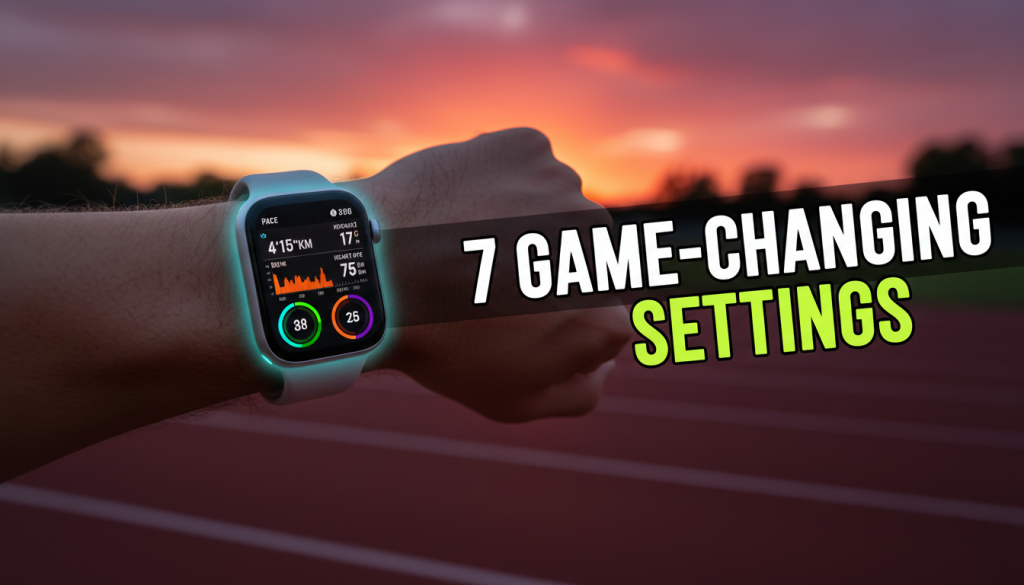
If you’re a runner with an Apple Watch, you’ve probably wondered whether you’re really getting everything you can out of it. The default Apple Watch Running Settings: are decent, but with a few targeted tweaks you can turn your watch from “nice gadget” into a truly powerful training tool—whether you’re jogging your first 5k or training for a marathon PR.
This guide walks through seven essential, proven settings changes and how to use them in real training. You’ll learn not just what to change, but why it matters and how it translates to better pacing, smarter workouts, and more accurate data.
Table of Contents
- Why Apple Watch Running Settings Matter More Than You Think
- Quick Overview of the Key Apple Watch Running Settings
- Tweak 1: Customize Your Workout Views for Race‑Day Clarity
- Tweak 2: Turn On Precision Start, Auto‑Pause (Sometimes), and Auto‑Lap
- Tweak 3: Optimize GPS, Heart Rate, and Battery for Your Run Type
- Tweak 4: Master Pace, Power, and Heart‑Rate Alerts
- Tweak 5: Use Custom Workouts and Structured Intervals
- Tweak 6: Lock In Training Zones With Heart‑Rate and Power Zones
- Tweak 7: Data After the Run – Splits, Trends, and Long‑Term Progress
- Bonus: Create Different Apple Watch Running Settings Profiles
- Common Mistakes and Quick Fixes
- When Settings Aren’t Enough: Should You Upgrade Your Watch?
- Final Tips: Build a System You Don’t Need to Think About
Why Apple Watch Running Settings Matter More Than You Think
Most runners unbox an Apple Watch, start the default Outdoor Run workout, and never touch the settings again. That’s like buying super shoes and then jogging in them only on the treadmill.
The right Apple Watch Running Settings: can help you:
- Pace more consistently in races and workouts
- Keep easy runs truly easy (and hard runs actually hard)
- Capture more accurate distance, pace, and heart‑rate data
- Extend battery life on long runs and race day
- Automate your intervals so you stop guessing or checking your phone
Settings are the bridge between your training plan and your real‑world behavior. Done well, they remove friction and decision fatigue. Done poorly—or left at factory default—they add confusion, stress, and bad data.
Quick Overview of the Key Apple Watch Running Settings
Before diving into the seven tweaks, it helps to know where the most important Apple Watch Running Settings: live. You’ll mainly adjust things in two places:
- On your iPhone in the Watch app:
- Open Watch > scroll to Workout
- Open Watch > Privacy for fitness data permissions
- On your Apple Watch:
- Open the Workout app > three dots (…) next to Outdoor Run
- Tap the settings icon or the pencil / edit button on some versions
We’ll walk through exactly what to tap for each tweak, but keep this in mind: Apple has gradually added more in‑depth training features, so if you haven’t adjusted things since you first bought your watch, there’s a lot of hidden performance waiting for you.
Tweak 1: Customize Your Workout Views for Race‑Day Clarity
Why Custom Workout Views Matter
The most important Apple Watch Running Settings: are the ones that control what you see while you’re running. If your main screen is cluttered or shows metrics you barely use, you’ll either ignore it or get distracted during key moments.
Think of workout views as your in‑run dashboard. You want:
- Fast feedback on pace or effort
- Easy‑to‑read fields at a quick glance
- Different layouts for easy runs, intervals, and races
How to Customize Workout Views
On your iPhone:
- Open the Watch app.
- Tap Workout > Workout View.
- Select Outdoor Run.
- Choose Custom and tap Edit.
Now you can add, remove, and reorder metrics. The key is to keep it simple and purpose‑driven.
Suggested Layout for Easy Runs
For easy runs, your mission is control and restraint—not speed. Recommended three‑field screen:
- Top: Current Heart Rate
- Middle: Average Pace for the Run
- Bottom: Distance
Use heart rate to keep yourself truly easy and average pace to keep overall effort sane. This is where pairing these Apple Watch Running Settings: with a focus on recovery pays off—especially if you’re following the kind of principles in What an Easy Run Really Is: 5 Essential Proven Benefits.
Suggested Layout for Interval Workouts
- Top: Lap Pace (or Current Pace)
- Middle: Lap Time
- Bottom: Heart Rate or Running Power
This setup tells you exactly how fast you’re running each rep without forcing you to think about total distance or total time mid‑session.
Suggested Layout for Races
For races like a 5K or half marathon, simplicity beats everything:
- Top: Lap Pace
- Middle: Average Pace
- Bottom: Distance
You want to see whether you’re on target for your goal pace while ensuring each mile or kilometer stays controlled. Combine this with a good pacing strategy—like those in 5K Race Pacing Strategy: 7 Proven Tips for Powerful Starts—and your watch becomes a true race‑day ally instead of a distraction.
Tweak 2: Turn On Precision Start, Auto‑Pause (Sometimes), and Auto‑Lap
Precision Start: Stop Recording Junk Time
If you start your run, then stand around waiting for GPS or the group to move, your average pace for the day gets skewed. Precision start features are one of those Apple Watch Running Settings: that quietly improves your data quality.
On many recent watchOS versions, you can:
- Open the Workout app on your watch.
- Tap the three dots (…) on Outdoor Run.
- Tap the settings icon > enable Precision Start or similar options like Start Reminder.
This lets you wait to start recording until you’re actually moving at running pace.
Auto‑Pause: Great for City Running, Bad for Some Workouts
Auto‑Pause detects when you stop (at a light or crosswalk) and pauses your workout timer, resuming when you start again. To enable or disable:
- On your iPhone, open Watch > Workout.
- Toggle Auto‑Pause for Running.
Use Auto‑Pause when:
- Running in high‑traffic urban areas
- You care about “pure” running time vs. stop‑and‑go delays
Turn it off when:
- Doing tempo runs, threshold sessions, or specific time‑based workouts
- Racing – you want total gun time and a realistic sense of effort
Auto‑Lap: The Most Underrated Apple Watch Running Setting
Auto‑Lap automatically records splits—commonly every 1.0 km or 1.0 mile. This keeps you honest and gives you post‑run insight without manually hitting lap.
- Open Watch on your iPhone > Workout.
- Find Auto‑Lap settings (may appear as a per‑workout option).
- Set to 1.0 km or 1.0 mi depending on your preference.
Now, every split you get during a tempo run or race will be neatly structured, making it clear if you’re fading or holding pace.
Tweak 3: Optimize GPS, Heart Rate, and Battery for Your Run Type
Why Accuracy and Battery Are a Trade‑Off
Apple offers different GPS and heart‑rate sampling modes to balance accuracy and battery life. Long trail runs and marathons put different demands on your watch than a 30‑minute easy jog. Smart Apple Watch Running Settings: let you match GPS mode to the run.
Max Accuracy for Key Workouts
For intervals, track sessions, and goal‑pace long runs:
- Open Watch on your iPhone > Workout.
- Check for Precision Start, GPS, or High Accuracy options.
- Keep Always On heart‑rate monitoring enabled.
Also:
- Wear the watch snugly on your wrist, above the wrist bone.
- Disable Low Power Mode during these sessions for the best data.
Battery‑Friendly Mode for Long Runs
For long easy runs or ultras, you need the battery to survive.
- On your watch, open Settings > Battery > Low Power Mode during workouts.
- In Watch > Workout, look for options like:
- Reduced GPS sampling
- Reduced heart‑rate sampling
Use this only for runs where second‑by‑second accuracy isn’t critical, like long easy runs focused on time on feet instead of pace precision.
Consider an External Heart‑Rate Strap
If you often do high‑intensity training or run in the cold, an external chest strap improves accuracy:
- Pair the strap via Settings > Bluetooth > available devices on your watch.
- The Workout app will automatically use it once connected.
This becomes especially helpful if you train by heart‑rate zones, or if you’re looking to refine zones for marathon or Half Marathon prep.
Tweak 4: Master Pace, Power, and Heart‑Rate Alerts
Why Real‑Time Alerts Change Your Training
The biggest benefit of modern GPS watches is real‑time feedback. When your Apple Watch buzzes because you drifted out of your target pace or heart‑rate zone, you can adjust immediately instead of discovering the mistake in your post‑run analysis. (Official Apple running)
These Apple Watch Running Settings: act like having a quiet coach on your wrist—guiding, not shouting.
Setting Heart‑Rate Zone Alerts
First, make sure your heart‑rate zones are set correctly:
- On your iPhone, open the Health app.
- Tap your profile > Health Details to ensure age and other info are correct.
- Check heart‑rate zones in the Watch app > Workout > Heart Rate Zones.
Then enable alerts (naming can vary slightly by watchOS version):
- In the Watch app > Workout, look for Alerts or Pace & Heart‑Rate settings.
- Enable Heart‑Rate Zone reminders.
Use this for:
- Easy runs – alert if you go above Zone 2 or low Zone 3
- Tempo runs – alert if you drop below your target zone
Pace Alerts for Races and Tempo Runs
Set pace alerts to keep yourself from going out too fast or too slow:
- Open Workout app on your watch.
- Select Outdoor Run > tap three dots (…)
- Look for options like Set Pace Alert or Pace in custom workouts.
For example, in a marathon pace workout, set a target of 5:00/km (or 8:03/mi). Your watch will buzz if you drift outside that range for sustained periods.
Running Power: A Newer Option
Many Apple Watch models now support wrist‑based running power. While not perfect, it can be useful on hilly routes where pace gets distorted.
You can:
- Add Running Power as a field in your custom workout view.
- Base hill intervals or steady climbs on a power target instead of pace.
Over time, you’ll learn what wattage roughly corresponds to different effort levels for you, just like heart‑rate zones.
Tweak 5: Use Custom Workouts and Structured Intervals
Why Structured Workouts Are a Big Upgrade
Instead of staring at your watch every 30 seconds or counting laps in your head, let your Apple Watch tell you when to speed up, slow down, or recover. This is one of the highest‑leverage Apple Watch Running Settings: if you do any type of intervals or tempo work.
How to Build a Custom Interval Workout
On your watch:
- Open the Workout app.
- Select Outdoor Run > three dots (…)
- Scroll down to Create Workout.
- Choose Custom or similar option.
Now you can add blocks like:
- Warm‑up – 10 minutes easy
- Work – 5 x 3 minutes hard
- Recovery – 2 minutes easy between reps
- Cool‑down – 10 minutes easy
You can base each segment on time, distance, or open (manual) laps.
Adding Pace or Heart‑Rate Targets to Segments
When creating segments, look for options to add a target:
- Pace range (e.g., 4:30–4:40/km)
- Heart‑rate zone (e.g., Zone 4 for tempo)
- Power range
During the run, your watch will buzz if you’re above or below target. That turns complex workouts into simple “run by feel, adjust when it buzzes” sessions.
Saving and Reusing Workouts
Once you’ve built a few common workouts—like 6 x 800m, 20‑minute tempo, or hill repeats—save them. Next time, you just scroll to your custom workouts and tap to start. Over weeks and months, this becomes the backbone of a consistent training routine, especially when combined with broader planning strategies like those in Why Long Term Running Needs 7 Essential Proven Habits.
Tweak 6: Lock In Training Zones With Heart‑Rate and Power Zones
Why Zones Matter More Than Single Numbers
Running performance is built by spending the right amount of time at specific effort bands—not chasing arbitrary single‑pace targets every day. Apple’s zone‑based tools make that easier, but only if your Apple Watch Running Settings: are tuned to your body.
Setting or Adjusting Heart‑Rate Zones
Apple can estimate zones automatically, but refining them helps:
- Open the Watch app on your iPhone.
- Tap Workout > Heart Rate Zones.
- Choose Manual if you know your thresholds (e.g., from a lab test or a strong race).
Typical structure:
- Zone 1–2: Easy / recovery
- Zone 3: Steady / moderate
- Zone 4: Threshold / tempo
- Zone 5: VO2max / short intervals
Your goal: most weekly mileage in Zones 1–2, key workouts touching Zones 3–5 by design, not accident.
Using Zones During the Run
In your custom workout views, add a metric like:
- Current Zone (HR Zone)
- Or Heart Rate plus color‑coded zone bands
Then, for example:
- On easy days, keep it in Zone 2
- For tempos, stay in high Zone 3 to low Zone 4
This reduces the urge to race every run and helps avoid the “always medium, never easy or hard” trap.
Running Power Zones (If Available)
If your watch and OS support it, you can also use running power zones. These are usually calculated from your recent efforts and adjust over time. They work particularly well on rolling terrain where heart rate lags and pace is distorted by hills. (Best running settings)
Add “Power” and “Power Zone” to a dedicated workout view, especially for hill workouts and race‑pace long runs.
Tweak 7: Data After the Run – Splits, Trends, and Long‑Term Progress
Why Post‑Run Review Matters
Your Apple Watch Running Settings: shape the data you see after every session. That data is only useful if you know what to look for. You don’t need to be a numbers geek; you just need a simple review ritual.
Key Metrics to Check After Each Run
In the Fitness app on your iPhone (or comparable dashboard):
- Average Pace – Was it appropriate for the day?
- Splits (Auto‑Laps) – Did you fade or get faster?
- Heart‑Rate vs. Pace – Was today harder or easier than similar runs?
- Elevation – Explains why some splits were slower.
A quick 1–2 minute review is enough. Ask yourself: “Did I execute the intended purpose of this run?” If not, which setting or behavior needs adjusting?
Weekly Trends That Actually Matter
Once a week, look at:
- Total volume (distance or time)
- Distribution of easy vs hard sessions
- Average resting heart rate or HRV trends if available
If your watch data shows a steady climb in volume plus more time in higher zones, yet you feel tired or stale, that’s a warning flag for overtraining. Dialing back intensity, adding rest, or adjusting targets can prevent burnout.
Privacy and Data Control
With all this detailed tracking, it’s worth remembering that your training and health data are personal. Review app permissions and privacy policies for any services connected to your watch or phone. Understand who can see your routes, heart‑rate data, and workout history—and how it’s used—by checking each app’s published guidelines, often linked from their Privacy Policy page or equivalent.
Bonus: Create Different Apple Watch Running Settings Profiles
Why One‑Size‑Fits‑All Doesn’t Work
No single configuration works perfectly for every kind of run. Thankfully, Apple lets you create multiple variants of the Outdoor Run workout, each with its own view and behavior. Think of these as “profiles” for different training days.
Example Profiles to Create
On your watch, in the Workout app:
- Outdoor Run – Easy
- Auto‑Pause: On for city running
- Metrics: Heart Rate, Average Pace, Distance
- Heart‑Rate zone alerts: Enabled to keep you low
- Outdoor Run – Intervals
- Auto‑Pause: Off
- Metrics: Lap Pace, Lap Time, Heart Rate
- Custom structured workouts: saved sessions
- Outdoor Run – Long
- Low Power Mode: On for battery if needed
- Auto‑Lap: 1 km or 1 mi
- Metrics: Average Pace, Distance, Duration
- Outdoor Run – Race
- Auto‑Pause: Off
- Metrics: Lap Pace, Average Pace, Distance
- Pace Alerts: Narrow range around goal pace
Once they’re set, starting the right profile becomes a quick habit: tap Outdoor Run, pick the right variant, and go.
Common Mistakes and Quick Fixes
Problem: Pace Bounces Around Wildly
Causes:
- Trees, buildings, or tunnels interfering with GPS
- Using current pace instead of lap pace
Fixes:
- Use Lap Pace instead of Current Pace for stability.
- Check that GPS accuracy is set to higher sampling on key workouts.
- Run known routes occasionally to validate watch distance accuracy.
Problem: Heart Rate Looks Too High or Too Low
Causes:
- Watch too loose or worn over clothing
- Cold weather or tattoos affecting optical sensor
Fixes:
- Wear the watch snug, just above the wrist bone.
- Warm up properly before judging early‑run heart rate.
- Consider an external HR strap if accuracy remains poor.
Problem: Battery Dies Mid‑Long‑Run
Causes:
- Always‑on display and high‑accuracy modes during multi‑hour runs
- Older battery health
Fixes:
- Use Low Power Mode for long easy runs.
- Disable unnecessary background apps and notifications during workouts.
- Start with at least 80–90% charge for very long sessions.
When Settings Aren’t Enough: Should You Upgrade Your Watch?
At some point, you might hit the limits of what settings can fix—especially with older models. Battery life, GPS accuracy, and advanced training metrics have improved a lot in recent generations of watches.
If you’re regularly doing long runs, racing seriously, or want richer tracking (like multi‑band GPS or brighter screens), it may be time to consider new hardware. For a deeper look at whether newer screens and GPS tech are worth it, check out Should You Upgrade Your Running Watch for AMOLED and Smarter GPS? and compare what you have now with current options.
Still, don’t underestimate how far the right Apple Watch Running Settings: can take you before you spend money on an upgrade. Many runners can get 80–90% of the benefit just by using their current watch better.
Final Tips: Build a System You Don’t Need to Think About
The real power of these Apple Watch Running Settings: isn’t in any single tweak; it’s in building a system that runs almost on autopilot. Your watch:
- Prompts you to keep easy days easy
- Guides you through intervals and tempos
- Tracks progress without extra work
- Stays out of the way on days you just want to run
A practical way to implement this over the next few weeks:
- Week 1: Customize workout views and enable Auto‑Lap.
- Week 2: Add heart‑rate zones and alerts for easy runs.
- Week 3: Build two or three basic custom workouts.
- Week 4: Refine GPS/battery settings for long runs and races.
Layer changes gradually so you don’t overwhelm yourself. Each improvement compounds, especially when paired with smart training structure, sensible volume progressions, and good recovery practices—similar to the long‑term, habit‑focused approach you’ll find in resources like Running Injury Prevention Strategies: 7 Proven, Powerful Tips.
In the end, your Apple Watch is just a tool. These settings make it a sharper, more reliable one—but your consistency, patience, and willingness to listen to your body are what turn that tool into actual fitness gains and race‑day breakthroughs.