Gear & tech 5 min
How accurate are running watch heart rate and GPS in 2026

Running watch GPS and heart rate sensors are significantly more accurate in 2026 than five years ago, but neither is perfect. GPS drifts in urban canyons and under tree cover; heart rate sensors struggle during fast arm movement. What matters is consistency, not lab precision—and knowing the limits of your data.
GPS accuracy: where watches struggle and excel
Modern running watches use multi-band GNSS (Global Navigation Satellite System), typically combining GPS, GLONASS and Galileo. This gives better signal lock than GPS alone. In open air, accuracy is typically within 5 metres. The real problems emerge in cities, forests and tunnels.
- Urban canyons: tall buildings reflect signals, causing 10–30 metre errors or false loops in your route
- Tree cover: dense canopy blocks signals, creating gaps and drift of 15–25 metres
- Tunnels and underpasses: complete signal loss; watch estimates your path using motion
- Cold start: first lock takes 20–60 seconds; older firmware is slower
- Moving between open and enclosed areas: watches struggle to re-acquire quickly
Distance error from GPS drift is usually 1–3% over a 10 km run—acceptable for training, not for racing. Pace spikes from brief signal loss are annoying but don't affect your overall splits much. For consistency, run the same route and compare sessions on the same watch; don't compare your watch distance to a GPS track on a map.
Heart rate sensors: optical accuracy in 2026
Wrist-worn optical heart rate sensors have improved, but they are not chest straps. Most modern watches achieve ±5 bpm accuracy at steady effort. During sprints, surges or uneven arm swing, they lag or spike by 10–20 bpm. Motion, tattoos, skin tone and sweat all affect readings.
- Steady running: ±5 bpm typical, reliable enough for zone training
- Variable pace or sprints: lag of 5–15 seconds; can overestimate or underestimate peaks
- Loose strap or arm swing: errors of 15–30 bpm are common
- Tattoos and darker skin: older sensors struggled; newer multi-LED sensors are better but still variable
- Chest strap (Bluetooth): ±2 bpm, faster response, but requires a strap
For training, wrist heart rate is good enough to track trends and confirm you're in the right effort zone. Don't obsess over a single reading. If your watch is consistently 10 bpm high or low compared to how you feel, it's probably fine—just use it as a reference point for your own runs.
Which measurement matters more for training
GPS distance and pace affect your training log and help you benchmark improvement. Heart rate helps you manage effort and avoid overtraining. For most runners, consistency trumps precision: the same watch measuring the same run twice should give similar numbers, even if the absolute value is off.
- Establish a baseline on your watch over 3–4 runs; this is your reference
- Compare future runs to that baseline, not to Strava or other runners' watches
- Use heart rate to stay in your intended effort zone, not to hit an exact number
- Review the route map after each run; if GPS looks clearly wrong, check signal in that area next time
How RunV uses your watch data
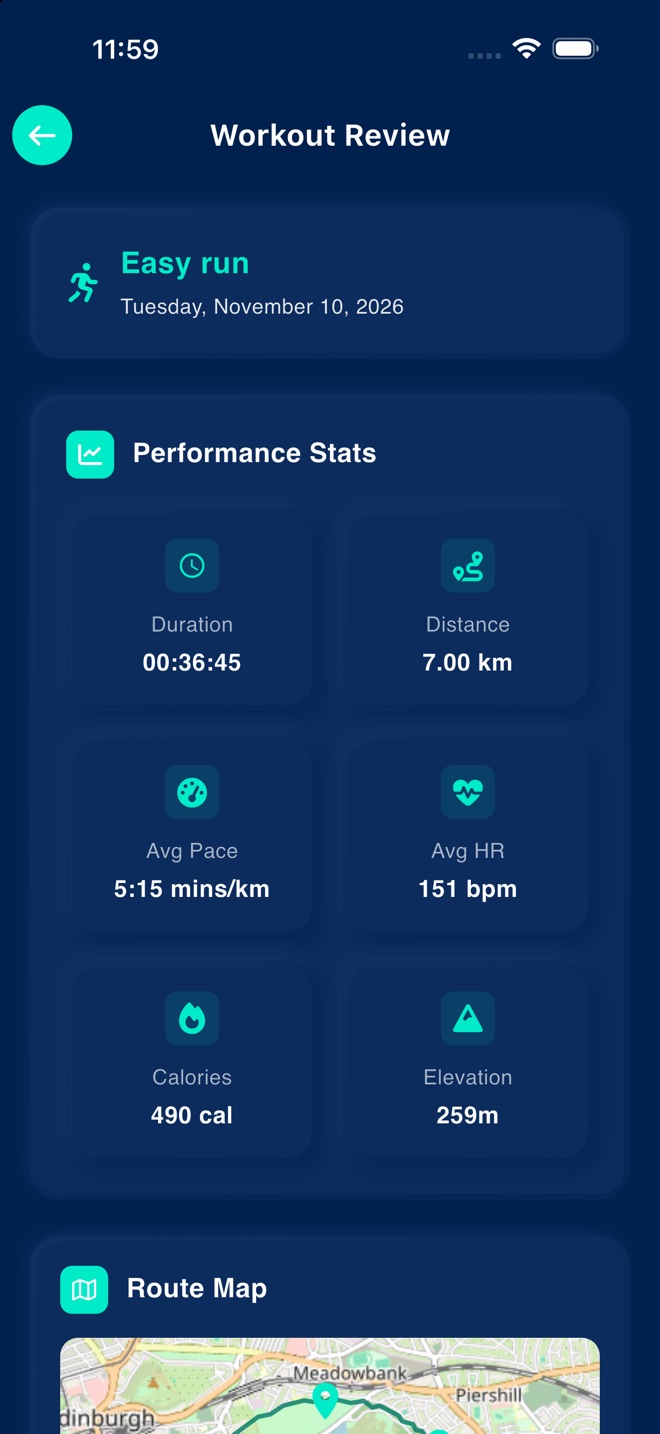
RunV works with Apple Watch, Wear OS watches and Garmin watches, recording your GPS distance, pace, heart rate and route. The free version shows route maps, splits and pace after every run. RunV Premium includes Coach Crawford training plans from Couch to 5K to the marathon, plus custom plans built around your goal and race date. Voice cues speak kilometre or mile splits during runs. Because your watch data is consistent over time, it's more useful for tracking progress than chasing perfect accuracy.
What to do about watch inaccuracy
- Wear your watch snug but not tight; loose straps reduce heart rate accuracy
- Let it acquire a GPS lock in open air before you start, especially after a long rest
- Compare your session to your previous run on the same route and watch, not to other devices
- If GPS distance seems off by >5%, check if you took a different route or if tree cover changed
- Trust your effort perception; if the numbers feel wrong, they probably are
The bottom line
Running watches in 2026 are reliable for training but not laboratory instruments. GPS accuracy of 1–3% error and heart rate readings within 5–10 bpm are typical and useful. The key is consistency: use the same watch, the same run, and compare trends over weeks and months. Your watch will tell you if you're getting faster, stronger and more efficient—and that's what training is about.
FAQ
- Should I use a chest strap instead of wrist heart rate?
- Chest straps are more accurate (±2 bpm) and faster to respond, but wrist sensors are convenient and good enough for most training. Use a chest strap only if you're doing structured heart-rate-zone work or racing and need live feedback. For general training with RunV, wrist heart rate is reliable.
- Why does my GPS distance sometimes jump or look wrong on the map?
- GPS signal loss or multi-path reflection (signals bouncing off buildings) causes the watch to estimate your location, creating loops or straight lines that don't match your actual route. This is most common in cities and forests. Comparison of the same route on the same watch is more useful than trusting the absolute distance.
- Can I compare my watch distance to other runners' watches?
- No. Each watch has its own GPS accuracy profile, and comparing distances between different models or brands will mislead you. Only compare your own runs on your own watch. If your watch is consistently 2% short, that's your watch—use it as your personal standard.
Train smarter
RunV turns this thinking into your plan — adaptive coaching that rebuilds after every run.
Keep reading